A breath of fresh air for the Bundestag
UW/H graduate Anna di Bari talks to us about her motivation for running for office, the challenges of the shortened election campaign and about party cohesion.
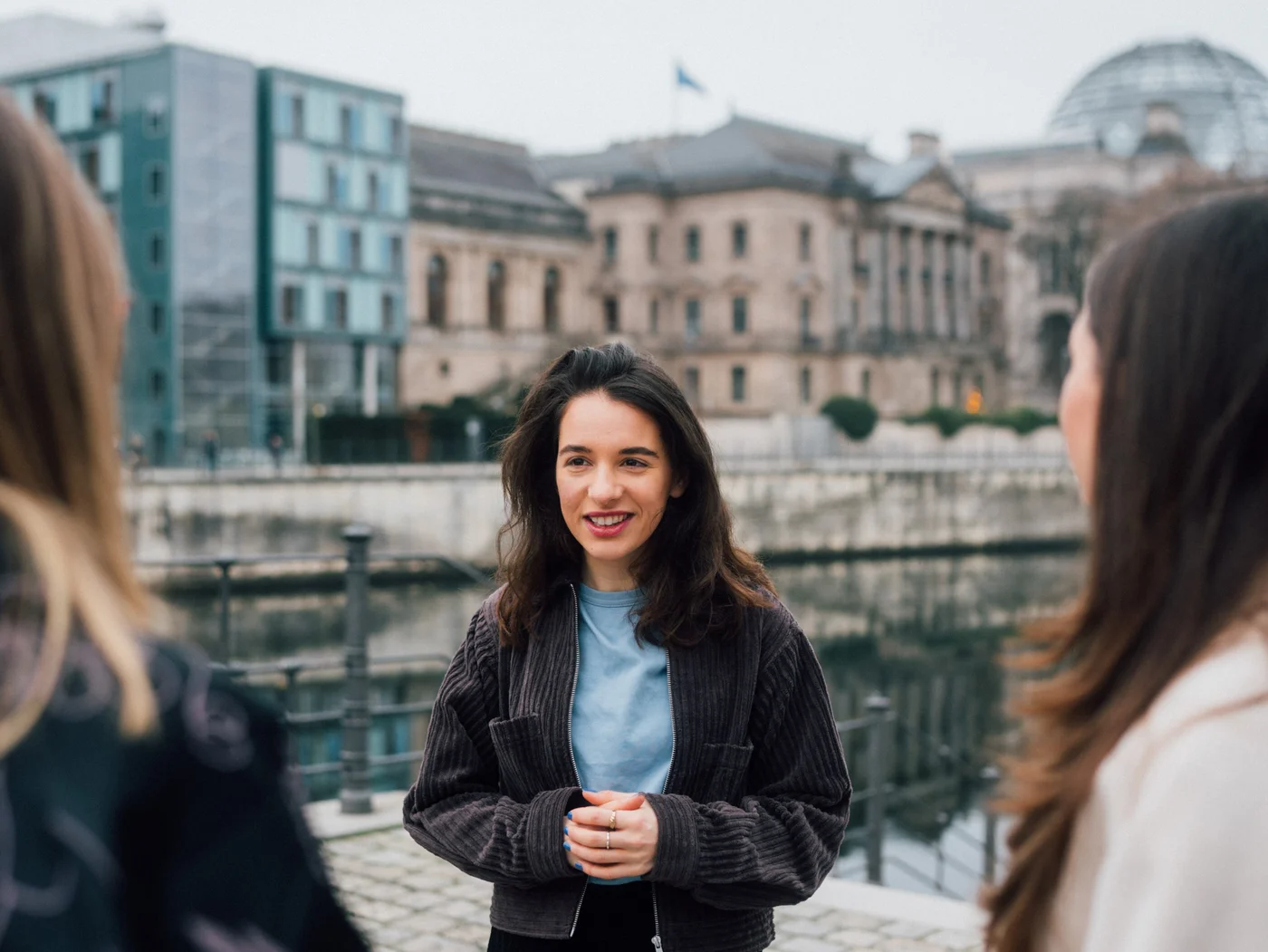
Next stop: the Bundestag! Nothing less is Anna di Bari's goal. The recent UW/H graduate of the PPÖ - Philosophy, Politics and Economics (B. A.) degree programme is standing for election for the first time for Bündnis 90/Die Grünen in her constituency of Bochum/Herne. As a candidate, she is experiencing first-hand what early elections mean and what it is like to go vote-catching in the middle of winter. She encounters citizens who are disenchanted with politics as well as motivated supporters. Her mission: to bring more solidarity and social justice to federal politics.
UW/H graduate Anna di Bari wants to know!
Hanging up election posters in winter, door-to-door talks with voters between New Year's greetings and party programmes - Green politician and UW/H graduate Anna di Bari is experiencing her first election campaign as a candidate for the German Bundestag in fast-forward. The early elections on 23 February 2025 bring with them a number of challenges for the parties, which are also keeping Anna on her toes: "The lack of preparation time is noticeable everywhere. In a normal election year, we would start organising in January and develop a timetable before the hot phase of the election campaign starts in the summer. Now my team and I have already been out on the streets for a fortnight doing door-to-door campaigning. We can only plan further measures from week to week and have to weigh them up carefully. Time is a valuable resource right now."
In conversations with citizens in her constituency, she experiences a divided mood. Many vent their frustration and disappointment with the current government, and the tone can become very harsh. "We in the Greens in particular get a lot of flack," she says. But Anna also reports constructive dialogue and people who are happy about her commitment to the citizens of Bochum and Herne.

Anna is certain that the Bundestag needs representatives who do not fit the "typical politician image". Her supporters have told her that women and students in particular would like to see greater representation. The support from new party members is particularly encouraging for the new candidate.
Following the collapse of the Ampel coalition in November, Bündnis 90/Die Grünen experienced a veritable membership boom in all parts of Germany. Anna identifies two main reasons for the growth: "I believe that people want a new political style and concrete content from a party after the Ampel coalition ended. The Greens are not working on the issues or failings of other parties, but are clearly fighting for key aspects such as climate protection and social justice."
Anna describes the re-election of Donald Trump as another mobilising trigger: "Many perceived the event as a tipping point in global politics and our society. This has obviously awakened their activism, because the new party members have not just filled out a membership application. They are now taking to the streets with us in the election campaign and want to make a difference themselves."
"As a society, we must measure ourselves by how we treat the most vulnerable people."
Anni di BariUW/H graduate
For Anna, her political engagement is also a coping strategy to deal with the often frightening news and developments in the world and the looming feeling of powerlessness. "I know that I can't solve all the problems, but I feel energised and have starting points to take action in my sphere of influence," says the 24-year-old.
However, both in her work for socially disadvantaged families and in sea rescue together with the organisation Sea-Eye e. V., she is finding that local politics and humanitarian aid are reaching their limits. Poverty and migration are among the major issues that are decided at federal level. For the young politician, this is what motivated her to run for the Bundestag. "As a society, we have to measure ourselves by how we treat the most vulnerable among us. People who are at risk of drowning symbolise this," says Anna. "If we don't manage to position ourselves in a humane and responsible way, we have a lot of work to do. Solidarity must regain its value."
Strengthening democracy with non-partisan cooperation
Verbal attacks in the Bundestag and public attacks with foam pies are examples of the tense political climate in Germany, which is increasingly characterised by polarisation and disrespect rather than constructive debate. Anna also recognises this. "At political talks and public interviews, I often get the feeling that it's not political opponents who are debating, but enemies. Yet the democratic parties should focus on what they have in common and stand united against the threat to our democracy." For the Green politician, the power games in the Bundestag are also a generational issue. At a cross-party workshop for new candidates at the beginning of the year, she experienced constructive discussions between the young MPs, which remained fair and respectful despite differences in content.
With a worried look at the AfD's poll results, she would like to see less polemics from the democratic parties and more concrete offers and perspectives of their own: "Young voters in particular, who have felt neglected by politics in the past, need better guidance on what the individual parties stand for. This is the only way we can get them excited about content again."

Anna di Bari provides transparent insights into her politics and the current election campaign on her social media channels. Reels, stories and TikToks are an important political tool for her to stay in touch with voters and discuss issues.
As with door-to-door campaigning, Anna also experiences two worlds online: "I've already made a lot of valuable contacts, especially via Instagram. New party members who are eagerly following my election campaign are also getting in touch with positive feedback."
However, some critics accuse her of living in an elitist bubble as a young woman in the Green Party and not looking beyond these boundaries.
Another problem: with a large reach and a flood of comments, moderation on her own channels is no longer possible. This is what happened to Anna when she announced her candidacy: more than 900 hate comments poured in on her. With hate speech on this scale, she has no choice but to practise resilience and ignore the comments. However, she does bring charges in cases of real hardship.
Whether Anna makes it into the Bundestag will be decided on 23 February 2025.