A Paradigm Shift in the Management of Fever – New Guidelines Lead to a Reassessment of Care
The S3 guideline on fever management in children and adolescents from the University of Witten/Herdecke has been published in the prestigious Deutsches Ärzteblatt, thereby introducing new recommendations for managing fever into general medical practice.
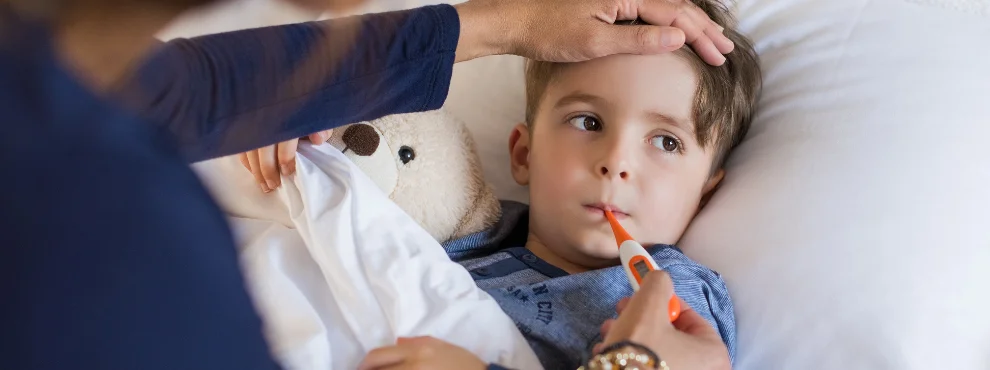
Fever is an alarm signal for many, so the first impulse is often to bring it down. However, the national S3 guideline "Fever management in children and adolescents", which was developed under the auspices of the German Society for Paediatrics and Adolescent Medicine (DGKJ) and coordinated by Prof. Dr David Martin from the University of Witten/Herdecke (UW/H), focuses on the child's well-being rather than the temperature. It is now being published in the German Medical Journal (17 April) and will thus reach the entire medical profession in Germany. Hardly any other medium has a comparable reach and authority in medical care. The recommendations of the guideline will thus reach practices, emergency departments and paediatric clinics directly - where decisions are made every day on how to deal with children with a fever.
From paper to practice
What is special: The guideline is the first time that the Association of Scientific Medical Societies (AWMF) has issued clear, scientifically proven recommendations for dealing with fever in children. For example, it advises not to reduce fever prematurely. "In most cases, fever is a sensible reaction of the body - we shouldn't fight it reflexively, but rather focus on the child," says David Martin.
Thanks to the publication in the German Medical Journal, the recommendations are now becoming a benchmark for practice: fever-reducing medication is used in a more targeted manner and unnecessary treatments are avoided. The use of antibiotics is also clearly limited - fever alone is not a reason for a prescription. This increases patient safety and counteracts antibiotic resistance. At the same time, doctors gain more confidence in dealing with fever.
Orientation for everyday life
The guideline also provides clear information for parents. Children often feel cold during the fever phase, which can be characterised by chills or cold hands and feet. During this phase, it helps to fulfil their need for warmth: cover them up, give them rest, create closeness.
Only if the child is visibly suffering from a fever and other measures have not helped can medication such as paracetamol or ibuprofen be considered. And even then only for a limited period of time. In this way, the guideline also supports parents in dealing with fever and helps to reduce visits to the doctor.
Further information:
The S3 guideline was developed in collaboration with 13 scientific associations and a patient association and was funded by the Innovation Fund of the Joint Federal Committee with 200,000 euros. David Martin also heads the Fit for Fever project, which is funded with 2.6 million euros and is investigating the implementation of the new guideline as part of a study involving 60,000 children.
Photos for download

Contact person

Svenja Malessa
Press Officer
Administration | Communication & Marketing
Alfred-Herrhausen-Straße 48
58455 Witten
Room number: 2.F05