From theory to practice
How psychology master's students at Witten/Herdecke University treat themselves in the teaching clinic
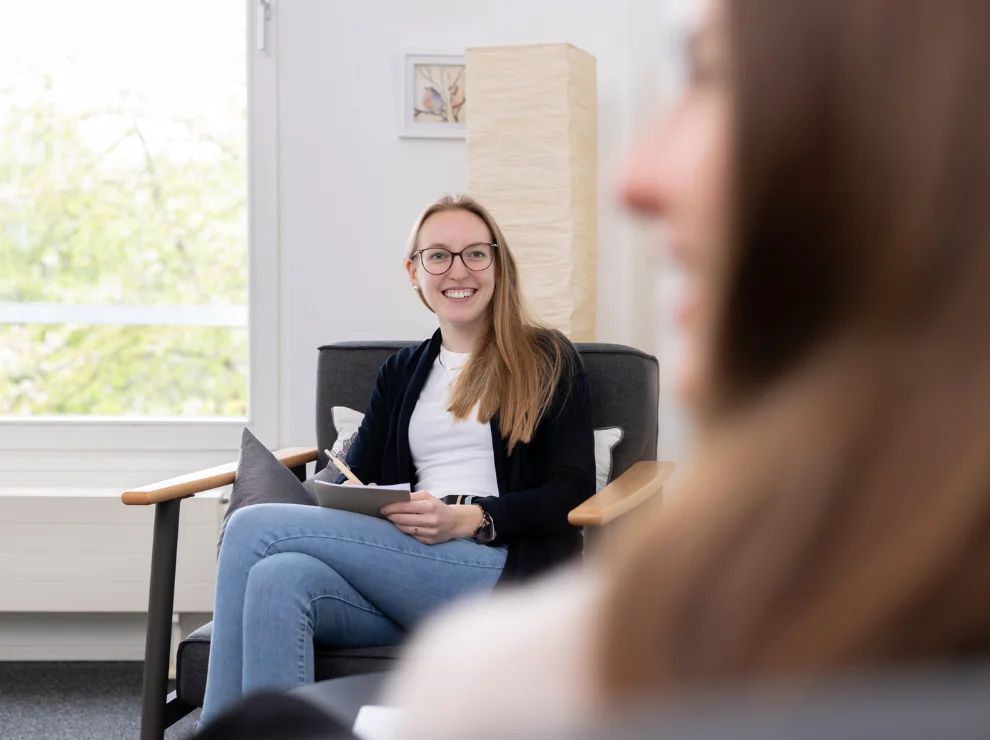
How does it feel to conduct outpatient psychotherapy for the first time? This is what students on the Master's degree programme in Psychology with a focus on Clinical Psychology and Psychotherapy experience in the UW/H's teaching outpatient clinic. Graduates Nils Kruse and Yannik Kulik talk about their experiences in this special therapy setting.
The moment when a patient takes a seat in the therapy room for the first time remains in the memory of many prospective psychotherapists for a long time. It was also a special moment for Nils Kruse: his first case of his own - while still a student. "We had already done internships and gained experience in clinics and inpatient therapy," recalls the graduate of the Master's degree programme in Psychology with a focus on Clinical Psychology and Psychotherapy at the UW/H. "But this was something else. "But that was something else. Suddenly there's a person sitting in front of you looking for help - and you're the person accompanying them."
Nils is one of the first Master's students to have conducted counselling sessions with patients at Witten/Herdecke University's primary care teaching therapy clinic and thus immersed himself in practical work. This is because, in the teaching therapy setting, the students take on outpatient therapy sessions themselves for the first time - closely supervised by experienced, state-certified psychotherapists. Nils: "During our studies, we have learned a lot about the manualised psychotherapeutic treatment of individual illnesses, so we bring a lot of knowledge and tools with us. It's a great and empowering experience when you can adapt your own expertise and academically sound treatment approaches to the individual person."
Learning psychotherapy - with good support and comprehensive supervision
One student is paired with a psychotherapist at the UW/H teaching centre. Together, they prepare and follow up the sessions intensively and talk about challenges and uncertainties. In the supplementary supervision sessions, three to four students meet with their teaching therapist every fortnight, watch video recordings of the sessions and reflect on their therapeutic work.
"I felt like I was being taken by the hand and had a good first experience," says Nils. "My training therapist gave me a lot of space during the therapy, but also had a good sense of where I needed support and where she should intervene. That makes it much easier to start your later professional life and reduces inhibitions. As a result, I started my actual work with a different attitude and composure."

Nils Kruse (Photo: private)
Yannik Kulik, also a graduate of the Master's degree programme in Psychology with a focus on Clinical Psychology and Psychotherapy at the UW/H, emphasises how much trust such a setting requires from all sides. "We always shared our thoughts and experiences openly and addressed everything that was on our minds - both with the other students and with the teaching therapists. And we were always able to contribute our own ideas; it was never about following a preconceived path."
Building real relationships and making a difference
For Yannik, it was also special to accompany "his" patient over a longer period of time and to learn a lot about building relationships. "In the previous internships, we had more superficial contact. Twelve 50-minute sessions are a different kind of time in which you can build up a relationship and experience the entire process from the first conversation to the end," he says.
At the beginning of the treatment, the students use standardised questionnaires to assess their patients' stress and well-being. After the twelve sessions, these values are assessed again. "My patient's values actually improved," recalls Yannik.

Yannik Kulik (Photo: private)
"She told me back that she benefited greatly from the therapy. It was a really nice feeling to be able to make a difference. Of course, the therapy was a challenge, you want to do it particularly well, preferably preparing sentence after sentence. When you have a sense of achievement like that, it not only strengthens your basic understanding of the therapy, but also your self-confidence for later practice."
Real responsibility and an intensive learning experience
For the students, the teaching clinic means real responsibility - and at the same time an intensive learning setting. After the detailed initial consultation, the comprehensive diagnostic phase and the individual sessions, patients have a better understanding of themselves and their illness and can look for a suitable place for follow-up therapy if this is required. They also receive a comprehensive final report. Nils emphasises: "Therapy in the teaching clinic is shorter than with a psychotherapist in private practice, but it really is a special environment. We give the patients a lot of space, think intensively about each case, exchange ideas and consider how things could work best. I think it's simply a good place where you can meet people in a positive way and get help at short notice and with a low threshold." Studies also show that therapies by newcomers to the profession can achieve comparable success to treatments by experienced therapists - partly because the cases are prepared and reflected on with particular care.
Both Nils and Yannik now have their full licence to practice after completing their Master's degrees. If they want to work independently as psychotherapists, they still have to complete a five-year further training programme. Both are currently working in a psychotherapy practice, while Yannik is doing his Master's in General Management at UW/H at the same time. Here he is acquiring additional skills in the field of Management, which complement his psychological profile well - especially if he were to open his own practice later. He can imagine practising as a child and youth therapist after his further training. The teacher training programme has encouraged Nils and Yannik to continue working in an individual therapy setting - and to build on their positive initial experiences.
