"I want to inspire people to think entrepreneurially" - Fabian Schmidt passes on his start-up expertise to the next generation
Fabian talks to us about his time at UW/H, his start-ups, his Master's degree in the USA and how he now encourages young teams in his UW/H seminar.
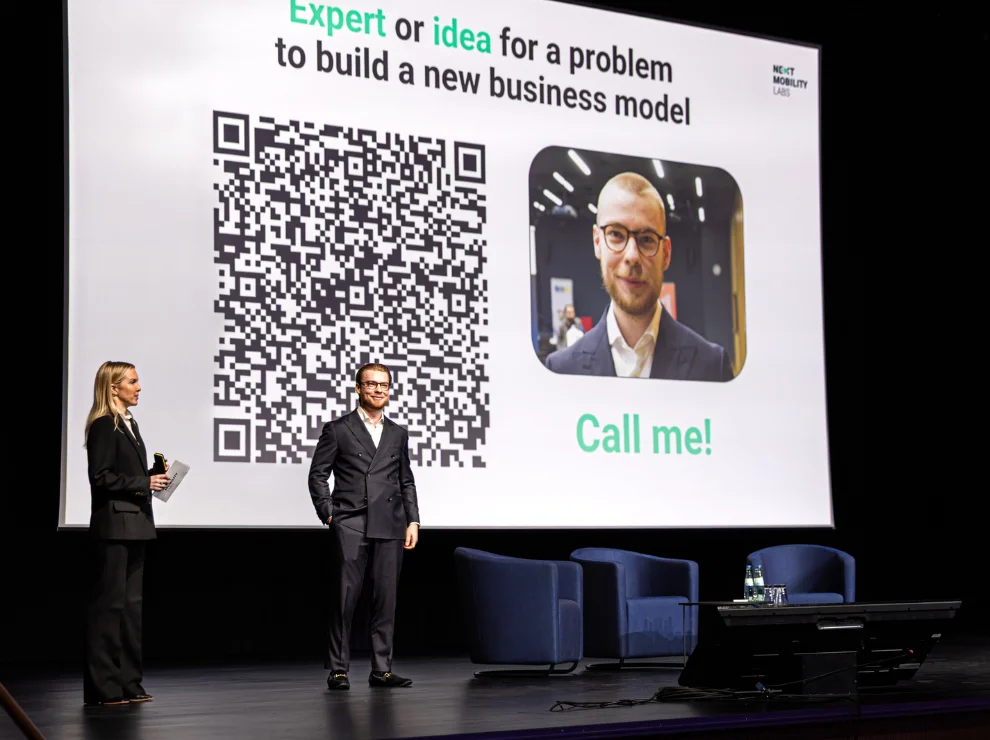
At 25 years old, UW/H graduate Fabian Schmidt is currently the youngest guest lecturer at Witten/Herdecke University (UW/H). As an entrepreneur, AI expert and initiator of several start-ups, he brings his extensive practical experience to teaching - at the place where it all began for him. In this interview, he talks about what motivates him and how he wants to support people with business ideas on their journey.
You have returned to your former university as a lecturer. Why?
I was born in Witten, did my Bachelor's degree in Management here and graduated in 2022. UW/H has always been a special place for me. When the opportunity arose to give something back, I really wanted to take it. When I was 23, I got a teaching appointment at the University of Konstanz - without a doctorate or professorship. Now I'm teaching my first course in Studium fundamentale (Stufu): "Building a Company with AI". I want to strengthen the topic of start-ups at UW/H.
What exactly can participants on your Stufu course expect?
I want to inspire students to think entrepreneurially. The seminar is all about finding problems that you are really passionate about. The teams then spend the weekend developing initial solutions, business models and a pitch deck with the support of artificial intelligence. At the end, they should have a colourful team, an initial idea and a feeling for how they can use AI to drive their start-up forward.
If exciting ideas come up, I'm also happy to make contacts - I now have a good network. And who knows: maybe in two years' time, one of the teams will launch a real company. That would be my dream.
The course was fully booked immediately. What does that tell you?
The 25 participating students come from very different disciplines - medicine, psychology, management. This is exactly the kind of interdisciplinary team that the start-up scene needs. I am delighted that there is so much interest.

How did your management degree programme in Witten shape you?
Three things stand out for me. Firstly, critical thinking: In seminars, we were always encouraged to scrutinise things critically. Especially as a founder, this approach to new topics is extremely helpful. I ask different questions than traditional industry experts.
What does that mean in concrete terms?
As a founder, you always look at a specific problem. Take the topic of sustainable mobility, for example, which has very different facets. If you only look at an idea from an engineering perspective, you quickly lose sight of the user's perspective. I believe that a certain degree of mental flexibility is required in order to recognise and take different perspectives seriously.
In the seminars at UW/H, it was often like this: a problem was posed in the room, everyone contributed their point of view - and in the end we had a variety of perspectives with different approaches to solutions. When I look at a start-up today, I don't just look at an isolated area, but at the entire system behind it.
You mentioned three aspects: What else did you take away from Witten?
The second is the exchange with others, especially through the interaction between Studium fundamentale and regular courses. There are hardly any traditional frontal lectures, instead we worked in small groups in seminars, exchanged ideas directly with the professors and worked together on projects. I always really appreciated that.
And the third point: the teaching is very practical. I've always preferred tackling things rather than just reading about them. And of course that also helps as a founder. The practical seminars with Prof Dr Thomas Clauß in particular helped me a lot. We are still in contact, by the way.

You founded your first company while you were still studying for your Bachelor's degree. How did that come about?
It was a spontaneous idea. A fellow student had already founded a company and we wanted to replace the compulsory internship with a real business. So we started a search engine optimisation consultancy - that was a booming topic at the time, 2019/20.
It ran successfully for four years, but at some point I realised that I was more interested in implementing than consulting. When I went to Babson College in the USA for my Master's in Entrepreneurship, it was clear to me that the consulting business was over for me.
And today - what are you currently working on?
I am currently Entrepreneur in Residence at Next Mobility Labs - a company that builds and finances start-ups in the field of sustainable mobility. I'm currently working on a new project there, which is due to be launched as a start-up in the summer. At the same time, I'm also working on an energy drink project that I started with a fellow student in the USA. At Babson College, it was part of the curriculum to develop your own start-up.
Now you are helping others to start up as well. What motivates you to do this?
I have learnt and experienced so much through my studies and my experiences as a founder - I would like to pass this on.
If my seminar results in just one start-up that really makes a difference - then it will have been worth it. Start-ups add value to society, they create jobs - and they fit in really well with the university's focus. If I, as a graduate, can help to encourage students and empower them as entrepreneurs, that is very fulfilling for me personally.
