"I wanted to get out for a change." - Pia Klee on independence, community and learning in Witten
Pia has been studying medicine at the UW/H since October 2025. In a very short time, she has got to know and love her fellow students and her place of study.
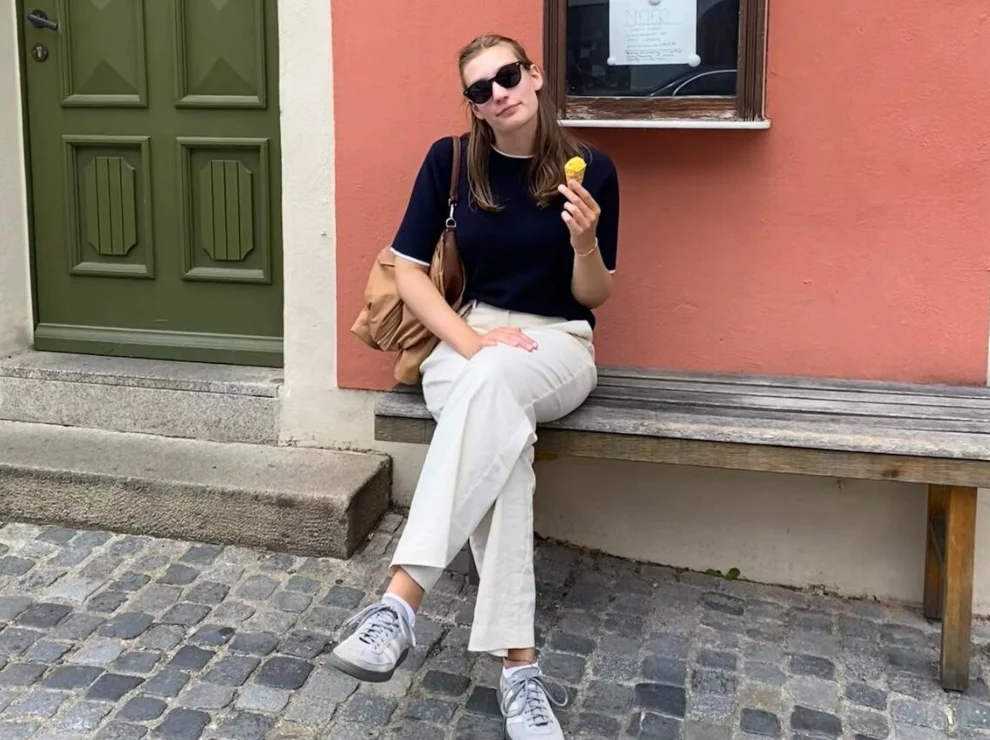
For Pia Klee, the move to Witten was one thing above all: a conscious step towards independence. The 20-year-old grew up in Wiesbaden in Hesse, surrounded by her family, the charm of an old building and lots of nature. At the same time, she also finds the big city anonymous and vast. For her medical studies, she decided to make a fresh start in the Ruhr region in order to live according to her own rhythm. In Witten, she has found exactly that - responsibility for her own flat, new challenges and a university that thinks learning differently.
With the move to Witten, Pia fulfils her wish to be independent
Pia has known for a long time that she wanted to move out after school. "I really wanted to stand on my own two feet and be more independent," she says. No more being asked when to come home for dinner or who was going to empty the dishwasher, but organising everyday life herself. After being accepted by the UW/H, she started looking for a shared flat.


But time is pressing until the start of her studies and feedback from potential flatmates is delayed. Without further ado, Pia changes her plans and looks at flats for herself at her parents' suggestion. She found what she was looking for in the Witten-Mitte district, right next to the main railway station and not far from the popular Wiesenviertel neighbourhood. "It's highly praised everywhere - and I understand why. The small bars and cafés; everything is close together." Pia quickly learnt to appreciate her place of study. She says: "My fellow students all live around the corner. I don't know that from home. There, I always travelled 40 minutes to get to school or a friend's house. Here, I'm usually only a ten-minute walk away - it's super convenient."
However, her first impression of Witten is anything but positive: "When I came to Witten with my parents for the information day for the first time, we were a bit shocked. It's just the Ruhr region. But I've since discovered how beautiful it is here." The keen swimmer and racing cyclist has Lake Kemnader at the top of her list for the summer. And even the Witten Christmas market surprised her: "Very cosy."
Despite the big step of moving away from home to another German federal state, homesickness hardly plays a role for Pia. Even as a child, she travelled a lot, on school trips and holiday camps. "I somehow don't know the feeling like that," says the student. Of course she looks forward to seeing her family when she visits home - but she also looks forward to her own world. The fact that she quickly made friends in Witten makes many things easier. "You're never really alone."
Medicine as a decision of the heart
Pia developed the desire to study medicine at an early age. Both her parents are dentists with their own practice in the house. At school, she was particularly interested in science and everything to do with people. After her higher education entrance qualification, she decided to do a voluntary social year (FSJ) at a hospital in Wiesbaden. It was there that she finally realised: "I looked forward to seeing the patients and colleagues every day," she says. Working in a team and the familiar atmosphere at the hospital in particular confirmed her decision.

She finally came across UW/H through recommendations from friends. What immediately fascinated her was the attitude behind the degree programme: the holistic view of the person, not just the symptoms or individual specialist areas. An approach that felt right for her. "I was always taught this by my parents. In their case, it was important to not only look at the individual diseased tooth, but also to consider the whole picture." She applied two weeks before the application deadline - and was accepted.
Arriving - in a community and at university
Even before the start of the semester, an initial sense of community emerged. The new first-semester students made contacts in a WhatsApp group. When Pia read that a fellow student was from Mainz - very close to her home - she wrote to her directly. "We have to meet up. I'd like to get to know you before you start university." She wasn't alone on her first day at university. But the 20-year-old also felt a direct connection with the other first-year medical students. "Everyone was still disorientated, but super open and interested."
Pia cites problem-based learning (POL) as a decisive reason for her application to Witten. In this practical teaching and learning method, students acquire interdisciplinary medical knowledge based on real patient cases. "Not plunging into a book without a system, but questioning and recognising connections - this type of learning is totally plausible for me," says Pia. She finds the learning counselling in medicine at the UW/H particularly valuable. "We are given so many tools to help us cope with the amount of material." Knowing that there are fixed contact persons is an enormous relief, especially in challenging phases.
Pia wants to get the most out of this new phase of her life. That's why she enrolled in as many courses as possible right from the start, volunteered as a semester speaker and found out about opportunities to fully enjoy her student life away from the classroom. She was particularly impressed by the variety of student initiatives. "What students get up to here is incredible!" She is now a member of the Future Doctors Network and the Herzergreifend initiative and has found a special balance in her commitment. "For me, it's like a hobby that I share with my fellow students here at the university."
Pia's curiosity and desire to try out many things is something she also encourages others who are just starting their studies or still have to do so. "The most important thing is to be open and take advantage of the freedom you're given."