Insights into the US election campaign: Political engagement between populism and perspectives
Simon Shaw and Victor Wolff are studying Management and PPÖ - Philosophy, Politics and Economics at UW/H. In autumn 2024, they swapped seminar papers for party manifestos and flew to the USA for the election campaign.
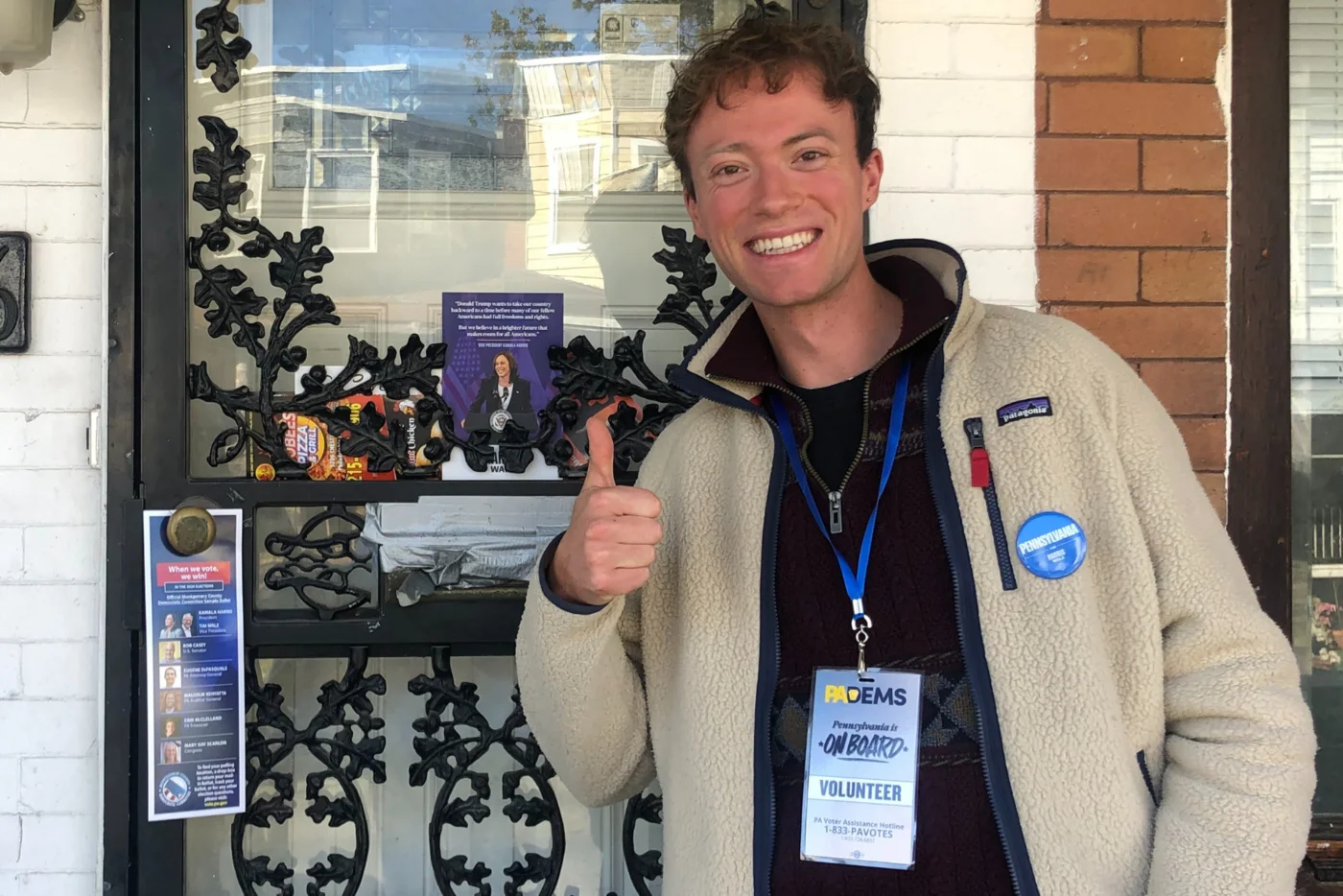
As full-time volunteers, UW/H students Simon Shaw and Victor Wolff supported the Democratic candidate Kamala Harris in the contested swing state of Pennsylvania, held personal conversations with voters and watched the decisive election night, from which Donald Trump emerged as the clear winner and 47th US President. The experiences made a lasting impression on the two students. They took fellow students with them virtually via the university's Instagram channel, shared their impressions and answered questions about the US election campaign adventure.
In this guest article, Simon and Victor reveal what they took away from their political involvement, what thoughts have moved them since then and what they would like to see in election campaigns and politics in Germany.
First things first: the adventure was worth it and we would do it again. In just under six weeks, we gained an insight into US society that you rarely get anywhere else. We quickly learnt how to talk to Americans as Germans - about their politics, about their country. It was relieving to see how well this works, even across party lines. It was interesting to see how incredibly personalised the election campaign in the United States is. Content and facts are in the background, with Kamala Harris vs Donald Trump in the spotlight. Formats such as the televised debates play a major role in this, and somehow this type of election campaign also suits this country.
The dispute over who is the right person for the future could hardly be greater in this polarised society. For this very reason, it was exciting to see that there is a core consensus on many political goals (e.g. a strong economy, international peace). Contrary to our expectations, we did not have a bad experience coming from another country to campaign. On the contrary, looking back, our origin was a door opener for many interesting conversations.
One thing is certain: Donald Trump will be the 47th President of the United States
Admittedly, our predictions that the Democrats would win the race ("clearly" according to Simon) have not aged well. We thought the count could take weeks to months. But by election day, it was clear that Donald Trump, not Kamala Harris, would become the 47th President of the United States.

A convicted felon, democratically elected by the American people, will lead the country through the next four years. Like many others, we are anxiously looking forward to his second term. Even close associates from Trump's first term are explicitly warning against his second presidency. The current cabinet, on the other hand, is filled with loyalists who are not supposed to slow him down this time. Health Minister? A vaccination sceptic. Minister of Defence? Someone who is sceptical about the idea of women in the military. Education Minister? The former head of the largest wrestling organisation. Government according to the motto: Expertise doesn't matter, the main thing is loyalty. It is therefore understandable that pessimism and exhaustion dominate for many Americans, but also for many people around the world.
But even if Trump's presidency will soon be an inevitable political reality, the development of the next four years is not set in stone. History does not write itself, but depends on a multitude of actors that go far beyond the president and his cabinet. Although Trump and his team will have a decisive influence on events, there are also activists, politicians and lawyers who have been preparing for this election result for months in order to be able to act immediately.
In our immediate area, campaign workers reorganised in less than 24 hours after Trump's victory to plan how to minimise the negative impact of another Trump presidency. After months of campaigning, they are not even taking a day off to actively shape the coming years. These people, who have not allowed themselves to be demoralised by the current political results and the rise of populism, but on the contrary are now thinking even more ambitiously and taking action, have become role models for us. In this sense, Kamala Harris has very aptly formulated what the election result in the USA actually means: "The fight is not over, it has merely changed."

The US election campaign has left a lasting impression on us
The USA seems far away, but these thoughts are just as important for us in Germany. There will be new elections in February 2025 and we too are struggling with rising populism - with the AfD probably as the second strongest force. We have learnt two lessons from the election campaign in the USA:
1. action is always worthwhile. Sounds banal, but it's important. In our studies so far, we have discussed a lot of political issues with like-minded people. But unfortunately, just discussing doesn't make much difference to the election results. What does make a difference is getting actively involved - beyond a small group discussion, a presentation or a term paper. The supposed hurdles are usually self-made. We had never been politically active before and were underqualified for the US election campaign. Nevertheless, we simply booked flights a few months ago and were rewarded not only with an exciting time, but also with a lot of feedback from people we were able to persuade to join Harris. This encourages us and should also encourage others to simply get started - a lot of things will then happen by themselves.
2) Here in Germany, we must also act in a results-orientated, not ideal-orientated way for the upcoming election. Right now, this means not demonising all parties except our own, but standing up for a strong result for all parties that stand for our fundamental democratic values. It also means leaving aside niche debates, however important they may be in an ideal world, and focussing on the core issues that concern the majority in this country. Trump's most successful campaign advert was about gender reassignment - with the punchline: "Harris if for them/them. Trump is for you." This doesn't mean that we don't think gender debates, for example, are right. But the realistic possibility of implementing progressive policies dwindles if these issues are placed too much at the centre of an election campaign. We met many voters who didn't want to vote for Harris because of the transgender debate, because they thought she was prioritising the issues wrongly. "Woke is broke" - at least when it comes to stopping populism. That's why we believe that politicians must meet their voters where they stand in terms of issues during the election campaign. This is not about wanting to change fundamental values, but about showing which parties could actually be in their interests and why. We were rewarded with exciting, honest and effective discussions, particularly at the community colleges, through which we were able to win many votes for Harris. Something similar is also possible in Germany in the current election campaign.
So there is reason for optimism for us here too, provided we act actively, realistically and with a focus on results.