Johanna "Emmi" Mentzel on belonging, studying full of opportunities and life between East and West
In this interview, Emmi talks about feeling at home and wanderlust - and why she appreciates studying at a small university like UW/H.
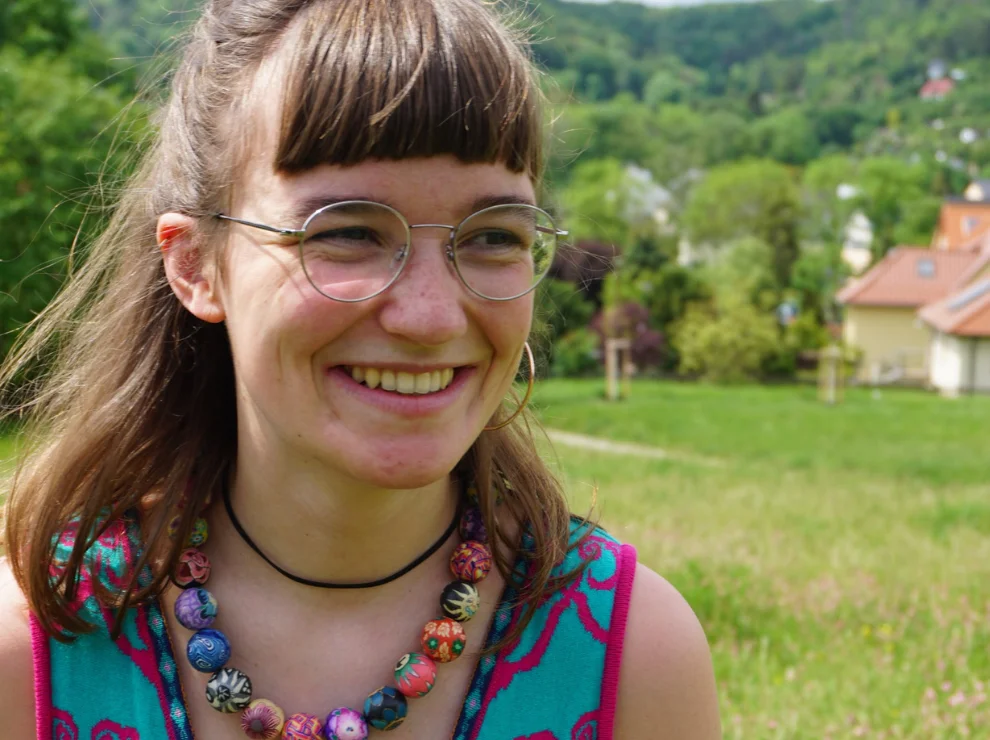
Johanna Mentzel - almost everyone just calls her Emmi - moved from Jena to Witten to study at the UW/H. Today, the 26-year-old is in her eighth semester of medicine in the clinical section and is doing her Master's in Ethics and Organisation at the same time. For her, the move to NRW was less a leap into the unknown than a conscious decision for something new: for different perspectives, for a small university with plenty of room for development - and for a city that you slowly discover.
Why did you decide to study at the UW/H and how do you feel about university life?
My aunt drew my attention to the university in Witten. I still remember the information day that took place online during Corona. I sat in front of the screen for a whole day and was totally captivated. Especially the Studium fundamentale (Stufu), but also the people who presented the university - it was just perfect. Looking back, that was definitely confirmed.

The UW/H may be small, but there are so many opportunities - be it the Stufu or the numerous student initiatives. Of course, sometimes I wish I could sit in a large lecture hall with 300 students on folding chairs. But in the long run, I'm glad that I can call most of the lecturers by their first names and that we fellow students recognise each other.
What do you particularly appreciate about studying medicine today?
Since I've been in the clinical section, I've been incredibly grateful for the great practical relevance. Almost every internship makes me realise why I'm doing all this. I think it's valuable to get a taste of everyday medical life so early on - also to become more resilient in the long term and learn to set your own boundaries.
I also really appreciate the fact that you can combine two degree programmes here. In my Master's degree in Ethics and Organisation, I can put thoughts that concern me in medicine, society or the healthcare system into a different context.

How did you find your feet in Witten and finally settle in?
My flatmate Clara and I found each other through WG-Gesucht. She had a nice flat in Witten-Mitte for a shared flat for two, and we've been living there for more than four years now - with a supermarket just around the corner and very close to the Wiesenviertel neighbourhood.
As Clara started studying with me, we initially supported each other and gave each other support. We both had quite a long journey home, so we really had no choice but to get involved in our new place of study. Before the semester started, we spent a week simply walking around Witten without any appointments and exploring the city.
How did you organise the move from afar back then?
Very minimalist. I only moved in with a chest of drawers and a mattress because I'd never been to Witten before and didn't know what to expect. We got some furniture, crockery and other small items from bulky waste and eBay classifieds also helped. And my bike, my clothes and a few favourite plants came with me bit by bit over many train journeys from home. You can certainly put a lot more thought into it, but in the end, relatively little is enough to live on.
What was it like for you to move so far away from home? Were there any particular challenges when moving to another German federal state?
After my final degree, I had a real wanderlust. I wanted to get as far away as possible. The hardest thing for me was finally realising how difficult it is to maintain contact from home over a distance. That really bothered me, especially in the first few years. Proximity changes when you can no longer spontaneously drive past.
Especially as my grandparents got older and I felt the need to visit them more often, the distance sometimes became a burden. But travelling by train then simply became a hobby - with the semester ticket, I could travel home for free and study at the same time.
How did you experience Witten as a city - especially in comparison to your home town?
Fortunately, Witten and Jena are almost the same size. So I was already familiar with the fact that you meet at least one familiar face on every route. Some days I find that really nice, on others I'd rather have a big hood on.
The basics are easy to find in Witten, you only discover the insider tips over time. My favourite place is the swings opposite the Saalbau. And if I had to describe Witten with a feeling or a picture: a falafel roll in the sunset with "Witten City" by Creuzfeld & Jakob (a hip-hop band from Witten) playing in my ears.
Were there any regional differences that surprised you?
Yes, definitely. I like the direct manner here and that people are on first-name terms quickly. At the same time, I realise that things that I took for granted in Thuringia sometimes work differently here. In my environment in Jena, for example, there was a much closer network among neighbours: We were constantly ringing the doorbell somewhere to borrow cooking utensils or looking after each other's flowers or pets. I have the feeling that this happens less naturally here - but it may be different in other neighbourhoods.
And sometimes I just miss the Thuringian Forest and the fresh air in the metropolitan region with its many cities.
You talk about the differences between East and West Germany. What has changed for you?
Before the move, I didn't realise that these differences were still so strong - or that they still play a role at all in our generation. I've only really felt like an "Ossi" since I moved to Witten because I always have to defend "the East". So here's a little clarification: the cities there are really beautiful and not just grey. Of course there are a lot of AfD voters - but they can also be found in some cities in the Ruhr area. And many cities in the east have a stable left-wing scene. And yes: we actually always have bananas and coffee in the supermarket.
What have you personally learnt about yourself since you've been in Witten?
That I have a sense of home. We recently realised in our group of friends that perhaps you first have to leave to realise that. But there are always moments when I think: now I've arrived in Witten. These are often very small things - when I come back to our flat after travelling or when I'm with loved ones.
In conclusion: What advice would you give to students moving to NRW from another German federal state?
Come round and have a look. Witten is a nice place - sometimes quite grey, but you can make yourself comfortable. And if you come from East Germany: Take the opportunity to discover the differences. But don't let yourself be pigeonholed into clichés.
