Kobanê, Istanbul, Witten: Sami Barkal's path to medical school
Sami Barkal fled from Syria to Germany in 2015. For a long time, his dream of becoming a doctor seemed unattainable. He talks to us about his formative experiences, his studies at Witten/Herdecke University and why courage pays off.
When Sami Barkal came to Germany in 2015 at the age of 15, he had a long time of hardship behind him: war, flight, years without schooling and hard child labour in textile factories. A few years later, he completes his higher education entrance qualification in Germany and fulfils his dream: to study medicine!
Sami was born in one of the Kurdish regions in northern Syria and grew up in Aleppo for a long time. When war broke out in 2011, his previous life was shattered. The family initially moved back to the north, but later fled to Turkey to escape the Islamic State's attack on Kobanê. "As a 14-year-old, I already had to work to support my family. I got a job in a textile factory in Istanbul, together with people who were much older than me," says Sami. It wasn't entirely legal, but it was the only way to survive. "I had to grow up relatively early and think about my uncertain future. It was a stressful experience."
A new start in Germany with major hurdles and new opportunities
After two years in Turkey - characterised by poor working conditions, constant insecurity and dwindling hope for peace in Syria - the decision is made to flee to Europe. After travelling through several countries, the family finally arrived in Germany. This marked the beginning of a new chapter for Sami, which was initially overwhelming. "I didn't speak a word of German and had no knowledge of the culture," he recalls. The fact that he was nevertheless able to attend a secondary school shortly after his arrival is thanks to a dedicated retired teacher who supported refugee families locally.
"This support was the foundation on which I was able to build." The step back into a regular school routine is not easy. Shortly before, Sami had been working ten to twelve hours a day in a factory - now he sits in a class with younger classmates and can barely communicate. "The early days were new, scary and uncertain." At the same time, he experienced stability for the first time in a long time - and discovered his love of learning.

Two years later, he graduates from secondary school at the top of his year and transfers to grammar school. His success continued there too. At the same time, he began to get involved, looking after refugee children, accompanying parents to meetings and campaigning for their interests. "Commitment is part of my life. When I was in need, I benefited enormously from the support of committed people. Now it's my turn to help."

Sami's dream of studying medicine comes true at Witten/Herdecke University
For a long time, Sami could not imagine pursuing an academic career. "My parents are both illiterate. My father had never seen the inside of a school during his childhood," he explains. Nevertheless, the desire to become a doctor matured in him early on.
"I couldn't and didn't want to imagine anything else. I was fascinated by the human body and the possibilities of curing diseases." Now his dream seems to be within reach and Sami wants to seize his opportunity: During his A-levels, he is intensively researching study options. He was particularly interested in the UW/H's model teaching concept in medicine. When he received the invitation to admission interviews, it was a key moment for him. "It was unforgettable and emotionally overwhelming because I had been working towards this opportunity since I arrived in Germany in 2015." Shortly afterwards, he was accepted.
For Sami, the initial period in Witten is as challenging as it is rewarding: "After all, studying brings with it a special sense of personal responsibility: you have to find the right sources and materials for learning. At the same time, I quickly established close contact with my fellow students so that we could support each other." He particularly appreciates problem-based learning (POL). "In the small groups, we were able to discuss patient cases in detail or sometimes argue about issues. But that's exactly what makes good teaching for me." For the 26-year-old, one thing is clear: this learning culture has not only allowed him to grow professionally, but also personally.
A research year in Oxford: insights into tumour immunology
Today, Sami Barkal is in his tenth semester, "free of licence fees and admitted to the second state examination". He is currently writing his doctoral thesis at the University of Oxford - an experience that still amazes him.

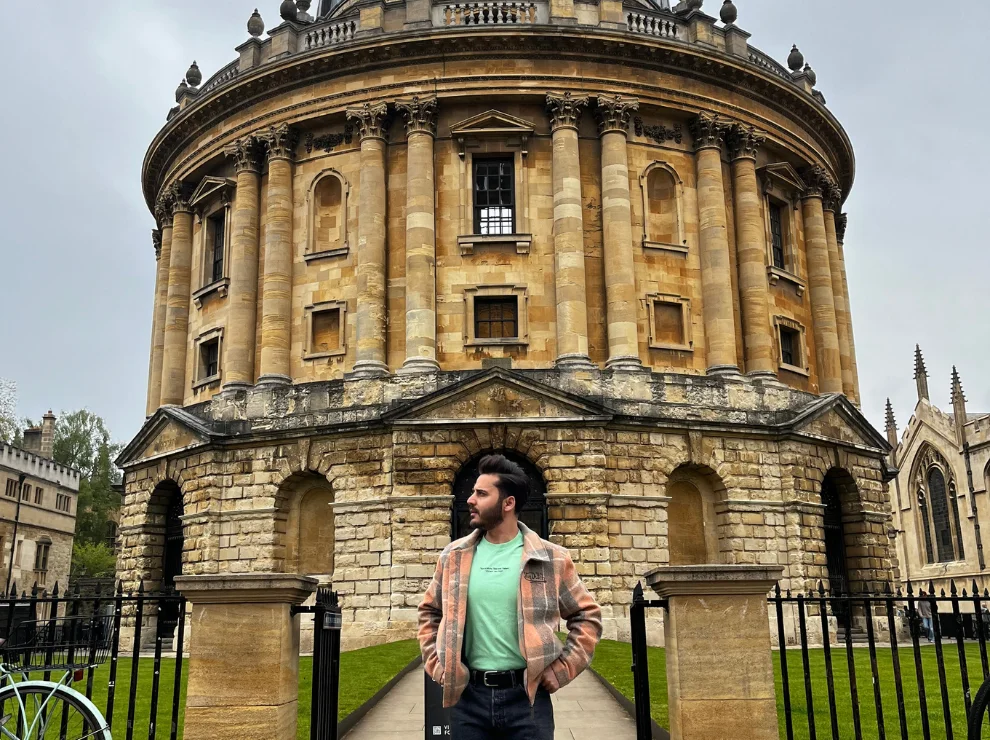
"In 2014, I was still sleeping in tents with 4,000 people in refugee camps in the Spanish city of Melilla. Ten years later, I was suddenly standing in front of the Sir William Dunn School of Pathology - where penicillin was developed as a drug - to do a two-month internship. I couldn't believe it. A year later, I came back to Oxford to do my experimental PhD research." Here, Sami works in the field of tumour immunology and investigates how immune cells, known as T cells, destroy tumour cells under certain conditions.
After his second state examination and practical year, Sami would like to work as a clinician scientist to combine research and patient care. "I think the connection between medical work in the clinic and laboratory work is extremely important. It enables a doctor to conduct research on projects of clinical relevance."

Scholarships as an opportunity: support and commitment for others
Scholarships play an important role in Sami's career. He himself is a scholarship recipient of the Studienstiftung des deutschen Volkes and the Deutschlandstiftung Integration. "Scholarships can completely change a life - that was the case for me."
Through the Studienstiftung, he was not only able to finance part of his studies, but also make contacts that have inspired him in many ways. It is important to him to pass on his experiences and the support he has received to others. He is involved as a regional spokesperson and ambassador for the Studienstiftung, organises regulars' tables and is a contact person for fellow students.
He particularly wants to encourage young people with a history of migration: "Origin, skin colour or religion shouldn't determine what you can achieve." It is important to inform yourself, look for opportunities and seize chances. "Some organisations have targeted, non-material support programmes for talented young people with a migrant background, such as Geh deinen Weg from the Deutschlandstiftung Integration."
Sami himself summarises what drives him: "The experiences of war and flight have taught me to deal with certain challenges and to believe that there is light at the end of the tunnel." Patience and confidence - he wants to retain this resilience.
