"Thanks to my studies in economics, politics and law, I now understand what actually happens in the Bundestag."
Two UW/H graduates talk about formative teaching moments, innovative examination formats and the strength of being a generalist.
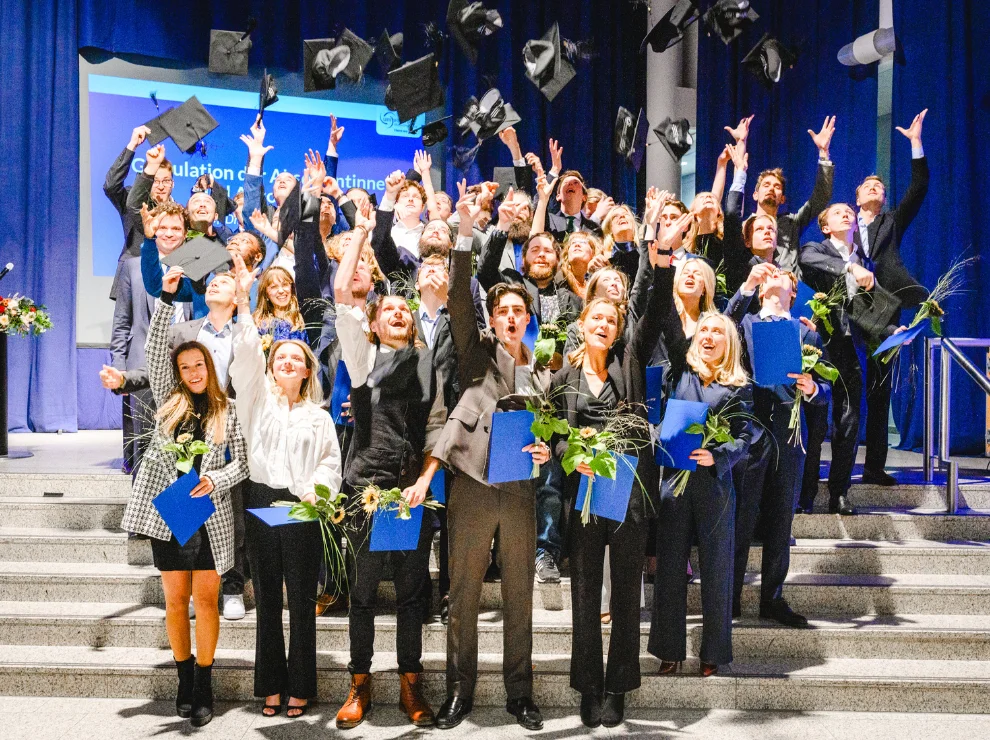
Lena Jakobi and Moritz Krauss are among the first graduates of the interdisciplinary Wirtschaft, Politik und Recht (B. A.) degree programme. After completing their Bachelor's degree in Management in 2022, both decided to take up the newly introduced programme as a second degree - and with the WPR degree, they finally made the leap into renowned Master's programmes and the accompanying one-year CEMS Master's in International Management at the Copenhagen Business School (CBS).
You have just graduated from an interdisciplinary degree programme. When did you first realise how strongly economics, politics and law intertwine in everyday life?
Moritz: Very clearly in the legislative process. It used to be an abstract process for me. Thanks to my studies, I understand much better what the Bundestag does operationally and can categorise it: What stage of the process are we at? What does a law mean for companies? And what legal consequences does a political decision have before it actually becomes binding?
Lena: I mainly experience it at work - during my internships or as a working student in consulting. When we discuss strategic decisions, I realise how much economic issues always touch on political and legal dimensions.
You had both already studied Management and then decided to take up the then new degree programme in Business, Politics and Law. What was your motivation?
Lena: After my higher education entrance qualification, I actually wanted to study law, but I was also interested in economic and political topics. If WPR had been available when I started my studies, I would probably have enrolled on this degree programme straight away because it combines all my interests. Looking back, however, I am glad that I combined both subjects. When I started, I didn't know exactly where my path would take me. I still don't know 100%, but that's not a bad thing. What I do know is that UW/H was the best decision for me as a university - because I never just wanted to follow a straight line, but always wanted to see a bit more, do a bit more and shape my own path.
Moritz: I wanted to get the most out of my time in Witten. Thanks to the Management Bachelor's degree, I had already overcome the initial challenges that come with starting a degree course and had already internalised many basics, such as learning methods and academic work. This allowed me to concentrate fully on the content of my second degree programme. That was a great advantage!
What characteristics do you have in common with your fellow students who also studied WPR?
Lena: The joy of discussing and getting involved. The openness to listen to different positions and to be challenged. It's important to stand behind your own opinion, but at the same time you should also be willing to compromise and be able to agree on solutions that take different perspectives into account.

Were there any people or courses that particularly impressed you?
Moritz: For me, it was two people - first and foremost Prof Dr Christoph Schreiber, whose teaching first got me interested in WPR. Alicia Kloppenburg's "Constitutional and Organisational Law" course had a particularly lasting impact on me. Since then, I've been watching the news with a different eye and a deeper understanding.
Lena: Prof Dr Nils-Christian Bormann and Dr Matthias Mader were definitely able to pick me up with their way of communicating political topics. They motivated me to develop my own viewpoints on issues and to look at political situations from different perspectives and temporal contexts.

You were both involved in the "jurOhr" podcast project. Here, WPR students produce their own episodes on legal topics as part of their exams. What was that like for you?
Moritz: I produced an episode on the Whistleblower Protection Act - that was new, but incredibly exciting. You not only learn content, but also project management, coordination and scheduling. And the knowledge definitely sticks in your mind because you deal so intensively with the topic of the episode, rewriting and re-recording texts again and again to convey legal contexts in an easily understandable way. This made the examination more like a project of the heart.
What skills did the interdisciplinary degree programme give you and how do you benefit from them today?
Moritz: Above all, the ability to argue in a differentiated way: What is legally possible? What is politically realistic? And what makes economic sense? This separation helps enormously - also when solving current problems. Although I am concentrating on Finance and Strategic Management in my Master's programme at Copenhagen Business School, WPR helps me a lot in my everyday life as a German student in Denmark to gain a better understanding of the state and the system here.
Lena: I'm currently studying for a Master's in Strategy, Organisation and Leadership at CBS and I'm also applying my knowledge from my Bachelor's here in a university context. In case studies, I have realised that it is not a matter of course for students with a different subject background to have a broad view of companies. I can often provide valuable food for thought when it comes to considering the political and legal context.
What advice would you give future students?
Moritz: WPR makes you a generalist. What some might see as a weakness is actually the great strength of the degree programme: every new area you explore can show you more clearly where your personal strengths lie. At the same time, there are so many opportunities to specialise during your studies if you are particularly interested in certain topics. The lecturers are always open to suggestions, which may then become new courses and modules. Or they help you to find suitable research projects that you can work on. And finally, like us, you have the option of specialising in the Master's degree.
You were recently in Witten for your graduation ceremony. What do you associate with the UW/H?
Lena: Witten offers an environment in which many committed and motivated people come together who are keen to do more. This has really inspired me and encouraged me in everything I do. I have been able to develop a kind of basic trust in myself and my own abilities.
In Witten, you quickly strike up conversations and every conversation takes you further and is instructive in some way. During our time as students, there was a lot of talk about the Witten spirit - an image that I couldn't grasp at first. In retrospect, I really feel that the atmosphere and the self-image lived at UW/H is something very special. You simply have to experience it!
