The green transformation requires enormous quantities of resources: How can this demand for raw materials be met sustainably and limited at the same time?
A seminar in the Studium fundamentale programme at Witten/Herdecke University followed by an excursion to the German Mining Museum in Bochum takes a look at resource policy between climate protection and global justice.
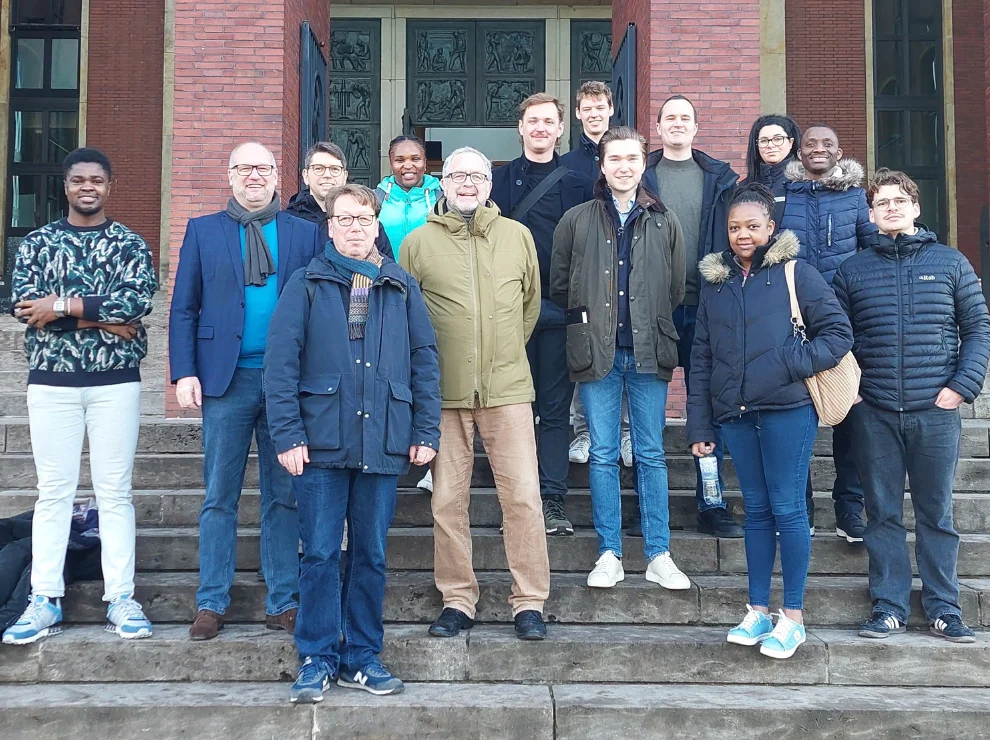
How can the green transformation be shaped without exacerbating new ecological damage, geopolitical dependencies and social injustices? Which raw materials are necessary for the sustainable restructuring of energy, transport and industrial systems - and where are the ecological and political limits to their extraction? Students from different disciplines and regions of the world addressed these questions in the seminar "The Policy of Resources in Times of Green Transition" in the Studium fundamentale (Stufu) at the UW/H under the direction of Prof Dr Reinhard Loske.
The seminar centred on the realisation that the ecological transformation of modern industrial societies is urgently needed in order to limit the climate crisis and environmental destruction. Photovoltaics, wind energy, battery technology, electromobility, green steel and hydrogen are core elements of the European "Green Deal" and a climate-friendly future. At the same time, it became clear that these technologies themselves require huge quantities of raw materials such as lithium, copper, nickel, cobalt, rare earths and other materials, which can cause considerable environmental problems when extracted. Students from Africa, the Middle East and Europe contributed their perspectives to the discussions and shared their thoughts on green areas and red lines.
Global perspectives on raw materials and power relations
The seminar also shed light on new dependencies - for example on China, which dominates the aforementioned commodity markets - geopolitical conflicts and human rights violations in various producing countries, particularly with regard to local communities and indigenous peoples in the Global South. The participants discussed political strategies to limit the negative effects of the green transformation: international cooperation on an equal footing - for example between Africa and Europe -, a sustainable circular economy or diversification of supplier countries. One topic that is often avoided in political debates repeatedly took centre stage: sufficiency, i.e. the renunciation of certain industrial activities. "Above all, it will not work without sufficiency," summarises Prof. Dr Reinhard Loske. The question "How much is enough?" must be asked if the transformation is not simply to lead to a shift in environmental problems. For many students, this change of perspective - away from thinking purely in terms of efficiency and growth - was an important stimulus.

During an excursion to the German Mining Museum in Bochum, the participants gained an insight into underground mining technology. (Photo: Moritz Hirner-Couderc)

Dr Michael Farrenkopf from the German Mining Museum Bochum explains coal mining in the Ruhr region (Photo: Reinhard Loske)
A critical look at deep-sea mining
The group also took a particularly critical look at the threat of deep-sea mining, which some countries want to get involved in. It would involve considerable interference in the sensitive ocean ecosystem, which is already facing stress factors such as overfishing, acidification, warming and coral death. Additional interventions could cause irreversible damage - with hardly foreseeable consequences for the global ocean ecosystem.
One of the highlights of the seminar was the excursion to the German Mining Museum in Bochum. There, the students were able to learn about all aspects of raw material and fuel extraction during a guided tour.
"Anyone looking to the future of resource policy must also know and understand the past of mining, its welfare effects, but also its negative external effects on the environment and society," says Prof Dr Reinhard Loske. The excursion made it clear that a responsible resource policy can only succeed if the past, present and future are considered together.
