"The work and energy we invest is recognised and appreciated"
Three honorary positions, two degree programmes, one fellowship: UW/H student Lisa Kaupert is one of 39 students who have been awarded the Deutschlandstipendium scholarship at Witten/Herdecke University.
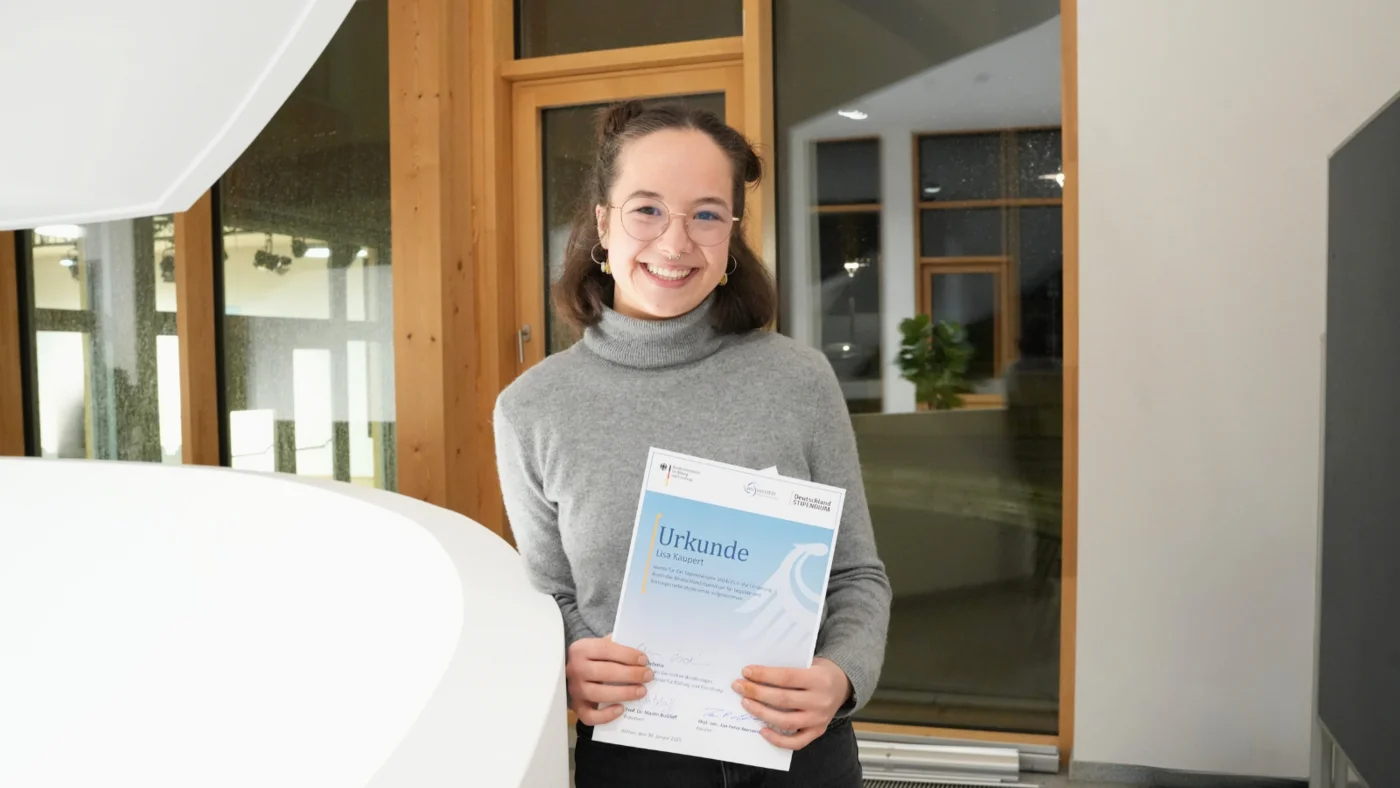
The 21-year-old UW/H student Lisa Kaupert is involved in the Senate, the faculty student council and the student cultural association Unikat - at the same time she is studying PPÖ - Philosophy, Politics and Economics as well as Psychology. How does she manage the balancing act between studying and voluntary work? What role does the Deutschlandstipendium scholarship play? And why this particular combination of subjects? The scholarship holder explains in an interview.
How did you come to be so involved with the university in so many different ways?
My involvement developed more organically than if I had consciously planned it. When I came to Witten, I had an image in my head of a lively community in which people support each other and make a difference together. This image was confirmed for me - and motivated me to become active myself. I joined the student council in the second semester and gradually took on other voluntary positions.
Here in Witten, distances are short: you constantly get to know new people, hear about vacant positions or are approached directly. I actively used this exchange, networked and spoke to many people to find out more about different areas of organisation. Through these exchanges and experiences, I have grown, become more confident and taken on more responsibility.
What motivates you?
The people here are incredibly active and bursting with ideas. People support each other, enjoy organising things and are happy to take on responsibility. The feeling of community runs through all my tasks - be it in the Unikat, the Senate or the faculty student council. That's what motivates me to get so involved: I want to be an active and responsible part of this community.
How does the Deutschlandstipendium support you?
On the one hand, it is clearly a financial relief. The monthly support allows me to focus more on my voluntary work and studies without having to worry so much about financial aspects.
But for me, it is also an idealistic support: it shows that the work and energy we put into voluntary projects is recognised and appreciated. Knowing that there are so many scholarship recipients who, like me, are committed and contribute their ideas in very different areas is incredibly inspiring.
You are studying two subjects at the same time. Why the combination of PPÖ - Philosophy, Politics and Economics and Psychology?
This decision has also grown step by step. I started with psychology and am still very happy with it. In the first semester, I often talked to fellow students who were studying PPÖ and found it really exciting to see what they were working on. Of course, one aspect that also played a role was the opportunity to study the cheaper degree programme for free. Ultimately, however, it was mainly the desire to delve deeper into this combination of subjects that influenced my decision. In the first few semesters, I wanted to concentrate on my studies and the student council presidency, but once that was well established in the fourth semester, I started with PPÖ.
For me, it's the perfect combination: in psychology, we deal a lot with the systemic approach - how people are influenced by a system as part of it. PPÖ expands this view: The focus here is on the social, political and economic system, and we examine how we as individuals can influence it. Both degree programmes complement each other perfectly because they illuminate the connection between the individual and the system from different perspectives, giving me a more comprehensive understanding.
Of course, it's a double burden. But as they are not state examination degree programmes, I can be flexible with my timetable. This semester, for example, I have only taken one psychology course and am writing my Bachelor's thesis, while at the same time I am doing five PPÖ courses that are important for the coming semester. The lecturers also show understanding when I'm absent due to overlaps. That's how I manage to balance both degree programmes and my voluntary work.