"We need to think about biodiversity, climate protection and climate adaptation together and shape them together"
An excursion by UW/H students to the renaturalised Lippe floodplain shows how this can be achieved.
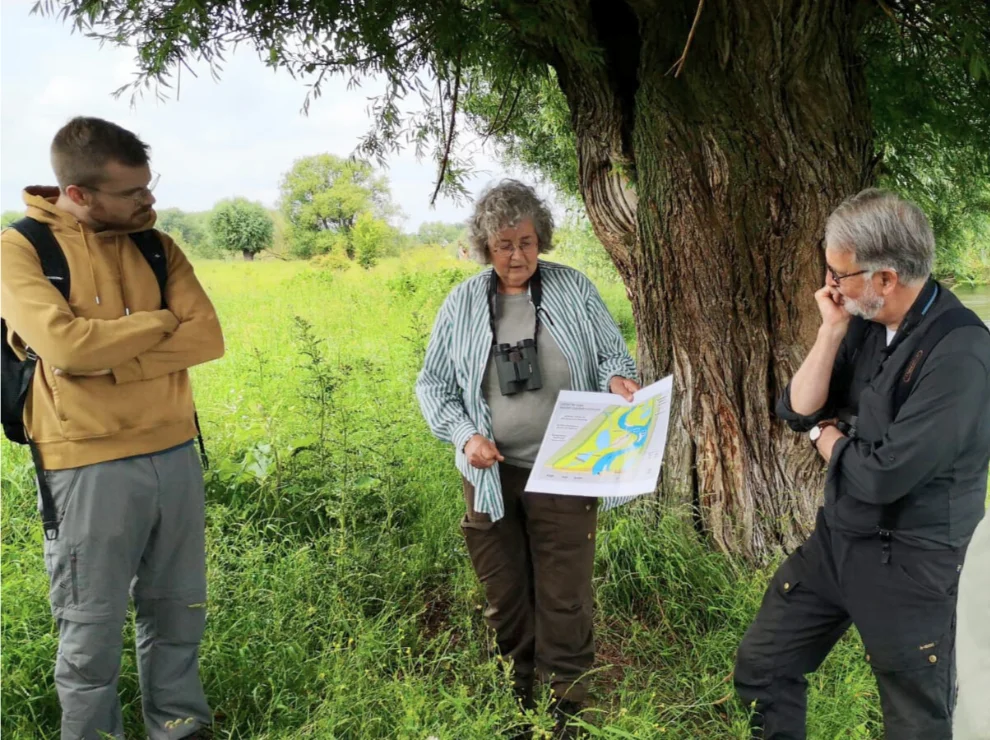
How can we best preserve biodiversity in times of species extinction? Which nature conservation measures are particularly effective? And how exactly do renaturalisation projects contribute to the protection of biodiversity, climate protection and flood protection? Equipped with these questions, participants in the Stufu seminar "The future of biodiversity" set off on an excursion to the Lippe floodplain west of Lippstadt.
Before setting off on the excursion, the students first looked at the global perspective together with Prof Dr Reinhard Loske in the UW/H offices: The concept of planetary boundaries makes it clear that humanity is on a fatal course with regard to global warming, biodiversity loss, land and freshwater overexploitation, deforestation and over-fertilisation, which urgently needs to be changed. The industrialised countries in particular, with their environmentally harmful production and consumption habits and their historical emissions and consumption of resources, have a responsibility to drive forward the necessary ecological and social transformation.
The laws and agreements for the protection of nature were also part of the preparation: from the UN Convention on Biological Diversity (1992) to the World Conservation Conference in Montreal (2022), from the German Biodiversity Strategy (2007) to the current EU Biodiversity Strategy for 2030. The conclusion at the end of the presentations and discussions was clear: many good resolutions, but too little implementation.
Decline in biodiversity due to intensive industrial use of the River Lippe
Equipped with this package of knowledge, sturdy shoes and plenty of provisions, the next day we set off into the field in glorious weather. The participants were guided by biologist Dr Margret Bunzel-Drüke and water expert Joachim Drüke from the Working Group for Biological Environmental Protection in the District of Soest (ABU), which is also the sponsoring organisation of the Soest Biological Station. Both have been actively involved in the Lippe renaturalisation project for 35 years.
Joachim Drüke began with an introduction to the cultural history of the Lippe. Since the Middle Ages, the natural riparian forests along the river have been cleared. The river itself was dammed up so that it could be used for water mills. In the 19th century, the Prussians then made the Lippe accessible for ships by partially straightening it and forcing it into a rigid bed. Until well into the 20th century, industrialisation, water pollution, drainage of the floodplain, hydraulic engineering and intensive agricultural use severely impaired the last near-natural floodplain areas. This led to a rapid decline in biodiversity in the river and its floodplains. At the same time, the straightened river deepened deeper and deeper into the terrain due to increased flow velocities and force, which increased the risk of flooding in the middle and lower reaches.
How renaturalisation became a success story
It was not until 1990 that people gradually began to realise that nature conservation, water management and flood prevention were a joint task. The NRW state government set up a floodplain programme and provided it with generous funds for the purchase and exchange of land. This was the starting signal for the renaturalisation of the Lippe. The river was given more space to find its own path and floodplains were created in the event of flooding.
Three favourable factors drove the renaturation forward: the old Office for Agricultural Planning took over the time-consuming negotiations for the acquisition and exchange of land with the landowners, the state water management administration was responsible for the renaturation of the river and the ABU (Arbeitsgemeinschaft Biologischer Umweltschutz Bad Sassendorf) took over the ecological management of the Lippe floodplain as a well-connected NGO.
The project was so successful that even the initially sceptical parts of local politics now support it because it attracts national attention, draws local recreationists and even creates regional value-added activities. "The Lippe has shown us impressively how, with a little luck, a lot of commitment from a few people and perseverance, something as wonderful as this can be created," says Niklas Schäffer, medical student and excursion participant, summarising the cultural history.
The area is now home to an enormous variety of rare animal species. Whether osprey, white stork, kingfisher, grey goose, beaver or tree frog - nature lovers are sure to find what they are looking for here. Margret Bunzel-Drüke vividly explained to the participants which species can be found here and spontaneously included passing birds such as the cuckoo or cormorant in her explanations. Psychology student Siwan Ristau was touched by the liveliness of the lecture: "For me, it was inspiring to see the enthusiasm with which we were given an insight. It gives you a bit of hope to see what can be possible and what has already been created on site."
How "aurochs" and Konik horses are used as landscape gardeners
One aspect in particular captivated the seminar participants: the use of large mammals as "landscape gardeners". For around 30 years, back-bred "aurochs" and Konik horses have been used to keep the floodplain open, prevent scrub encroachment and thus protect nature. They help to keep the growth of bushes and trees to a minimum by trampling or biting off the young plants that grow back.

The "aurochs", known as "Urrind", has been extinct since the 17th century. However, many regional cattle breeds in Europe have retained characteristic traits of the Urrind, which can now be used for back-breeding programmes in Spain, the Netherlands and Germany.
"I was particularly impressed by the fact that Europe was once characterised not only by forests, but also by vast grasslands with large grazing animals. This historical diversity of large wild mammals in Europe was a surprising discovery," reports PPÖ student Johann Eickenbrock.
Success factors of the Lippe renaturalisation

"For me, there are two main results at the end: It has become clear that biodiversity, climate protection and climate adaptation belong together. Restored wetlands such as the Lippe floodplain promote biodiversity, store large amounts of carbon and make a relevant contribution to flood prevention," says Prof. Dr Reinhard Loske, summarising the excursion.
"The excursion also showed that perseverance, openness and cooperation between state and civil society actors are necessary to achieve such successes. We can learn from this."
On the third and final day of the seminar, now back at the university, the findings from the excursion were compared with various theoretical nature conservation concepts in Germany and abroad: What potential does "rewilding" offer for species and climate protection? Are protected areas the ideal solution for nature conservation? What should be the relationship between sustainable land use and nature conservation? Is the economic valorisation of nature the right way to preserve biodiversity or is it rather a wrong path that ultimately leads to the exploitation of nature? These questions were at the centre of the discussions.
The three days, with their mixture of ecological, economic, historical and legal aspects in theory and practice, passed quickly, but will certainly resonate for a long time.
