How Domenik Treß, while still a student at PPÖ, initiated lasting change at his university
Alumnus Domenik Treß has been a driving force behind the University of Witten/Herdecke ecological transformation. In this interview, he shares the experiences that have had a particularly profound impact on him.
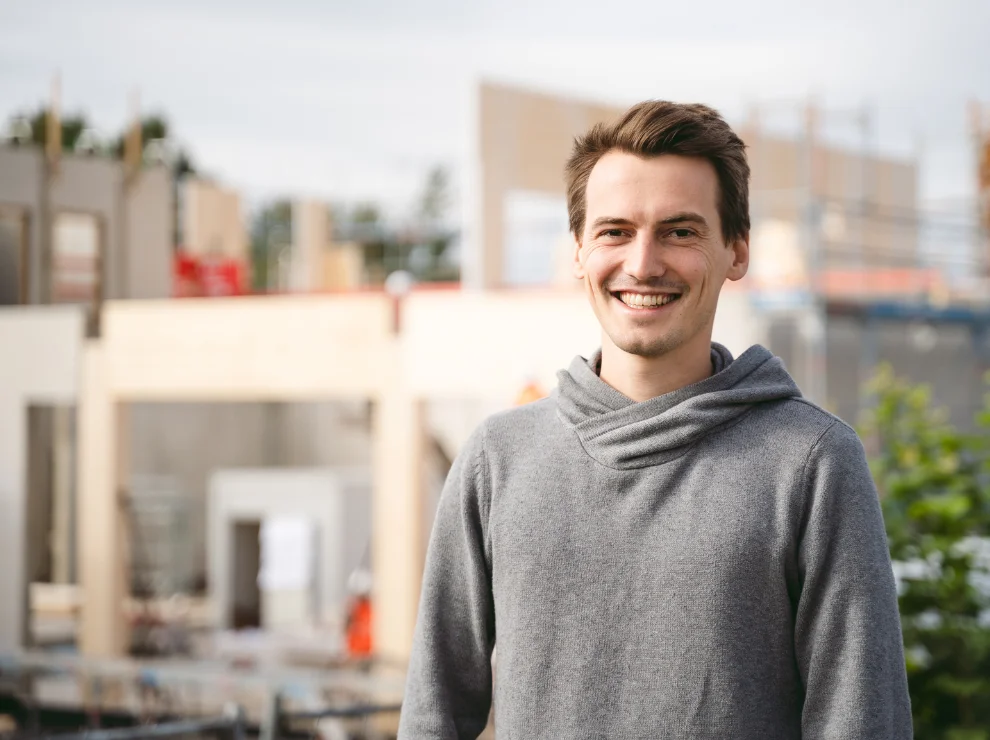
In summer 2016, as a student of philosophy, politics and economics, you founded the Initiativlabor in order to anchor sustainability more firmly at Witten/Herdecke University (UW/H). At that time, there was no sustainability management at most universities. What motivated you to become active?
It wasn't just my idea. The student initiative Oikos already brought together all of the university's sustainability initiatives under one roof. In one of the Oikos projects, we looked at the question of how we could strengthen the topic beyond teaching in operational implementation.
We were in close contact with Network N - a network of young people who are committed to sustainability and climate protection at universities. This enabled us to familiarise ourselves with the idea of the "Green Office" from the Netherlands and the UK. These are sustainability offices that are run by students. This inspired us to implement such an idea here too. After all, it was an ideal fit for UW/H - in line with the motto: you can also take responsibility for your own university as a student and promote sustainability. And so we founded the Initiativlabor.
At the time, the “Initiativlabor” had a dual role: on the one hand, networking and workshops for the initiatives so that not every student project starts from scratch and encounters the same hurdles. On the other hand, a kind of sustainability office that initiates and supports projects for more sustainability on campus.
Students don't stay at the university forever - how did you deal with the fluctuation?
In fact, we have found that student involvement works very much on a semester basis and that it is difficult when students who volunteer take on responsibility on their own. That's why we decided together with the university management to hire student assistants for the initiative lab. This enabled us to set up an institution that is student-led, but with a more long-term commitment - just as it already works well with the student community.
In 2021, UW/H opened one of the most sustainable university buildings in Germany. You were part of the project team from 2016 - what was important to you during the construction phase?
I mainly wore the sustainability hat in the team. In the early phases, it was more about the big questions. For example, defining our understanding of sustainability but then also transferring this to campus planning, for example for a sustainable mobility concept.

Later on, it was more about technical components and sustainability certification. I spent a lot of time on the details - such as planning the solar system or the question of whether we could reduce suspended ceilings in order to save material and thus reduce the consumption of resources.
It was also important for us as a project team to closely involve the university community right from the start. In total, over 300 students, teaching staff and employees were actively involved in the design and planning of the new building. After all, this is also an aspect of sustainability: the more attention you pay to ensuring that the needs of the people who will later learn and work in the building are met, the less space you give away.
For example, the students wanted the taps to be positioned so that they could fill up their drinking bottles with tap water. I still remember how we were given several taps and washbasins as samples and tested whether the bottles really fit under the taps.
What are you most pleased about when you walk through the finished new building today?
The highlight for me is the fact that it has become a timber hybrid building. That wasn't clear from the start, there were initially a lot of sceptical voices. Over time, however, the timber hybrid building became the favourite design all by itself. Not only was the concept with the best carbon footprint realised, but also the highest quality. Everyone I've spoken to so far is particularly impressed by the interior design. For me, it also fits in with the values of the university that we have focussed on the inner qualities.

You later became the first sustainability manager at UW/H. Which topics were particularly important to you at the time, and what did you initiate?
After planning the new building, we realised that although we had launched an innovative, ecologically oriented university building, we wanted to make the university as a whole even more sustainable.
This is why we created the "Sustainability Networking Office", which Dr Annaliesa Hilger has headed since June 2021. The Initiative Lab, which continues to be run by student employees, is also docked here and still focuses on supporting student initiatives while contributing to the university's sustainability development.
It was important to us to set up a decentralised office - that's why we didn't call the department the "Sustainability Office" or "Sustainability Management", but rather the "Sustainability Networking Office". After all, the worst sustainability centres are the ones that are created in order to be able to say: "There's someone who takes care of it, so we don't have to do it anymore." To prevent this, the networking centre works with all departments to develop individual concepts instead of prescribing ready-made solutions. The goals of each department are incorporated into a joint roadmap; at the same time, the topic is promoted by the networking centre through targeted measures.
Although this "whole institution approach" is more common, I believe that it works particularly well in Witten. The larger a university is, the more closed the silos can be and the less it works to bring together the many decentralised ideas into one big whole.
In addition to the small size, it was also an advantage that there was an openness and willingness to tackle the topic together at UW/H right from the start. This is not a matter of course, as I have learnt in many conversations with other universities.
You qualified as a sustainability manager at the ZNU, the Centre for Sustainable Corporate Management at UW/H. What did you take away from it?
We were always in close dialogue with the ZNU. The management part - i.e. the question of how to get things moving as an organisation - can be easily transferred to an entrepreneurial university like ours.

Nevertheless, the issue of sustainability is different here than in a production company because it is not just about a product, but also about the question of how our education and research can contribute to the sustainability transformation of society, for example. This is even more complex than just manufacturing and presenting a product with the lowest possible carbon footprint.
After your time in Witten, you completed your Master's degree in Sustainability Science and Environmental Studies in Sweden. Today you work for NRW.Energy4Climate. What do you want to drive forward in your job?
Broadly speaking, my topic area is about the question of how NRW as an industrialised state can promote a climate-neutral economy in the long term - in other words, industrial transformation. Together with industrial stakeholders and policymakers, we draw up position papers and act as mediators in working groups and networks.
While most of my colleagues come from an engineering background, I work on the topic from a social science perspective. For example, I deal with issues such as structural change after the coal phase-out or the acceptance and promotion of new technologies such as hydrogen or the storage of carbon dioxide underground.
I am currently very concerned about polarisation, which benefits too many inertial forces. The sooner we manage to avoid polarisation, the more likely we are to master the transformation in the long term. I am therefore in favour of strengthening those forces that want to change things.

When did you develop the desire to work for a more sustainable world?
It started for me as a teenager: I realised then that my future was at stake and that the next few years were crucial. At the end of my life, I want to be able to look back and say: I have done my part to ensure that a good life is also possible in the future.
How are you feeling about the climate crisis? Are you more hopeful, more desperate - or both?
When you deal with my subject area, there are always moments when you think: I don't know how we're going to manage this, we've lost so much time. It's been clear for decades that something urgently needs to happen, but as a society we just can't manage to react quickly enough.
Nevertheless, I keep coming out of this valley because it is clear to me that this does not change the fact that it is important to act now. No matter how much time is lost, even if the 1.5 degree target is no longer achievable: every tenth of a degree counts. It makes a huge difference to our quality of life whether we grow old in a world with 1.7 degrees or 3 degrees of warming. This knowledge drives me on again and again.
