World politics up close: Insight into the largest simulation of the United Nations
Jette Thra is studying PPÖ - Philosophy, Politics and Economics and Global Sustainability at UW/H. In April 2025, she travelled to New York City with 22 fellow students to take part in the National Model United Nations conference.
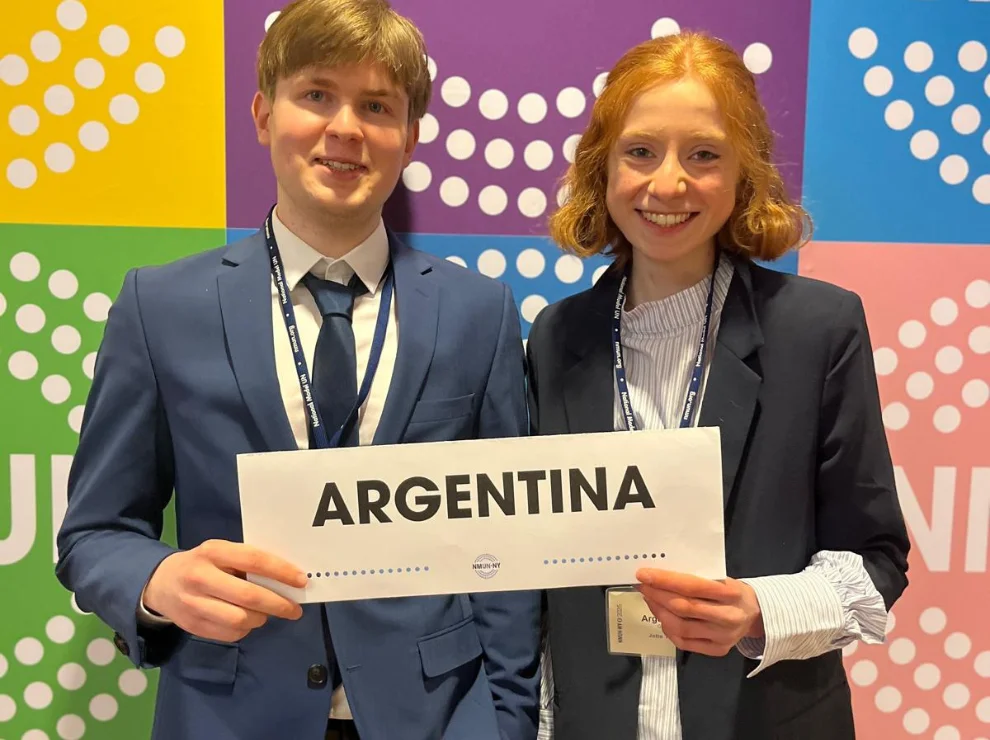
Jette Thra slipped into the role of a diplomat for four days at the United Nations' largest student simulation game and represented the Republic of Argentina on the Committee on Disarmament and International Security. In her search for allies, she met students from all over the world and negotiated solutions to global challenges. The experiences she gained made a lasting impression on the student. In her guest article, Jette tells us what she took away from her trip.
"I've never been to New York!" - I can no longer proudly say that. I'm studying PPÖ - Philosophy, Politics and Economics and Global Sustainability at UW/H. As early as my first semester, I learnt about the many ways in which students at UW/H can get involved alongside their studies. I came across the Model United Nations initiative - the perfect opportunity to combine my political interest with social commitment. Without knowing exactly what to expect or what it meant to fly to New York alone, I submitted my letter of application - and was accepted.
¡Hola, Argentina! - The UW/H delegation represents the Republic of Argentina
At the first introductory meeting of the UW/H delegation, we revealed the big secret of which country we would be representing. It quickly became clear that the MUN team would be travelling under the Argentinian flag in 2025. From then on, we intensively analysed Argentina's politics and values in order to prepare for the conference and formulate a well-founded position paper on global political issues such as climate protection, economic trade and human rights.

We were actively supported by the four initiators, especially the two head delegates. In our roles as diplomats, we joined different committees - my fellow student Randolf Maercker and I became members of the General Assembly 1 (GA1) committee, focussing on nuclear disarmament and international security.

April was approaching, excitement was building and travel preparations were in full swing: I found roommates, booked my flights, ironed my blouses - to match the formal dress code - and studied the rules of behaviour for the individual sessions. Despite recent reports of entry difficulties, we arrived safely in New York.
Our accommodation, the Hilton Hotel in Midtown, was firmly in MUN hands. In the lobby there was a separate check-in desk for participants in the simulation game and everywhere you looked you could see young, excited students from all over the world.
Although we weren't due to start until Sunday, many of our Argentinian delegation arrived a few days earlier. This allowed us to spend the first evening in a typical American diner, discuss our journey and clarify any remaining questions. The dinner together became a bonding ritual for us.
The conference started with a grand opening ceremony and we listened together to the words of the MUN President about the long tradition of MUN and inspiring stories of past conferences. At the end, we watched a personal video message from the current UN Secretary-General Antonio Guterres, who encouraged us to fight for a just future and to stand up for our right to co-create.
Between global politics and personal growth
All the delegations then split up for the first meeting. As members of the GA1 committees, Randolf and I, together with over 200 other students, moved into one of the largest rooms in the hotel complex and first decided on the order of topics.

By a large majority, we declared nuclear security, coupled with nuclear disarmament, to be our priority. The "Speaker's List" was then opened for the formal part of the meetings, in which all countries had the opportunity to present their positions. In the informal part, Randolf and I were able to exchange ideas and discuss our strategy: Which countries have the same interests? Who could we convince of our proposals? And what alliances are possible?
The aim of the meetings was ultimately to adopt one or more resolutions that are supported by as many countries as possible. To achieve this, it is necessary to reach a consensus with as large a group as possible. Although it took a lot of effort at first, I quickly enjoyed meeting new people. Sometimes I could hardly believe that I was actually talking to other students about the future of nuclear weapons and that I was speaking out in favour of disarmament as a representative of Argentina in this simulation game. And suddenly I was overcome by the feeling of being part of the big world stage myself.
In my role as a diplomat, I also had to talk to more difficult representatives such as China, Russia and Iran in order to convince them of our resolution. What might not be possible in the real world, I managed to do here.
In addition to discussions about politics and nuclear weapons, I also had private conversations, which allowed me to get to know the people behind their country names. I made friends with a student from the Philippines who invited me to Manila, students from Los Angeles, Chicago, West Virginia and even Nepal! They all sparkled with commitment and determination to make a difference and make the world a better place.

After four intensive days of meetings, several night shifts and resolutions, our perseverance was rewarded on the last day of the MUN with a visit to the official UN headquarters in New York. Where high-ranking politicians from all over the world normally sit and discuss the world situation, there were now young, politically interested and ambitious students from all over the world.
The crowning finale was the traditional "Delegate Dance" - exuberant and absolutely deserved. Wistful, because the day of departure was imminent, but nevertheless inspired by the impressions of the last few days, I enjoyed the last few hours in New York with the people I had grown so fond of during this time.
I am infinitely grateful for this experience. It enriched me personally, but also my studies, and I would advise anyone and everyone to seize the opportunity and become part of an MUN delegation themselves. New York as a city was impressive, but it was much more the interpersonal contacts and valuable conversations that I took away from this time.
No matter what insecurities you had to deal with, no matter how you got here, at the MUN and in the great Argentinian delegation from Witten, we all felt seen, respected and accepted. With all the scary political developments, meeting people who believe in the good in the world gave me hope. If we expect change, we have to take action ourselves.
