Activism as a Corporate Responsibility: How Students Are Pushing the Boundaries of Corporate Activism
Social issues, climate crises, and geopolitical upheavals are also becoming challenges that businesses must address. Master’s students at UW/H explored this topic as part of a blog seminar.
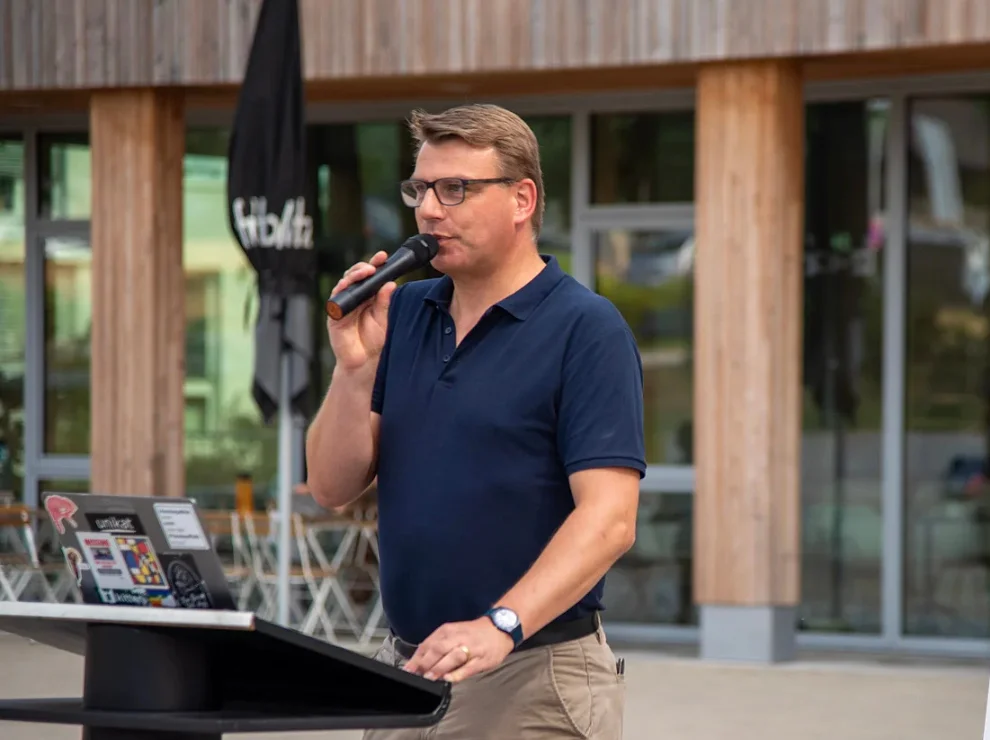
A lively debate flared up right at the beginning of the seminar: How legitimate is the involvement of companies in socio-political discourse? Should they stay out of it because they are not democratically legitimised - or should they not stay out of it because they are part of the problems and solutions?
This tension was the common thread running through the block seminar "Socio-Political Activism in and by Organisations" with 14 Master's students from the Philosophy, Politics and Economics (PPE) and Strategy & Organisation (S&O) courses.
A guest article from Vodafone illustrated the challenges in practice
A highlight of the seminar was the contribution by Sebastian Pfister, Head of Communication at the Vodafone Foundation. With his wealth of experience, he enriched the event with perspectives from the real world of corporate socio-political activism. In particular, he emphasised that educational programmes can help to advance an issue.

Students sit on the stairs and listen to a lecture by a student.
"Social issues, climate crises and geopolitical upheavals - the field of polycrises makes it clear that the time when companies could dismiss these phenomena as externalities is over," explains PPE student Leonard Römer in retrospect. "The seminar showed how companies can fulfil their inherent social responsibility."
His fellow student Sofie Rothenstein adds what a decisive role political framework conditions play: "Various market failures, such as environmental pollution, challenge us and cannot be solved without political and social intervention. I think it is naive to assign responsibility solely to companies. Corporate decisions have social and ecological consequences and are therefore always political. I encourage everyone to see themselves not only as an economic being, but also as a political one."