"I don't stand for the straight path": How Tim Schröder combines medicine, volunteering and responsibility
UW/H student Tim Schröder is passionate about emergency medicine. As one of 40 scholarship holders, he shows how the Deutschlandstipendium helps him to pursue his studies and his passion.
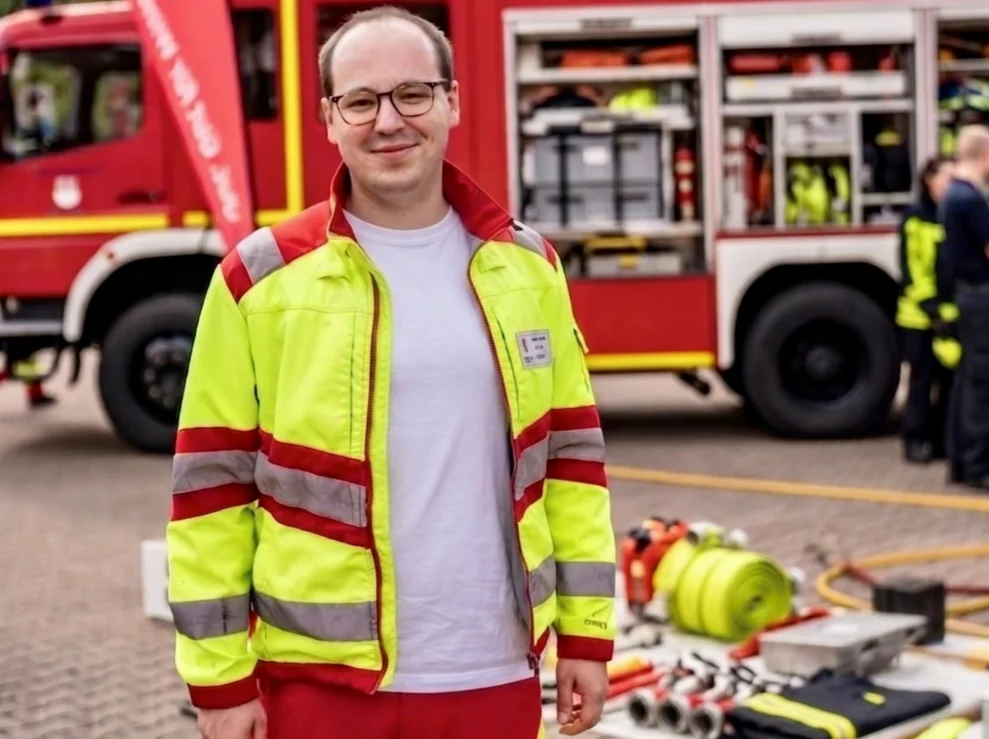
Secondary school certificate, paramedic service, A-levels at evening school - and now studying medicine: Tim Schröder's path has had many stages. He is consistently pursuing his dream of becoming a doctor. Alongside his studies, he is involved in a variety of activities. At Witten/Herdecke University, he finds the space to combine his studies, voluntary work and practice. In this interview, he talks about his passion for emergency medicine, his drive and what the Deutschlandstipendium means to him.
What does a typical week look like for you between studying, working and volunteering?
My weeks in the 5th semester of human medicine mainly consist of lectures and clinical blocks. In between, I try to find time for my student initiative, the emergency medicine working group- for example, to plan or evaluate events. I'm also involved in the volunteer fire brigade. It doesn't work out equally well every week - I have to cut back a bit during exam periods, but I never lose sight of my voluntary work.
You already had relevant experience before studying medicine. When did you realise: I want to become a doctor?
That came about during my voluntary social year after secondary school. I spent six months working in care and six months at a special school for children and young people with disabilities - that had a huge impact on me. At the same time, I started my training in the emergency services and worked there. This made me want to study medicine in order to underpin my practical experience with theoretical knowledge.
At the same time, my years in the ambulance service are benefiting me in my studies today. I am used to extraordinary stressful situations and can rely on my confidence and skills.
You completed your A-levels at the same time as working - what gave you the discipline to do this?
I think it was actually the goal I had in mind. After all, when I enrolled at secondary school, I had a completely different attitude to learning and worked very hard because I knew that it would bring me closer to studying medicine. There were days when I came back from a 24-hour shift in the emergency services, went straight to school and then continued studying. That was stressful, but my inner drive cushioned a lot of it.
Where does your passion for emergency medicine come from?
I've always found emergency medicine exciting because it goes beyond traditional clinical medicine. You work independently and without a team of doctors around you. You also have to make do with limited diagnostic and therapeutic resources, so the basics of emergency medicine are incredibly important.

You have to trust in your own abilities. At the same time, experience and gut instinct are important. I was already interested in it as a child, took first aid courses early on and joined the Red Cross. This fascination has stayed with me to this day. The combination of responsibility, dynamism and direct action is what appeals to me.
Were there any moments in the rescue service that had a particular impact on you?
Many missions are not highly dramatic at all - empathy takes centre stage. Older people in particular are often lonely and it helps a lot to take the time to listen. This shows me again and again that medicine is not just about technology, but above all about humanity.
In addition to your studies, you are involved in a wide range of activities. What motivates you to do this?
I simply find the topics exciting. And I really appreciate the camaraderie, especially in the volunteer fire brigade or the German Red Cross. You come together with very different people, support each other and do something socially useful at the same time. That's a good combination for me and also a valuable balance to my studies. That's why I plan fixed days for my voluntary work and my teaching at the rescue service school. Organisation and good time management are crucial in order to do justice to all areas.
You are also in favour of integrating emergency medicine more strongly into the degree course. Why is that important to you?
At the end of the day, we are all doctors - regardless of specialism. And in an emergency, people expect us to be able to help. And I don't just mean resuscitation techniques, but also advanced life-saving emergency measures. That's why I think that emergency medicine should be part of the degree programme at an early stage and on an ongoing basis. At the UW/H, we have found open ears for this in the Dean's Office and have already been able to initiate several projects.
Is this co-design something that particularly characterises your studies at the UW/H?
Definitely. The university is smaller and more personal. You're not just a student number, you know each other. You talk to each other as equals and can develop ideas together. That's a big advantage here.

What role does the Deutschlandstipendium play for you?
Specifically, it gives me time. Time that I would otherwise have to spend on part-time jobs. This gives me more capacity for my commitment and for projects that are important to me. It allows me to fulfil my potential during my studies and beyond.
What advice would you give to other young people who also dream of studying medicine?
I'm not necessarily in favour of the straight path, but of the experience you gain along the way. Later on, nobody asks how you reached your goal - the important thing is that you got there. Reorienting yourself in between and trying things out will help you in your studies and career. The important thing is to keep at it and not give up.
