Research on mental health in business families - Interview with Magdalena Wendt
For a coffee with: A series of talks with interesting personalities from the UW/H environment.
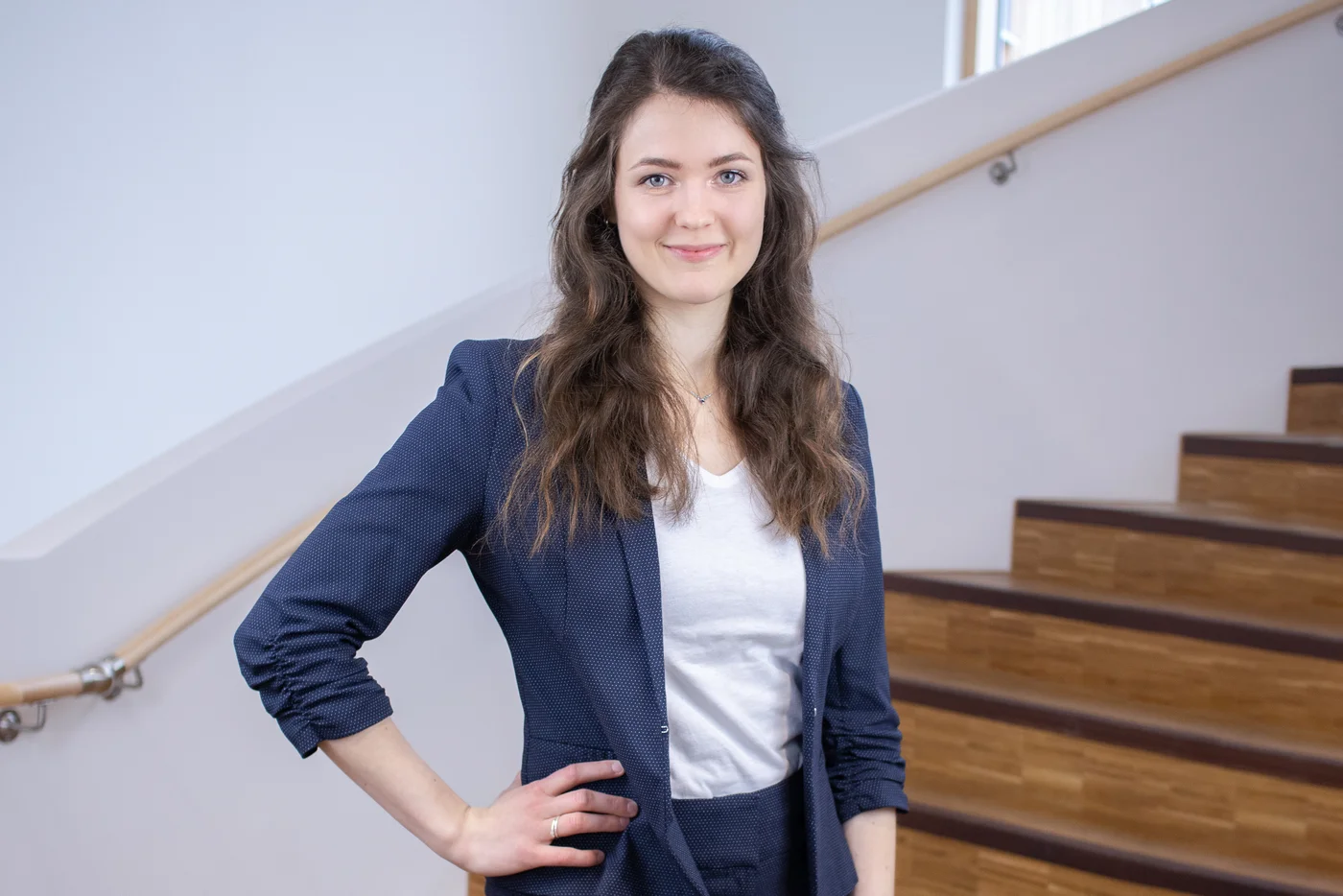
The Professional Campus in conversation with Magdalena Wendt, UW/H alumna, lecturer in the Qualification Programme for Shareholder Competence (GKE) and doctoral candidate researching mental health in entrepreneurial families.
Magdalena Wendt, M.Sc., M.A., is a clinical psychologist, certified mediator and family business consultant, research assistant at the WIFU Endowed Chair for Organisation and Development of Family Businesses, and at the Chair of Clinical Psychology and Psychotherapy III at Witten/Herdecke University (UW/H). Magdalena Wendt also teaches in the continuing education programme Gesellschafter:innenkompetenz (GKE) and will succeed WIFU Foundation Board Member Tom Rüsen in this role in autumn 2025.
Professional Campus: Dear Magdalena, you are doing your doctorate on the topic of "Mental Health in Entrepreneurial Families" in the cooperative research project between the Witten Institute for Family Business (WIFU) and the Chair of Clinical Psychology and Psychotherapy III at the UW/H.
How did you get involved?
Magdalena Wendt: My path to this topic was both professionally and personally motivated. I was already intensively involved with clinical psychology and psychotherapy during my Bachelor's and Master's degree programmes in psychology at the UW/H. I became increasingly interested in how mental health can be understood and promoted not only in an individual context, but also in a systemic context - for example in families.
Through my supplementary "Ethics and Organisation" Master's degree at the UW/H, I was able to broaden this perspective once again and link it more closely with issues from an organisational perspective. I deliberately focussed on family entrepreneurship and business families. This is because they are a particularly exciting field: they combine family dynamics with entrepreneurial responsibility - both topics that appeal to me personally.
Parallel to my studies, I have continued to further my education. Among other things, I became an internationally certified mediator (DACH) and trained in systemic constellations and biography work. These training courses have given me the tools to better understand and support complex family and organisational processes. All with the aim of being able to support people and systems holistically in their development.
Through my many years of work, first as a student assistant at the WIFU Foundation and later as a research assistant at WIFU, I was able to gain many in-depth insights into the world of business families. This is also where the connection to the current collaborative research project came about. I was immediately excited by the opportunity to combine my psychological expertise with family business research - and so I ended up becoming part of the interdisciplinary research project on"Mental Health in Business Families". This gave rise to my doctoral project, which I am now pursuing with great passion alongside my consultancy work.
Professional Campus: You can look back on many years of consulting work in the field of family businesses and business families; you were also involved in the organisation of the 23rd Congress for Family Businesses (FUK for short), a major event for family businesses that takes place annually at the UW/H, while still a student.
Where did your passion and interest in family businesses come from?
Magdalena Wendt: My interest in family businesses and in particular the families behind the businesses has developed very organically and at the same time consistently over the years - from a combination of personal curiosity, professional specialisation and practical experience. In any case, the organisation of the Congress for Family Businesses was particularly formative. There I experienced for the first time how complex, emotional and socially relevant the topic of family entrepreneurship with all its facets really is. It has stayed with me ever since.
Since then, I have worked intensively with business families, both academically and as a counsellor - with a particular focus on psychological and systemic aspects. Today, my research specialisation is mental health in business families, which I examine from a clinical-psychological perspective.
I also support business families in governance processes, in the development of (self-)management systems (e.g. the creation of family constitutions), as well as in questions of succession planning and conflict mediation. Working with business families is so fascinating for me because it combines economic, psychological and interactional aspects in a unique way.
"Business families bear a great deal of responsibility - for the company, the employees, but also for themselves. This is precisely what drives me: to help them to fulfil this responsibility in a reflective, empathetic and healthy way."
Professional Campus: From autumn 2025, you will be the lecturer successor to Tom Rüsen, who had, after all, launched the Associate:innenkompetenz programme. How would you describe your working relationship with Tom Rüsen? Was/is he something of a mentor to you? How did the handover and familiarisation process go?
Magdalena Wendt: I really appreciate working with Tom Rüsen. We have had the opportunity to work together intensively since I started working at the WIFU Foundation. During the transition phase to taking on the role of lecturer as part of the GKE programme, we organised a seminar together. This was not only very enriching from a professional point of view, but also a valuable personal experience. I gained deep insights into the motivations that led to the development of the training programme. Tom Rüsen was very open in sharing his thoughts on the content of the programme and the special role of associates in family businesses. In this sense, he was indeed a kind of mentor for me - someone who guides with a lot of experience, clarity and humanity, but also leaves room for further development.
I am very much looking forward to continuing the GKE programme in this spirit: academically sound, practice-oriented and with a strong focus on the individual reality of the participants - and in doing so, to carry on the impulses from Tom Rüsen's many years of work and to carefully develop them further, enriched by my expertise.
Professional Campus: You are now responsible for three modules in the Associate Competence programme:
Module 1 (Fundamentals of Business Family Management);
Module 3 (Family Strategy and Family Governance);
Module 5 (Reflecting on your own situation as a member of a business family)
What exactly are these modules about? What approach do you take?
Magdalena Wendt: Module 1 focuses on basic knowledge about business families: What characterises them? What systemic characteristics do they bring with them - for example in terms of context mixing, communication patterns, interactions or mental health? The aim is not only to impart knowledge to the participants, but also to provide them with tools with which they can reflect on and work on their own roles, family dynamics and potential areas of conflict.
A special focus is placed on the 3rd module, which is intensively dedicated to the family strategy process. Here we discuss how such a process can be organised, why it makes sense and what challenges can arise before and during it. Participants have the opportunity to contribute their own experiences - for example existing family structures - and to reflect on the role that mental health and their individual succession situation play in this context.
Heiko Kleve and I conduct the 5th module together. Finally, the focus is on reflecting on one's own situation in the area of tension between the three logics - company, ownership and family. Together, we will look at the changes that have resulted from the training programme and create a space to make personal development processes visible and effective. A central question will also be: How can I make my learnings effective within my family?
Professional Campus: Now your focus is on mental health in business families.
What are the special features of family businesses? Is the pressure higher, the risk of conflict in the family greater? Do you have to deal with your own responsibilities differently - for example towards your fellow human beings and your environment, but also between the generations?
Magdalena Wendt: There is actually little research on mental health to date that considers the family business as an influential factor affecting business families. Rather, we listed the research questions that are still open. There is also often a lack of knowledge about the special structures and stress patterns of business families in psychotherapeutic care. This is precisely where our research project "Mental health in business families" comes in, which I am conducting together with my colleagues Philipp Kitta, Christina Hunger-Schoppe, Heiko Kleve and Tom Rüsen. With our studies, we want to close initial research gaps and provide evidence-based answers to such an interview question. Firstly, we are conducting a representative survey (WIFU-GESUND study) in which over 500 business families across Germany are asked about stress and health-promoting factors. This survey was completed at the end of June 2025 and is now in the evaluation phase. On the other hand, my doctoral study is running in parallel - a qualitative interview study on the topic of "Mental health in the context of the entire life cycle of a business family". Initial analyses show that members of business families are confronted with specific developmental tasks - tasks that go beyond what we know from general population research. One key characteristic is, for example, the lifelong relationship to the family business - regardless of whether one is operationally active in the company or not. Our aim is therefore to use empirically based research to create a better understanding of how mental health can be promoted in business families and what support is needed to ensure sustainable (family) structures, especially in stressful phases.
These special dynamics have been the subject of systematic research for many years, including at WIFU, which has been working intensively on the structures and challenges in business families since it was founded. The founding fathers of the institute already shed light on these complex interactions - an approach that was carried forward by Arist von Schlippe and deepened in recent years by Heiko Kleve in particular. This has provided important insights into typical patterns, conflicts and structuring options within business families. These will also be incorporated into my modules.
Professional Campus: The Gesellschafter:innenkompetenz programme (GKE) has been running very successfully for several years. GKE is now entering the next generation - younger, female successors are no longer a rarity in traditional family businesses. How does this broaden or change the perspective? What will the management of family businesses look like in the future?
Magdalena Wendt: In business families - as in society as a whole - a profound change is taking place. This can be seen not only in changed, increasingly egalitarian inheritance structures, but also in a more diverse deepening and change of mental models. This change is also evident in relation to the role of women, both at a family level and at a property-related and increasingly entrepreneurial level. This is not only about greater visibility and recognition of women, their influence on and their work in the family and in the company, but also about structural issues: What framework conditions are needed so that succession can be organised fairly regardless of gender? New options are becoming apparent today, particularly in traditional family businesses - and the more successful examples there are, the more natural alternative models of leadership become.
"Interestingly, business families are even pioneers in some respects: they are used to dealing with different roles and expectations - to living with paradoxes and tolerating ambiguity."
I know from many personal conversations that many business family members, especially women, are now actively committed to adapting structures to make it easier for future generations and to overhaul old internalised thought patterns. This change in family strategy is central to the sustainable management of family businesses.
Professional Campus: Finally, one thing would interest us: Where do you gather strength for all these tasks and projects? Do you have any tips for us (and our readers)?
Magdalena Wendt: I've already learnt from my parents: it's important that you enjoy what you do and that your work fulfils you. And to be honest, I draw a lot of strength directly from my work. I love working with people, I'm curious by nature and I find it very rewarding to gain insights into entrepreneurial families, hear their stories and accompany them through different phases of development. What's more: I have really great colleagues with whom I enjoy working not only professionally, but also on a personal level.
I also have a very supportive personal environment: my partner, my family and close friends - I can recharge my batteries by spending time with them. And when it's time to really calm down, I find it above all in nature and exercise. Whether it's going for a walk or dancing - these are moments when I'm completely with myself and recharge my batteries.
So my tip would be: surround yourself with people you enjoy working and living with - and find rituals that do you good without them having to be "performance". Sometimes it's enough to simply breathe deeply, be in nature or dance.