Studying medicine with a child: How Elsa Heinsius found her own way between university and family life
Elsa Heinsius is living her dream of studying medicine at Witten/Herdecke University. She talks to us about her plans for the future, her son Oskar and how she fulfils her dual role as a student and mother.
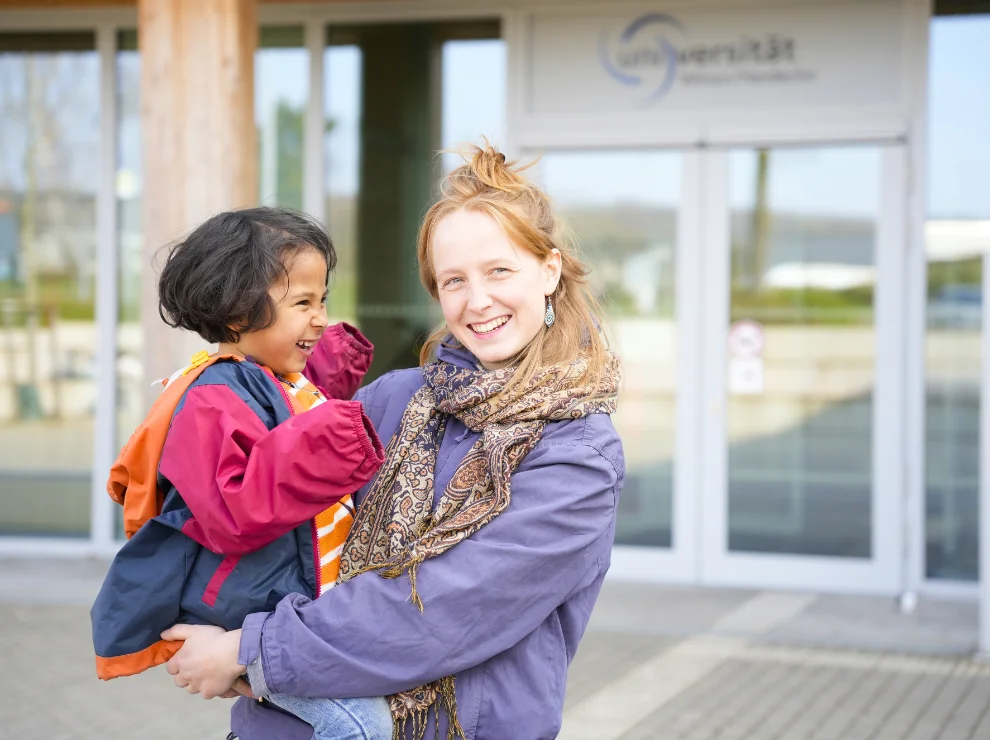
When Elsa gets up at 7 a.m., her day starts like that of many other families: preparing breakfast, packing a lunch box, looking for a bicycle helmet. At 8 a.m., she takes her four-year-old son Oskar to nursery school. An hour later, she is sitting in the seminar room - ready for anatomy, physiology or problem-based learning (POL). Until the end of her courses in the afternoon, she is all student - and then all mum.
Elsa is 24 years old, originally from Potsdam and moved to Witten to study medicine at UW/H. She will start her fourth semester in April 2026. "I would actually already be in my fifth semester, but I'm deliberately studying a little slower," she says. The decelerated course of study is important to her in order to combine her studies and family life.
Why Elsa decided to study medicine: "I didn't want to shatter my dream"
Elsa has wanted to become a doctor for a long time. "At times, I also toyed with the idea of becoming an educator or midwife, but in the end I was always drawn back to medicine. The mixture of working with people, lots of knowledge and lifelong learning really appeals to me." After completing her higher education entrance qualification, she first completed a voluntary service programme in Cameroon. She spent a year there working in an organisation for socially disadvantaged people and people with physical and mental disabilities. "It was simply wonderful to live with so many different personalities, to learn from each other and to listen," she says. "Listening is also really important to me in medicine in order to really understand patients and find out where the problem actually lies."
However, the path to studying medicine was not straightforward after her return: she applied to various universities alongside UW/H, but was initially rejected. Then she became pregnant. She was subsequently offered a place at a state university through a succession procedure, but decided against it. "The timing wasn't right. I just didn't feel it," says Elsa.
When her son Oskar is two years old, she applies again for a study place in Witten. She is convinced that she is up to the double burden. "I didn't want to shatter my dream just because I had a child. I was also totally convinced by the concept of the model degree programme in medicine at UW/H - especially the anthroposophical approach. If I want something, I'll do it." This time she was successful with her application and was accepted.

A discussion with the Office of Student Affairs was particularly helpful to her when starting her studies. During the personal counselling session, Elsa was not only able to set an individual timetable for her studies, but was also encouraged that a slower progression is not a failure. Since then, she has sought regular dialogue with the Office of Student Affairs to discuss her progress and learning plans. For the 24-year-old, this is a real relief in terms of balancing her demanding studies with motherhood.

How Elsa organises her everyday life between university and children
Her daily routine follows a clear structure during term time. She uses her time at university effectively. Between courses, she goes to the library, switches on focus mode and concentrates on her work until the next course starts or the kindergarten closes.
Because in the afternoon, she devotes herself entirely to Oskar. Together they go to the playground, into the forest or meet up with other families. When Elsa puts her son to bed at night, she takes care of the housework afterwards - or goes straight to sleep with him.
She doesn't hide the fact that her dual role is sometimes challenging. "It becomes difficult when courses take place in the afternoon or evening - especially if they are compulsory. In such cases, Oskar's dad looks after him." But Elsa's determination carries her through particularly intense phases. Most recently, there were ten exam days in a row. "That was hard for both of us. I took Oskar to nursery in the morning and wasn't home again until 6 pm. Of course I realised that he missed me." This made it all the more important for her to find a balance afterwards. Elsa and Oskar spent the days off very consciously and with lots of mummy-son time.
What helps Elsa when things get too much mentally and emotionally? "Letting it all out. Sport and sleep. Sleeping a lot helps me a lot to regain my strength." Above all, however, she has realised that she shouldn't place too high demands on herself.
How being a mother has changed her view of medicine
Since her own pregnancy and the birth of Oskar, Elsa has been particularly interested in gynaecology. "Being pregnant and bringing a child into the world is an extraordinary situation. I realised how vulnerable you are as a woman in these moments and how important good support is." The 24-year-old describes her own birth experience as self-determined and positive. However, during a later internship in a labour ward, she also experienced structural constraints and time pressure. "The healthcare system is very challenging. Doctors and midwives often don't have much room for manoeuvre." This tension still concerns her today. "That's why I want to become a gynaecologist myself, to provide women with the best possible support on this special journey."
The last four years have been extremely formative for Elsa. She has learnt to trust in herself and her abilities, but also to trust those around her. She says: "I've encountered a lot of understanding and goodwill at university - both from my fellow students and from the teaching staff." Again and again, fellow students offer to look after Oskar. She really appreciates this support.
Today, she is positive about the future. When she finishes her studies, Oskar will already be at school and in the third grade. Elsa has never regretted becoming a mum at an early age: "I believe that I am much more flexible during my studies than later in my professional life. I love being a mum and I'm glad it turned out this way."