"Courageous action brings democracy to life"
Why UW/H-graduate Frederike Westphalen is calling for more political engagement.
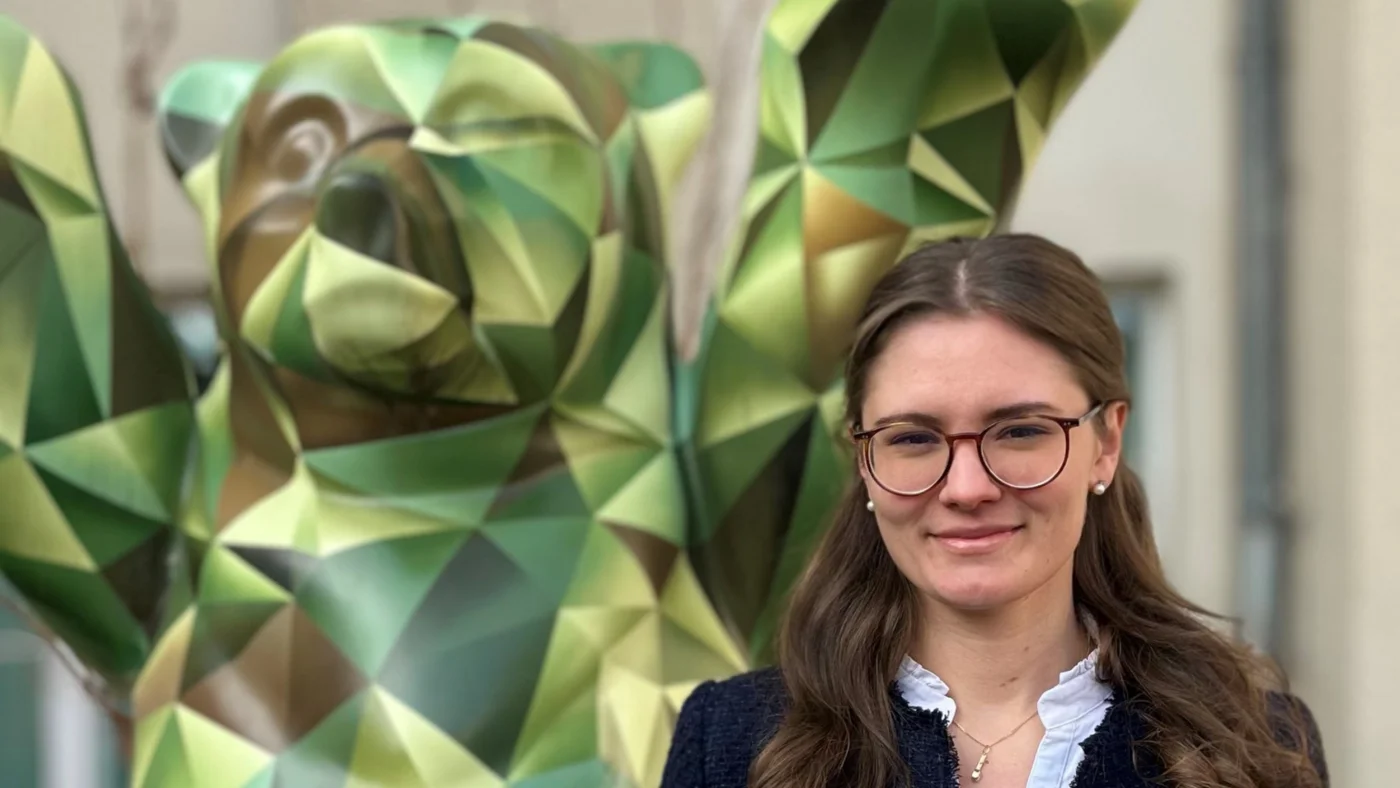
The firewall to the right is crumbling - and UW/H graduate Frederike Westphalen warns of the consequences. As a consultant for speeches and texts at the Federal Ministry of Defence, she has witnessed the political upheavals triggered by the unexpected new elections. In this interview, she explains how this has changed the work of the Ministry under the leadership of SPD Minister Boris Pistorius and where she sees the greatest challenges.
The unexpected new election has certainly brought dynamism and uncertainty to the ministry. What has changed - and how are you and your colleagues dealing with it?
If there's one thing I learned at the Ministry of Defence: Nothing is as constant as the change of situation.
The Ministry's strategic planning and the timelines of the legislative process were cancelled from one day to the next when the vote of confidence was announced. However, this did not mean that all plans had to be put on hold. On the contrary: an incredible final spurt was heralded. Operational capacities were fully utilised, procedural processes were accelerated to the maximum and - this is the special thing about the situation - majorities had to be actively campaigned for again in parliament.
What was the biggest challenge?
The break-up of the coalition meant the transition to a minority government. As a result, work suddenly had to be done not only with much more pressure, but also with more effort. The support of other parties had to be found for every new decision and a majority had to be secured in advance.
Despite all the efforts, there are still legislative proposals that can no longer be passed in this 20th legislative period. However, the drafts and their preparatory work are not out of the world. They can be prepared in such a way that the next government can seamlessly follow on from them.
In order to prevent the limited scope for action and decision-making from becoming a disaster in the vacuum between the new election and the formation of a government, the period immediately after the election must be considered before the election. This includes measures such as the early extension of mandates for foreign missions that expire in the spring. After all, nobody knows exactly when the new government will be formed and parliamentary decisions will be possible again.
Above all, however, one thing is certain: the new election is a legitimate step for our democracy. It allows us voters, as sovereigns, to exercise our power to decide what happens next. That is something very valuable.
What inspires you about people who are committed to democracy and what can each individual do to make a concrete contribution?
We have become accustomed to democracy. Young generations like mine know no other form of government from their own experience, which has made it a matter of course in our minds. Yet we forget too quickly what it once cost us. We must preserve this treasure, which was once fought for us, for future generations. And yes, that takes strength and courage. But being neutral is no longer enough.
What I want to say is that our democracy is gradually being eroded from within. On a single day, the victims of the Holocaust are commemorated in the Bundestag in the morning and in the evening, right-wing extremists cheer because the AfD has achieved a majority in parliament. This is a warning shot that could not be louder. The firewall to the right is crumbling and threatens to be torn down for good. We must prevent this before a conflagration becomes unstoppable. We have reached a point where we have to ask ourselves what role we want to play in history. The role of those who declare themselves incapable of judgement and trade their wishes and values for the will of others? Or rather the role of those who have the courage to use their own intellect in the Kantian sense? Acting courageously demands a lot, but it allows democracy to thrive.
And that is precisely what inspires me most about people who fight for our democracy - that they do not deny reality or even act according to selfish maxims, but instead use their energy and their lifetime for our well-being and values.
This is something that each and every one of us can do. Democracy makes our voice heard. So let's use our voice for democracy! By that I don't necessarily mean getting involved in a democratic party. We encounter disinformation, hatred and hate speech every day. Identifying these as such, recognising the motives behind them, clearly contradicting them and refuting them with arguments is an important contribution - even if it can be unpleasant.
Hate and hate speech are also on the rise in the digital world. The study 'Attacked & left alone' by the Technical University of Munich shows that this development is placing a heavy burden on many politically active people and is even causing some to withdraw. How do you experience digital violence in your appointment?
What I have just described, how people are committed to our common good, what they do and sacrifice for it, is something I observe every day - previously in the Bundestag and now in the ministry. At the same time, I have the feeling that criticism of these people is increasing and respect for their work is being lost. That hurts my soul, especially because their commitment is not only trivialised, but they are even accused of incompetence and malice.
Especially now during the election campaign, disinformation campaigns, destructive narratives and the financing of anti-democratic parties by foreign actors are being used as a means of exerting influence, especially on social media networks. Governments and security authorities are giving a lot of thought to protection concepts and adequate measures. However, it remains clear that this is a complex issue for which there is no one-size-fits-all solution.
Since August, you have been working for a practical year at the Ministry of Defence as a speech and text consultant for Parliamentary State Secretary Siemtje Möller. What skills or experience from your PPÖ degree have you been able to apply in your current position?
From my PPÖ studies, I clearly gained an awareness of the diversity of perspectives and approaches. When I start writing a speech, I first consider: Who is the audience? For example, is the speech aimed at parliamentarians, members of government from other nations, the defence industry or the troops directly? And almost more importantly: What do these people stand for? What motivates and moves them? Only if I understand this can I reach the audience with my words.
What was certainly also helpful was that the UW/H paid great attention to the clarity of arguments. For speechwriting, it is essential to be able to formulate logically clear lines of argument.
And what new things have you learnt?
A number of things, including, for example, the handling of diplomatic affairs, the advantages and challenges of a ministerial apparatus and the language of the military. Above all, however, I would cite the certain political sensitivity that takes place at the strategic and tactical level of ministerial leadership. This is simply something that you can't acquire through books or courses, but something you learn a little more about every day.
Where do you see yourself after the practical year? Have your experiences at the ministry already changed or sharpened your appointment goals?
I really enjoy writing speeches and texts. I think communication as a link between representatives of the people and the population is incredibly important, which is why I find my work meaningful. That means a lot to me.
The experiences I have at the Ministry of Defence are amazing. At the same time, my knowledge and understanding of security policy has reached a whole new level. As my understanding increases, so does my fascination. The big world politics suddenly feels much more tangible. Sometimes this is unsettling, sometimes it is a little intimidating. But first and foremost, it arouses curiosity for more. I consider it a great privilege to be able to work independently in such a setting.
This motivates me to want to incorporate and expand these unique experiences into my future career. In addition to my striving for greater animal welfare, the insights into the background of international relations in particular sharpen my determination to help shape politics - in whatever form, the future will show.