"I can no longer imagine my life without politics!"
Julia Brunow is passionately committed - as a PPÖ student, in local politics for the Christian Democratic Labour Union (CDA) and the CDU, and also as the office manager of a member of the state parliament.
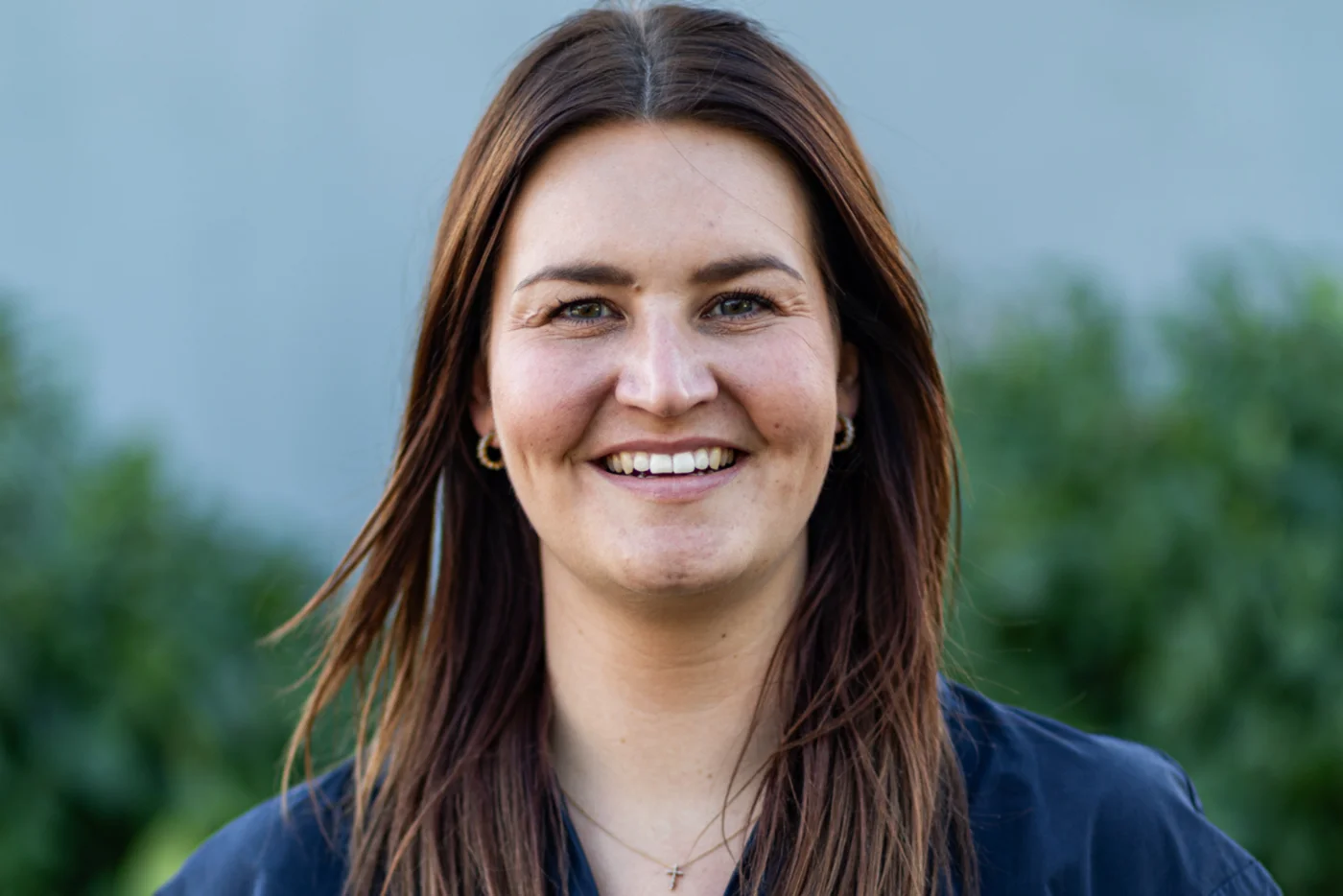
Shortly before the Bundestag elections, PPÖ student Julia Brunow also experiences negative aspects of her political commitment: as a young woman in the CDU, she encounters resistance, engages in heated discussions and experiences hostility. In this interview, she tells us why she is nevertheless passionate about social justice, a functioning migration policy and a sustainable democracy.
"I don't want to hide the fact that as a young woman in the CDU, I'm not very popular everywhere at the moment. Both in my circle of friends and with fellow students, I'm constantly having discussions and hearing accusations because of my party affiliation. The tone has definitely become harsher. I'm not currently affected by the physical attacks on colleagues and threatening phone calls, but I keep hearing about them," says Julia Brunow.
The PPÖ - Philosophy, Politics and Economics student joined the CDU in 2014 and is still involved in the party today. She is now a membership representative on the state board of the Christian Democratic Labour Party (CDA) NRW, the social policy wing of the CDU. She is concerned about the personal hostility that is increasing in view of the upcoming federal elections. She has also observed this in other democratic parties and is referring specifically to the public cake attack on FDP lead candidate Christian Lindner. "I can understand if someone doesn't like the CDU as a party. Political differences are right and important, otherwise there would be no different parties. That's what our democracy thrives on! But to condemn someone per se because they are involved in a democratic party - that has become a new extreme." She would like to see more reflection and recognition for such commitment, especially from people who are quick to judge but are not politically active themselves. Nevertheless, Julia is certain: "I can no longer imagine my life without politics and I don't think I would look for a job in the future that is completely removed from it."
The 31-year-old is fully absorbed in her dynamic job as office manager for Heinrich Frieling, a member of the state parliament. She commutes between her home office in Herdecke and the office in Düsseldorf, carries out scientific research, writes speeches, coordinates appointments and follows plenary and committee meetings.

"In the state parliament, there are 'normal' working days that start at 08:00 and end at 17:00. But then there are also phases - like the recent budget debates - when I don't get out of the office until midnight. That's part of it, but it's also what makes my work so exciting," says Julia. The flexibility she has to bring to her job benefits her in her private life: as a member of the CDA board, she can take part in joint events with the CDU in the Ennepe-Ruhr district association and support the teams during the hot election campaign phase. Julia says: "My job is a give and take - I really appreciate that. In the morning, I can work with my boss in Düsseldorf to prepare a meeting of the Committee on Internal Affairs and in the afternoon, in my honorary role, I can accompany an election campaign event for our Bundestag candidate for Herdecke and Witten, Katja Strauss-Köster."
"I am an absolute supporter of the welfare state. But the way it is currently designed, it doesn't work."
Julia BrunowPPÖ student
Supporting children and young people - with and without a history of migration - was a key motivation for Julia to enter politics eleven years ago. She found particular inspiration in former German Chancellor Angela Merkel. In the CDA, Julia is still committed to social and socio-political issues today. She is concerned about the current social situation and would like to see a change of course. Julia's view: "I am an absolute supporter of the welfare state and I am happy and grateful to live in a welfare state. But the way it is currently designed, it simply doesn't work."
The 31-year-old sees migration policy as an important lever. "In my ideal world, migration background shouldn't be a criterion. Anyone who is motivated to get involved and contribute to society is naturally a welcome part of society here in Germany," she says. She also sees it as the task of the welfare state to help people integrate and overcome trauma. "On the other hand, there are also clear consequences for all those who come here with negative intentions and take advantage of the welfare state - this naturally applies to Germans as well as everyone else. These negative examples lead us to lump people with a migration background together. As a result, those who are actually dependent on our support and open doors suffer."

In the new federal government, Julia hopes for a black-green alliance like the one in North Rhine-Westphalia. "The likelihood of that happening is currently very low, but NRW shows that it can work. We have seen from the Ampel government that there is too much toing and froing with three coalition partners. However, it is absolutely clear to me that forming a government with the extreme right is out of the question for the CDU," says the PPÖ student. Coalition theories are also the subject of her Bachelor's thesis, which she is currently finalising and working towards completing.