The 2025 Children's Sleep Award goes to Witten/Herdecke University
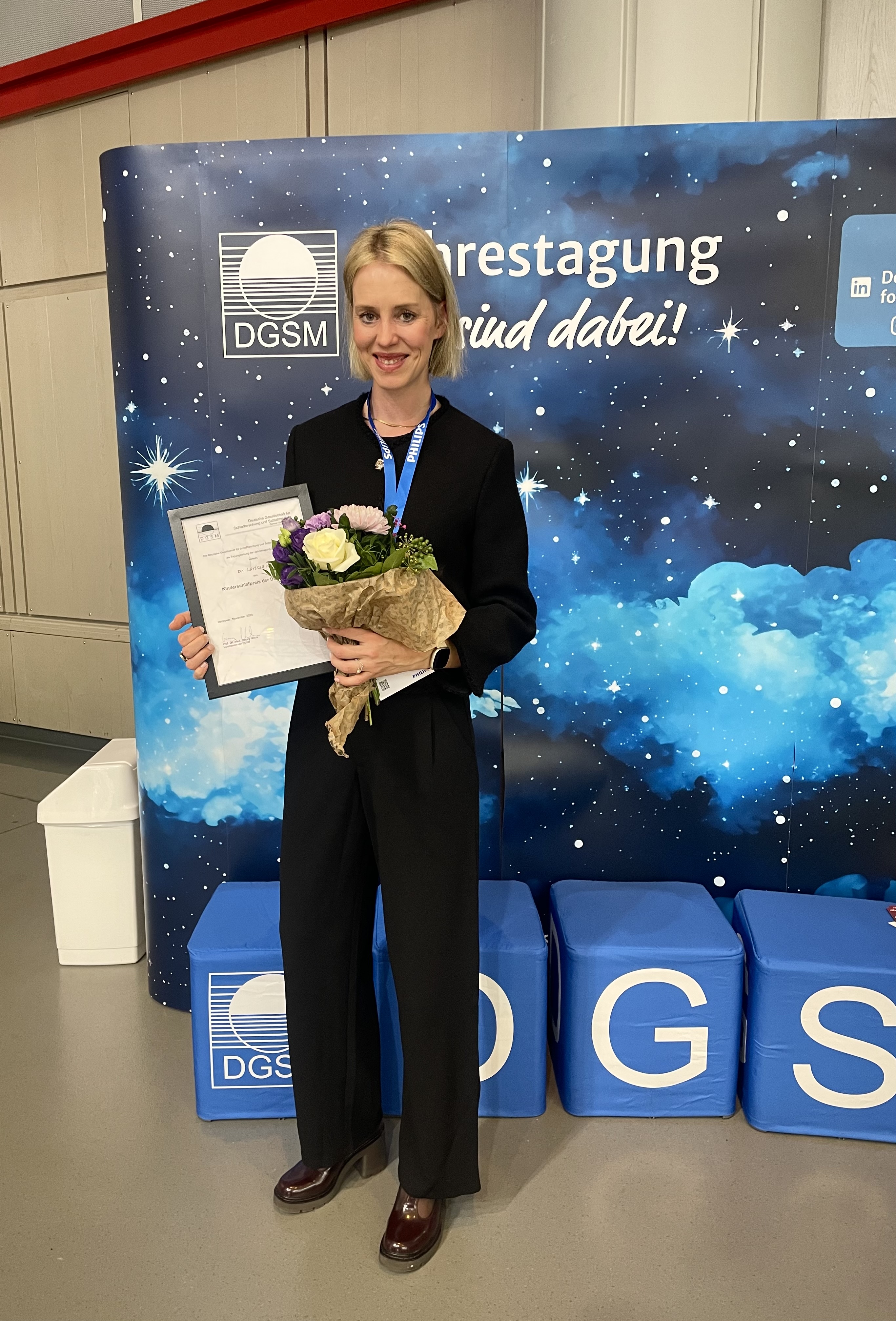
Psychologist Dr. Larissa Kubek has been honored by the German Society for Sleep Research and Sleep Medicine.

The German Society for Sleep Research and Sleep Medicine (DGSM) awards the Children's Sleep Prize 2025 to Dr phil. Larissa Kubek from the Witten/Herdecke University (UW/H). The award recognises her PhD thesis on sleep diagnostics in children and adolescents with life-limiting illnesses - a patient group that has so far received little attention in research due to high methodological hurdles. The work was supervised by Prof. Dr Boris Zernikow, Chair of Paediatric Pain Therapy and Paediatric Palliative Medicine.
Focus on a neglected patient group
Children with life-limiting illnesses (LLE) usually have complex, rare clinical pictures and often severe neurological impairments. Many are unable to speak, require long-term care or are dependent on technical support. Although sleep disorders are one of their most common problems, reliable data and diagnostic procedures suitable for everyday use have been lacking until now.
What the work achieves
For the first time, Dr Kubek is systematically investigating how frequently sleep disorders occur in children with LLE, how they manifest themselves and how they can be reliably recorded under the conditions of paediatric palliative care. The study is based on several studies at the Datteln Paediatric Palliative Care Centre - Witten/Herdecke University and affiliated hospitals.
One key finding: around half of the children examined showed at least one clearly classifiable sleep disorder. It also became clear that language barriers - for example in the case of non-German-speaking parents - make sleep medicine diagnostics more difficult.
New, practical diagnostics
One focus of the PhD thesis is the development of the Sleep Screening for Children and Adolescents with Complex Chronic Conditions (SCAC) - the first specific questionnaire for children with complex chronic conditions. The SCAC records sleep problems in a structured, time-efficient manner, even if the young patients are unable to report them themselves. The instrument has been scientifically validated and has already been translated into English.
The work also shows that actigraphy - a non-invasive, movement-sensitive measurement method - can be a practical addition or alternative to polysomnography, especially in children with severe neurological impairments. Together with questionnaires and sleep protocols, a diagnostic approach is created that incorporates both objective data and the family's perspective.
"Children with life-limiting illnesses need diagnostic procedures that take into account the special reality of their lives. The results can help to make care more structured and easier for families to understand," says Kubek.
Significance for care and research
The award-winning PhD thesis shows how a field that was previously difficult to access can be worked on in an academically sound and practical manner. It provides concrete impulses for paediatric palliative care teams, clinics and hospices to improve sleep-related diagnostics and integrate them firmly into processes.
For families, this means more orientation and more comprehensible treatment decisions. For professionals, the work provides clarity about which procedures can be reliably used in everyday clinical practice.
Photos for download
Contact person

Svenja Malessa
Press Officer
Administration | Communication & Marketing
Alfred-Herrhausen-Straße 48
58455 Witten
Room number: 2.F05