A closer look at Europe’s classrooms: Philipp Raschke is researching European educational cultures as part of his PPE Master’s degree
On the interdisciplinary Master’s programme PPE – Philosophy, Politics and Economics at Witten/Herdecke University, Philipp Raschke has the opportunity to combine his interest in education with fieldwork abroad.
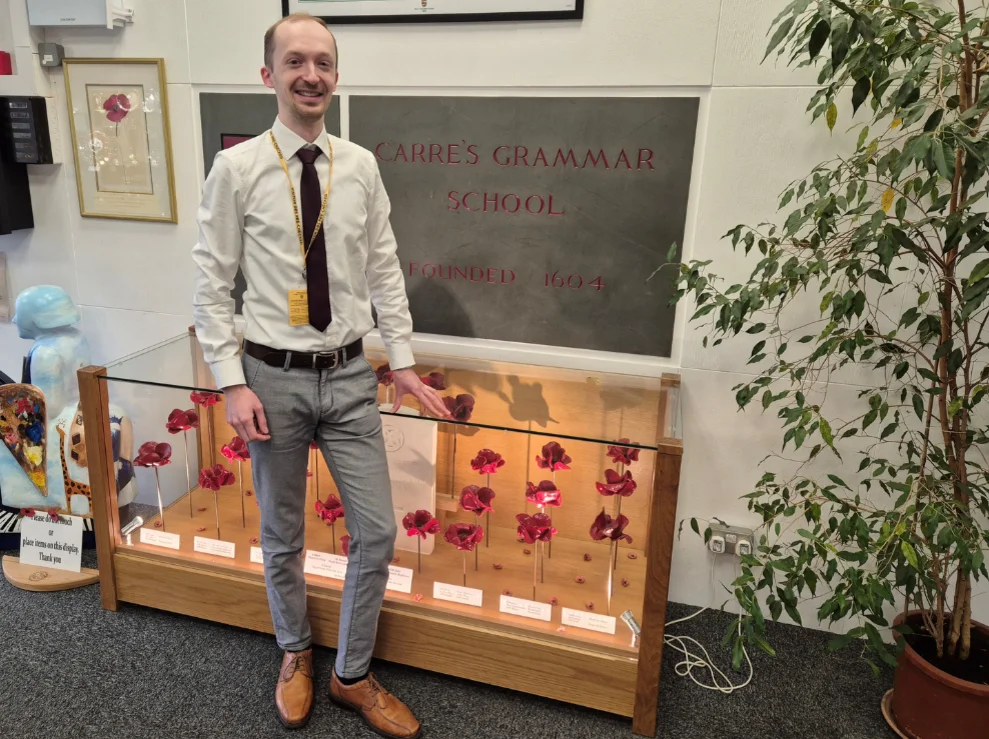
Pupils belong to different houses, collect points for their teams and compete against one another in sporting events. They wear school uniforms and, at the end of each lesson, wait in an orderly manner behind their desks for the teacher’s signal before leaving the room in an orderly fashion. Underpinning it all is the self-image of a school whose traditions date back to the 17th century. What many know only from novels about British boarding schools or fictional schools of magic, Philipp Raschke experienced first-hand in early 2026. For his Master’s thesis in the PPE – Philosophy, Politics and Economics – degree programme, he undertook a placement at a secondary school in Sleaford, England, and immersed himself in the daily life of an educational culture that was foreign to him. A few weeks later, he travelled on to Helsinki to experience everyday school life in Finland as well.
“My motivation was, and still is, to engage with education and educational systems on an international level. I’m interested in how everyday school life is organised in other countries – whether there are similarities or major differences due to individual cultural backgrounds and traditions,” says Philipp. To pursue his research, Philipp adopted an ethnographic approach: as a silent observer, he sat in on lessons, analysing teaching methods, routines and rituals, the spatial layout of the schools, and interactions between pupils and teachers. In the next step, he conducted interviews with pupils to find out how they experience their everyday school life and what education means to them. “I really enjoy working with young people. That’s why the most important thing for me was to find out what the pupils think and feel. Through the interviews, I gained very personal insights and valuable findings.”
Why PPE is the right place for his research project
When Philipp talks to his fellow students about the topic of his Master’s thesis, most of them react with surprise. Given the combination of philosophy, politics and economics, many of his fellow students operate at the intersection of these disciplines. For Philipp, however, the link to education is by no means contrived.

“Our degree programme is all about gaining a better understanding of how the world works. We examine the social, political and economic issues of our time and try to develop solutions. And education is a key part of that.”
The broad and generalist approach of the Master’s programme was one of the reasons why Philipp chose UW/H in 2023. He had previously completed his Bachelor’s degree in Management and Technology in Munich and then worked for two years at a foundation in the field of education and health. During this time, he developed a desire to underpin his practical experience with theoretical knowledge and to examine educational issues from an academic perspective. “My original plan was to study Economics at Master’s level. I simply wanted to understand more about the mechanisms of our society. But then I came across PPE and found the focus on Development Economics particularly fascinating.”
As well as the course content, he was particularly impressed by the small seminar groups and the close supervision. The support he receives from the Programme Coordinator, Prof. Dr Joachim Zweynert, who is also supervising Philipp’s Master’s thesis, is especially important to him. “We sat down for an initial brainstorming session a year ago, and he gave me some valuable insights,” says Philipp. The seminar “Institutional Economics”, which dealt with informal institutions – that is, social norms and cultural rules – was decisive for his current research topic. “I wanted to apply precisely this approach to education and examine the role culture plays in the education system,” says Philipp. Prof. Zweynert’s support for his interest in educational topics encouraged him in his endeavour. “That’s not something to be taken for granted, especially as ethnographic research in my department strays somewhat from the usual path.”
Philipp sees the freedom to shape one’s studies as a major strength of UW/H. At the same time, he values the approachability of the lecturers. “They treat us as equals and are always open to academic discussion. If you show initiative, you’ll find the doors wide open here.”

What distinguishes educational cultures in Europe and what they can learn from one another
During his field research in England and Finland, Philipp noticed clear differences between the two schools he visited. However, he stresses that his observations, made over a limited period at just two institutions, cannot be taken as representative of entire countries.
In England, he experienced a school that is known for setting high standards for its pupils, for competition and discipline, but also for a strong focus on mental health. At the same time, it enabled pupils to explore their interests through a wide range of extracurricular activities, such as trips abroad, where they could engage in charitable work and gain valuable experience.
From Philipp’s perspective, school life in Finland was characterised by a relaxed atmosphere and a high degree of self-directed learning. “The pupils have a great deal of autonomy.” He was particularly impressed by the holistic support provided to young people there. “Physical and mental health are very much integrated into everyday school life,” says the master’s student.

“There are school psychologists, a school nurse who carries out regular health check-ups, guidance teachers to help with individual timetables, youth workers and even a school coach for break-time activities.” Lunch is also completely free for all pupils in Finland. These differences in the institutional framework are particularly revealing for Philipp’s research.
Research also changes how you see yourself
The experience abroad has not only advanced Philipp’s professional development but has also strengthened him personally. “I would describe myself as rather introverted,” he says. “I enjoy meeting new people, but for me it’s always accompanied by a sense of uncertainty at first.” During his trip, however, he noticed how quickly he struck up conversations with all sorts of people. “In England, I stayed with a couple, which allowed me to forge close ties with local people. My host was a vicar, a qualified anthropologist and theologian, and he talked to me a lot about my research topic. In the schools, the informal chats with the teachers in the staff room were particularly valuable.”
He found the self-organisation particularly appealing: planning a six-week trip, establishing contacts with schools, finding accommodation and overcoming language barriers. “I love immersing myself in different contexts! But that takes courage and initiative. This experience has encouraged me to actively tackle new challenges.” For his stay abroad, Philipp received funding through a scholarship from the German Economy Foundation (sdw).
Future plans between the classroom and an academic career
What comes next after his Master’s degree is still open for Philipp. The idea of a teaching career has been on his mind for some time. At the same time, he can now also envisage an academic career. “Up until now, I’d ruled out doctoral studies because I didn’t want to do research on my own. But in a social setting like the one I’ve experienced now, I’ve reassessed the idea. There are two conferences on educational ethnography taking place in England this year, which I’d love to attend to exchange ideas with other researchers in this field who do it full-time.” Whether in the classroom or in research – education remains a subject close to Philipp’s heart, one he intends to pursue further.