WittenLab. Zukunftslabor Studium fundamentale
Research Area Collective Trauma
Research into collective trauma integration
On the occasion of the 75th anniversary of the liberation of the German concentration and extermination camp Auschwitz on 27 January 2020, Holocaust survivor Batsheva Dagan posed an interesting question in her speech: “Where was everyone? Where was the world that could see and hear this, and yet did nothing to save all those thousands?” (Morris, 2020).
Her question served as a powerful warning to humanity in the 21st century, a time when we are constantly confronted with terrible crises such as climate change, the refugee crisis, the political shift to the right, nuclear weapons, global poverty, the Covid-19 pandemic, and so on. In this time of global crisis, questions such as those posed by Ms Dagan should be asked time and again: “Where are you? Where is the world that knows, but does nothing?” Are we witnesses to the world?
When we see people’s suffering on the news – children starving in African countries, or a grieving mother holding her lifeless child in her arms in Syria – many people feel compassion and sympathy. Such tragedies are common in today’s world, but the impression they leave is not lasting, for the overwhelming flood of such news has desensitised many people to the pain and suffering in the world. This kind of passive, everyday attitude is deeply rooted in an individualistic dualism: I (the subject) and the world (the object) are separate. However, global issues such as climate change and the refugee crisis have led many people to realise that we are, in fact, interconnected. This enables us to bear witness to the suffering of others with the conviction that we are not separate from them. Instead, ‘we’ and ‘they’ are part of a larger system. This form of cognitive and emotional observation can be described as empathy, which has been the subject of intensive research in psychology and the neurosciences in recent years (cf. Bateson, 1991, 2009).
However, one critical question remains: is empathy enough? We and the world are interconnected, but in the ‘lived world’ (Nishida, 1911) we remain fragmented and do not experience our connection as such. I may see myself as a separate, closed system and be unable to recognise a larger, transcendent system in which ‘I’ (the subject) and the world (the object) are interconnected, for ‘history repeats itself and there is nothing we can do about it’ (Trilling, 2018). When someone from Western society sees a crying child in Syria on the news, they may feel empathy and compassion for that child. At the same time, they may feel helpless and powerless, experience a sense of despair, and have a peripheral sense of connectedness with the world.
How can one truly be present – mentally, emotionally and physically – with all people and living beings who are experiencing intense and profound moments of struggle, doubt and suffering? The question posed above – ‘Are we witnesses to the world?’ – is therefore not easy to answer. This research group aims to explore in greater depth what witnessing entails and to develop the capacity for witnessing as a means of collective trauma integration.
Person responsible for the research area
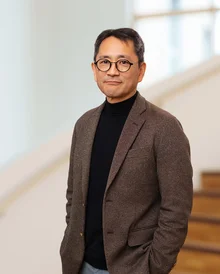
Prof. Dr.
Kazuma Matoba
Adjunct Professor
WittenLab. Zukunftslabor Studium fundamentale | Research Area Transformation
Adjunct Professor
Faculty of Management, Economics and Society (Department of Philosophy, Politics and Economics) | Chair of Moral and Political Philosophy
Alfred-Herrhausen-Straße 50
58448 Witten
Research
Many social and global problems, such as the refugee crisis, climate justice, racism and terrorism, have their roots in serious, unresolved historical traumas. These traumas were experienced by one or more members of a family, group or community and may have been passed down from one generation to the next via epigenetic factors.
Phenomena of collective trauma can be described more comprehensibly through their interpretation by quantum social science (cf. Wendt, 2016; Matoba, 2022). This interpretation provides a social pathology that offers methodological recommendations (treatment methods) for social therapy.
One possible example is the Collective Trauma Integration Process (CTIP) developed by Thomas Hübl (2020), a method for restoring fragmentation through the processing and integration of individual, inherited and collective traumas. This research unit focuses on methodological considerations for building a new culture through the integration of collective and intergenerational traumas, based on collective trauma research in psychology, sociology and quantum social science.
Current research projects
Publications
Teaching
Through a range of seminars and workshops at the Faculty of Management, Economics and Society and as part of the Studium fundamentale programme, students can exchange and help shape new ideas, strategies and tools that will assist them in becoming mature, global citizens at a time of worldwide upheaval and transformation.
The team of the Research Area Transformation
Adrian Wagner (doctoral student, Germany)
Research specialisation: Collective trauma integration and the great transition to sustainability: A case study of the practice of conscious social witnessing in the Pocket Project.
Christopher Then (project coordinator, Germany)
Research specialisation: The role of spirituality in activism, witnessing and social movements; Sacred Activism.
Wouter Extercatte (doctoral student, Netherlands)
Research specialisation: Ethics, action, dialogue: a theoretical exploration in the spirit of a bottom-up reorganisation of society.