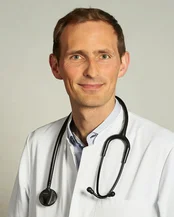
Dr. med. Priv.-Doz.
Leonard Fehring
Researcher
Faculty of Health (School of Medicine) | Chair of Health Informatics
Heusnerstraße 40
42283 Wuppertal
Orcid ID: https://orcid.org/0000-0002-3322-3724
School of Medicine
Chair of Internal Medicine IThe Chair of Internal Medicine I at Witten/Herdecke University is based at the Helios University Hospital Wuppertal, Medical Clinic 2 for Gastroenterology and Hepatology, Diabetology and Endocrinology. The Chair is held by the clinic’s Chief Physician, Professor Christian Prinz, MD.
The Medical Clinic 2 cares for a wide range of patients with internal medicine conditions, with a focus on gastroenterological conditions (particularly diseases of the pancreas and biliary tract) and diabetes. However, the clinic also treats many patients with conditions relating to conservative cardiology.
Further information on the range of services and the staff can be found on the clinic’s website.
Doctoral students and candidates for postdoctoral lecturing qualifications are always welcome.

Prof. Dr.
Chair Holder
Faculty of Health (School of Medicine) | Chair of Internal Medicine
Heusnerstraße 40
42283 Wuppertal
In particular, this research is investigating the predictive role of these molecules – possibly even on the basis of blood samples – in determining whether visceral carcinomas are present.
Contact: Prof. Christian Prinz
In this project, we are evaluating the role that artificial intelligence (AI) can play in the drafting and quality assurance of doctors’ reports. To this end, we are investigating potential applications on the one hand, and attempting to establish quality criteria for AI on the other.
Background: Communication between healthcare professionals and patients is crucial for the effective prevention, treatment and management of diseases. Discharge reports are particularly important in this context, as they contain key information such as diagnoses, treatment plans, medication and recommendations for follow-up care. These reports are often written in medical jargon that is difficult for laypeople to understand, which poses a particular challenge for patients with low health literacy.
Project objective: The aim of this project is to significantly improve the comprehensibility of hospital discharge reports using large AI-based language models (Large Language Models, LLMs). By applying these technologies, medical texts are to be translated into language that patients can understand, and personalised, lifestyle-related recommendations are to be added. By improving the comprehensibility of medical documents, we hope to achieve better patient compliance and satisfaction, a reduction in misunderstandings and errors in aftercare, and an overall improvement in health literacy among the recipients of these reports.
Contact: Prof. Christian Prinz
Funded by the internal research funding programme of Witten/Herdecke University, our aim is to develop a standardised, interoperable and digital diagnostic template for hospital discharge summaries – similar to the nationwide standardised medication plan. This is intended to be compatible with the electronic patient record via the Medical Information Objects of the National Association of Statutory Health Insurance Physicians (Kassenärztliche Bundesvereinigung) and to serve as the central hub of cross-sectoral communication.
Background: Alongside the medication plan, a well-maintained diagnostic header is at the heart of the hospital discharge summary. In Germany, there is currently no standardised format for the content and structure of such diagnostic headers. Consequently, there is a lack of interoperability, which prevents efficient digital exchange. Important patient information is often unavailable at the crucial moment; it is not possible to automatically transfer key information into the IT systems of the treating practitioners, and compiling the diagnosis header involves a significant administrative burden.
Project objective: The aim of this research project is to define the content requirements for a standardised digital diagnosis header, similar to the nationally standardised medication plan. This digital diagnosis header is to be based on the preferences of the medical profession and tailored to clinical reality and day-to-day care in practice. The objectives of the first three project phases are:
(1) To identify cross-disciplinary ‘best practices’ in Germany regarding the structure and content of the diagnosis header by analysing discharge summaries from various institutions.
(2) To determine the preferences of doctors in Germany regarding the overarching structure, content and level of detail of the diagnosis header in discharge summaries.
(3) To create documentation templates for selected clinical conditions by reaching a consensus on the specific information elements to be included in the diagnosis section for each condition.
Contact: Prof. Christian Prinz
In the past, our department has conducted extensive research into the role of digital health applications (so-called ‘apps on prescription’, or DiGAs) and other digital health solutions. This has resulted in numerous studies on acceptance, usage patterns among various stakeholders in the healthcare system, and cost-effectiveness.
Background: Thanks to continuous technological progress, digital health solutions have the potential to make healthcare more effective, efficient and cost-effective. Partly due to the flexibility in terms of time and location in the provision and use of such solutions – and the resulting easier access – digital health solutions can be deployed, either as a substitute or a complement, in situations where conventional healthcare services are not accessible or are difficult to access for certain population groups. Furthermore, the networking of relevant stakeholders within the healthcare system – in so-called digital health ecosystems – can enable additional benefits and improved healthcare provision for society.
Project objective: The aim of this project is to examine the added value of digital health solutions for individuals and society from both a medical and an economic perspective. The aim is to create transparency by researching the acceptance, intention to use, preference and cost-effectiveness of digital health applications. The perspectives of various stakeholder groups (doctors, users, health insurance providers, providers of digital health interventions, etc.) will be taken into account in order to gain insights into the potential of health ecosystems.
Contact: Prof. Christian Prinz
All Helios hospitals feed their billing data – and, in some cases, their clinical care data – into a shared database. With data from over 80 hospitals, this database is one of the largest of its kind in Germany and offers enormous potential for research projects aimed at further optimising the current state of healthcare provision. Our research aims to optimise medical care in the field of visceral medicine through the use of such big data.
Background: Medical care is constantly evolving as a result of new medical insights, such as updated guidelines and new treatment options, as well as political changes such as the hospital reform currently being discussed in the media and a greater shift towards outpatient care. The use of big data makes it possible to assess the impact of these changes and identify further areas for optimisation.
Project objective: Two current projects are presented in brief:
Contact: Prof. Christian Prinz

All publications from the Chair of Internal Medicine I at UW/H are listed in the university bibliography.
The Chair of Internal Medicine I is part of the model medical degree programme at Witten/Herdecke University. We support students throughout their internal medicine training across the entire clinical phase. To this end, we offer two block placements in the 5th and 9th semesters, with intensive one-to-one supervision of students on the ward. During the four-week block placements, students gain an insight into day-to-day ward work and endoscopy. They acquire key skills such as conducting a structured medical history, performing a physical examination, delivering bad news, and carrying out simple practical procedures such as ascites punctures and writing discharge summaries. Furthermore, a rotation to the central A&E department is possible. The practical block is complemented by a daily two-hour lecture on various internal medicine conditions. The practical block concludes with a practical final assessment.
As part of the Klinik.POL seminar, we hold an interdisciplinary main lecture on metabolic and digestive disorders.
In addition, the department is actively involved in problem-based learning in small groups (‘POL seminars’).
During their clinical year, students take on a fixed role within our team and are thoroughly prepared for their future working life. Weekly clinical year seminars are held to support students in their exam preparation.
The Chair has summarised the fundamentals of practice-oriented teaching in internal medicine in the Springer textbook *Basiswissen Innere Medizin*. To complement this, a project is currently underway in which students, under medical supervision, are developing a textbook containing case vignettes for use by fellow students to aid preparation for examinations.
The department conducts numerous state examination sessions each semester.
Details of the courses can be found in the current course catalogue.
Dr. med. Priv.-Doz.
Researcher
Faculty of Health (School of Medicine) | Chair of Health Informatics
Heusnerstraße 40
42283 Wuppertal
Orcid ID: https://orcid.org/0000-0002-3322-3724