School of Medicine
Chair of Surgery II
Teaching and research closely linked to day-to-day clinical practice
The Chair of Surgery II at Witten/Herdecke University is based at the Helios University Hospital Wuppertal, Centre for Surgery. The dialogue-based methods used in Witten/Herdecke University’s teaching approach promote teaching that is closely aligned with everyday clinical practice. The aim of teaching on the model degree programme in Medicine is to enable students to examine a patient surgically, assess the clinical picture and further diagnostic steps, and be familiar with the most important surgical treatments.
Chair holder
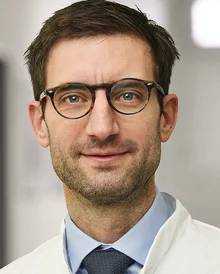
Prof. Dr. med.
Florian Gebauer
Chair Holder
Faculty of Health (School of Medicine) | Chair of Surgery II
Heusnerstraße 40
42283 Wuppertal
Research
Surgical research aims to gain a better understanding of the aetiology of surgical conditions and to continuously improve and expand diagnostic and therapeutic approaches. This is achieved through both experimental research ‘in the test tube’ and clinical research ‘at the patient’s bedside’. Clinicians play a central role in this, as only they are constantly confronted with the most important questions through their daily interaction with patients.
Surgical research should be guided by clinical practice and concern for patients. The problem must determine the method, not the method the problem.
Various research methods are employed at the Chair of Surgery II. The department has its own ‘Molecular Oncology’ laboratory, which is equipped with all standard procedures for gene and protein analysis, including its own FACS system. Here, surgical research questions from the field of basic research are addressed. In some cases, we carry out these projects in collaboration with other research laboratories both in Germany and abroad.
Particularly in the area of clinical research, we maintain close collaboration with other surgical departments, for example with the Department of Surgery at Berlin-Buch in the investigation of ‘sentinel lymph nodes in colorectal cancer’. In the field of sepsis research, multicentre clinical trials are underway to investigate new approaches to sepsis treatment, in collaboration with the pharmaceutical industry (the ASIS trial).

Publications
All publications by the Chair of Surgery II at UW/H are listed in the university bibliography.
Teaching
The surgical component of the model degree programme in medicine comprises various elements. The theoretical foundations are integrated into ‘problem-based learning’ (PBL), the seminars held during the so-called ‘theory periods’, and the seminars during the clinical block placements (core blocks for surgical subjects KBOF 1 and KBOF 2).
We teach the practical fundamentals of surgery in the two compulsory core blocks, KBOF 1 and KBOF 2, as well as in compulsory-elective blocks.
The Chair holders of Surgery in the School of Medicine, clinical lecturers from affiliated hospitals, staff from the Office of Student Affairs, and students have formed a ‘Surgery Working Group’. The aim is to provide students with as consistent a level of knowledge as possible. Nevertheless, in individual cases, it is also up to students to take the initiative to get more involved, set their own priorities or request specific content.
Clinical block training at the Chair of Surgery II
When does a block day start and end for students? How much time is set aside for lectures and seminars?
The block day for students begins at 07:15 with ward rounds. It ends after the afternoon briefing at around 15:30. Lessons take place during the block sessions from 13:00 to 15:00.
How many placement places do you offer? How many students are assigned to each ward? Is a rotation possible or preferred?
We offer a minimum of two and a maximum of four block placements. One student is assigned to each ward. Rotation is possible.
What are your expectations and requirements of the students? What prior knowledge is desirable for taking part in the block?
Students on the core module ‘Surgical Subjects I’ should have textbook-level knowledge of taking a medical history and conducting a physical examination, and should have read a surgical textbook, in particular the general section on ‘Surgery’. For the core module ‘Surgical Subjects II’ (KBOF 2), self-study of a surgery textbook is recommended.
What reading material would you recommend for preparing for and following up on the practical block?
A medical history textbook, as well as a textbook for the ‘Surgery’ module – for example, *Schumpelick* published by Enke-Verlag or *Chirurgie für Studium und Praxis* by M. Müller, Medizinische Verlags- und Informationsdienste. Further reading material is kept on hand and made available to students.
Does the clinic offer students the opportunity to work on research projects or to pursue doctoral studies?
Yes, that is a possibility.
Are there any placements available for the practical year?
The clinic can teach five clinical year students at the same time.
Clinic
Helios University Hospital Wuppertal is the teaching hospital of Witten/Herdecke University. It is the largest hospital in the Bergisches Land region and one of the largest comprehensive care hospitals within the Helios Kliniken group. The hospital has 1,051 beds and 26 specialist departments. Each year, the hospital admits around 50,000 inpatients and carries out approximately 100,000 outpatient treatments.
In addition to the standard range of general, visceral and vascular surgery, the Surgical Centre places particular emphasis on oncological surgery for gastrointestinal tumours.
We offer the full range of university-level oncological surgery, including surgery for malignant tumours of the oesophagus and the pancreas. Our Oncology Centre is certified by the German Cancer Society as a Visceral Oncology Centre specialising in pancreatic, oesophageal/gastric and colorectal cancer.
The team at the Chair of Surgery II
| Dr Anke Meyer, Chief Physician at the Department of Endocrine Surgery | · anke.meyer@helios-gesundheit.de |
| Dr Konstantinos Meletiadis, Chief Physician at the Department of Vascular Surgery | +49 202 896-1816 · konstantinos.meletiadis@helios-gesundheit.de |
Senior Consultants at the Department of General, Visceral and Endocrine Surgery
| Dr David Varga-Szabó, Lead Consultant | david.varga-szabo@helios-gesundheit.de |
| Dr Ahmed Abdelsamad, Lead Consultant | Ahmed.Abdelsamad@uni-wh.de |
| Dr Johannes Dörner, Managing Senior Consultant | johannes.doerner@helios-gesundheit.de |
| Dr Herbert Spelter | herbert.spelter@helios-gesundheit.de |
| Dr Christoph Mallmann | christoph.mallmann@helios-gesundheit.de |
| Rose Seiberth | seiberth.rose@helios-gesundheit.de |
Senior Consultants at the Department of Vascular Surgery
| Hannes Höning | hannes.hoening@helios-gesundheit.de |
| Houaida Sairawan | houaida.sairawan@helios-gesundheit.de |
| Dr Felicitas Tumczack | tumczack.felicitas@helios-gesundheit.de |
Specialists at the Department of General, Visceral and Endocrine Surgery
| Dr Sandra Denecke, MD | sandra.denecke@helios-gesundheit.de |
| Dr Jaswinder Singh | jaswinder.singh@helios-gesundheit.de |
| Leyla Ünal | leyla.ünal@helios-gesundheit.de |
Specialists at the Department of Vascular Surgery
| Svenja Tolksdorf | svenja.tolksdorf@helios-gesundheit.de |