
School of Medicine
Chair of Neurology II
Teaching and Research at the Department of Neurology at Dortmund University Hospital
The Chair of Neurology II at Witten/Herdecke University is based at the Department of Neurology at Dortmund University Hospital.
Dortmund Hospital itself, as a hospital affiliated with Witten/Herdecke University, is a maximum-care facility with 25 specialist departments and 5 further institutes – the largest municipal hospital in North Rhine-Westphalia. With approximately 1,400 beds, it treats around 65,000 in-patient patients annually; approximately 250,000 people visit us as outpatients. This is only possible thanks to the collaborative efforts of just under 5,000 staff members.
We in the Department of Neurology are a team of around 30 doctors, as well as therapists, nursing staff, support staff, students and trainees. We all share the same goal: to provide outstanding patient care in a friendly, respectful, motivating and cheerful atmosphere.
The Neurology Department has around 90 beds. These are spread across a dedicated neurological intensive care unit (10 beds + 4 intermediate care beds), a supra-regional stroke unit with twelve beds and two general wards. A large neurology outpatient clinic, including specialist clinics (infusions, neuromuscular disorders, botulinum toxin, ultrasound, MS/neuroimmunology, dementia, epilepsy, movement disorders, headaches), treats many patients every day.
Together with the Departments of Neuroradiology (Prof. Stefan Rohde) and Neurosurgery (Prof. Oliver Müller), we form the Neurocentre. We also act as the coordinating centre for the Ruhr-East Neurovascular Network (NVNR-O), a consortium of clinics dedicated to providing the best possible care for patients with vascular diseases (stroke, cerebral haemorrhage, aneurysms, vascular malformations).
The three departments work hand in hand. We collaborate very closely with the other specialist departments, in particular with the Departments of Vascular Surgery, Cardiology, Ear, Nose and Throat, and the Department of Ophthalmology.
We support the Neuro-Oncology Centre with our neurosurgical expertise: the centre treats all types of tumours of the central and peripheral nervous system in collaboration with the Westphalian Cancer Centre.
Further information is available on the hospital’s website
Chair holder
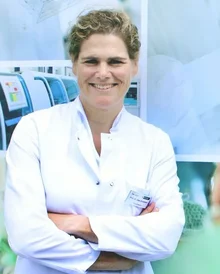
Prof. Dr. med.
Gisa Ellrichmann
Chair Holder
Faculty of Health (School of Medicine) | Chair of Neurology II
Director of the Clinic for Neurology, Klinikum Dortmund gGmbH
Research
Alongside clinical work, research is a key part of a university hospital’s remit. The majority of our projects involve clinical research with the direct aim of improving the diagnosis and treatment of various neurological disorders.
PhD topics for which you can submit an application are presented on a quarterly basis. From 2025, these sessions will take place on the first Wednesday of each quarter from 2.00 pm to 3.30 pm at Dortmund University Hospital, the Neurology Library, Building C, 1st floor (opposite Prof. Ellrichmann’s office).
We endeavour to facilitate time off for research projects for doctors with a scientific focus.

Publications
All publications by the Chair of Neurology II at UW/H are listed in the university bibliography.
Clinical work
What do we do?
We live and breathe neurology.
Whether it’s acute situations (e.g. stroke), ongoing care for a known neurological condition, or investigating symptoms of as yet unknown cause – we support patients and stand by their side.
Emergencies are treated in our interdisciplinary central A&E department. We work closely with the ambulance service and neighbouring hospitals. Planned admissions are coordinated through our admissions management team, whilst further appointments are arranged via our (specialist) outpatient clinics.
People are at the heart of what we do – we strive to balance humanity with the challenges of everyday life: performance expectations, efficiency, the shift towards outpatient care, cost calculations, staff recruitment …
The diagnostic laboratories are equipped with state-of-the-art technology: electroencephalography, electromyography, duplex and Doppler sonography, echocardiography, tremor analysis, transcranial magnetic stimulation (TMS, rTMS), evoked potentials and OCT are available. With the help of the three MRI scanners operated in-house by the Institute of Neuroradiology, state-of-the-art imaging techniques – including functional MRI and AI analyses – can be utilised. Genetic testing is carried out in collaboration with various partner clinics.
We place great importance on the training and recruitment of new staff. We are committed to providing thorough induction, further training, professional development, fostering independence, and maintaining a positive and supportive working environment.
Shall we get to know each other?
How can you get in touch with us?
Tel: +49 (0) 231 953 - 21810
Fax: +49 (0) 231 953 - 21039
Send an email
Neurology Outpatient Clinic
– Specialist Consultation Hours, Specialised Diagnostic Tests,
Tel: +49 (0) 231 953 - 21815
Fax: +49 (0) 231 953 - 20661
Consultation hours:
Mon–Fri 08:00 – 16:00
Klinikzentrum Mitte
Beurhausstraße 40
44137 Dortmund
Teaching
Why neurology?
Making a diagnosis is often like putting together a jigsaw puzzle: medical history, thorough physical examinations and specific diagnostic procedures help us to piece together the individual pieces of the puzzle to form a complete picture.
In few other specialist fields is knowledge advancing as rapidly as in neurology. Scientific discoveries are opening up new avenues of treatment. Solutions are now available for neurological conditions that were previously considered untreatable – and developments are progressing at a rapid pace.
Simple procedures (talking, observing, examining) combined with knowledge of neuroanatomy form the basis of diagnosis. Imaging techniques, laboratory tests and cerebrospinal fluid analyses, aided by state-of-the-art diagnostics, provide us with ever more detailed insights into the nervous system. Artificial intelligence is becoming increasingly integrated into medicine and supports us in our work.
So why neurology? … because it is a specialism in which practical skills, analytical thinking, curiosity, vigilance, empathy, an understanding of human nature, technology, dynamism and perseverance are wonderfully combined.
When? How? Where?
It’s never too early to start neurology …
Simply get in touch with us:
- as a school pupil for a work experience placement
- as an intern in any healthcare profession
- as a clinical student
- as a final-year medical student
- as a patient
- as a visitor
- or as a prospective visitor
Tel: +49 (0) 231 953 - 21810
Fax: +49 (0) 231 953 - 21039
Neurology Department Secretariat Prof. Dr Gisa Ellrichmann-Wilms
Stephanie Pellecchia: stephanie.pellecchia@klinikumdo.de
Studies
In line with the principles of Witten/Herdecke University, we shape the future together with our students, combining commitment, innovation and community. We do not merely provide young people with specialist training; we also encourage them to put their own ideas into practice and to act with commitment and effectiveness – both at the university and beyond.
We introduce students on the model degree programme in medicine to neurology at an early stage: in the third semester, we hold the ‘Day in Neurology’, to which we warmly invite you. You will spend a whole day with us and gain an insight into our day-to-day work.
Throughout the third semester, the neurology examination course takes place: here, students learn, in a systematic and detailed manner, examination techniques, the interrelationships with neuroanatomy and neurophysiology, and how to classify neurological conditions. In addition to lectures, we teach in small groups under the guidance of tutors and lecturers.
Students consolidate and expand their knowledge through block placements in the 7th semester. At Dortmund University Hospital, we welcome ten students at a time: we integrate them into our work. They apply what they have learnt so far to patients, conduct medical history interviews independently, practise performing a comprehensive neurological physical examination, and are involved in diagnostic and therapeutic decisions. To ensure the most comprehensive insight possible, they rotate between wards according to a fixed schedule, gaining experience in the A&E department, the intensive care unit, the stroke unit, general wards, the functional diagnostics department and even neuroradiology and neurosurgery. On our seminar days, we (the Head of Department, senior consultants and specialists) provide the necessary theoretical knowledge.
Students have access to a range of multimedia learning resources: face-to-face and online training courses, specialist journals, textbooks, the intranet library and the skills lab.
Any questions?
Prof. Dr med Gisa Ellrichmann-Wilms
Email: gisa.ellrichmann@uni-wh.de
Consultation hours: By appointment
Practical year (PJ)
PJ students are integrated into day-to-day clinical practice and, following appropriate induction, care for patients independently under supervision. Through a rotation programme, they become familiar with the various departments and gain an initial understanding of lumbar punctures, ultrasound techniques, and electroneurography and electromyography. Through daily or weekly interdisciplinary conferences (covering neuroradiology, neuroimmunology, neuro-oncology and neurovascular medicine), they gain an in-depth insight into neurology and closely related specialities. Through one-to-one tuition or in very small groups, participants in the final-year seminar are provided with personalised further training.
Further training
In addition to conferences – which can also be held online – weekly in-house training sessions covering various areas take place.
In addition, annual training courses and symposia are held (excerpt):
- Neurovascular Symposium (Dortmund)
- Neurokolleg (Dortmund, including the call for entries for the Science Prize)
- Neuroforum (Dortmund)
- Stroke Ideas Workshop (Dortmund)
- DW2 (Witten)
- Neurology Meets Paediatrics (Dortmund)
- Neurology-Nephrology Symposium (Dortmund)
Anyone interested is warmly invited to the annual congress of the German Society of Neurology in Berlin: many of the courses and events are aimed at young neurologists.
Links to the flyers for the respective events will be provided once they are finalised – further information on the events is also available on the clinic’s website.
Details of the events organised by the two Chairs can be found in the course catalogue for the model medical degree programme.
Careers in neurology: Training and further education
The Department of Neurology at Witten/Herdecke University Hospital offers all interested doctors a high-quality, very comprehensive neurological training programme. Our detailed induction programme makes it easy to start your career or make lateral entry into the profession.
We are deeply committed to helping you balance work, family and leisure time: we offer flexible working hours and provide support at every stage of your training and further education.
Specialist training follows a rotation-based programme – meaning that trainees pass through all wards during their training: general wards, the central A&E department, the stroke unit, the intensive care unit, the functional diagnostics department and the outpatient clinic. If desired, we offer the opportunity to gain an insight into clinical practice or into related specialist departments (neuroradiology, neurosurgery). In regular training reviews, we discuss shared ideas, aspirations and the progress of your training.
Regular participation in internal and external continuing professional development programmes, courses and conferences is available.
Specialist qualifications can be obtained whilst still undergoing specialist training. We hold training accreditation from the German Society for Clinical Neurophysiology and Functional Imaging (DGKN) for electrophysiological methods and from the German Society for Ultrasound in Medicine (DEGUM) for ultrasound diagnostics in neurology. Optionally, you can obtain the certificate in qualified botulinum toxin therapy from the German Society of Neurology (DGN) and/or the EEG certificate.
We look forward to receiving your applications or getting to know you during a work shadowing placement!