School of Medicine
Chair of Sociology
System-theoretical and phenomenological perspectives on medical treatment, psychotherapy and counselling
At the Chair, we focus on investigating the relationship between the self and the world in the fields of organisation and management, psychotherapy, and spiritual and religious training. Another area of research centres on the significance of artificial intelligence for our future experiences and actions. In doing so, we seek to bridge the gap between sophisticated sociological theory-building and qualitative or reconstructive social research.
Drawing on Niklas Luhmann’s systems theory and the work of Gotthard Günther, we have developed the methodology of contextural analysis and are testing it across various fields of research. Examples include organisational analysis, research into therapy, the study of the relationship between the self and the world in religious and spiritual practices, and the reconstruction of professional practice under the complex conditions of contemporary society.
We are also seeking connections with other theoretical traditions that address the complexity of modern relationships between the self and the world. In addition to sociological systems theory, we are also interested in the work of the cyberneticists Gregory Bateson, Norbert Wiener and Heinz von Foerster, as well as the biologists Humberto R. Maturana and Francisco Varela. We also seek connections to American pragmatism, the work of Bruno Latour, Pierre Bourdieu’s theory of habitus, Maurice Merleau-Ponty’s body-oriented phenomenology, and Gotthard Günther’s work on polycontexturality.
Another key area of interest lies in the sociological reconstruction of forms of scientific thought in biology and physics.
Chair holder
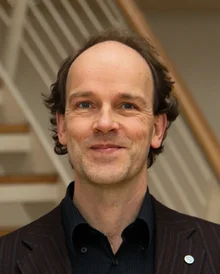
Univ.-Prof. Dr.
Werner Vogd
Chair Holder
Faculty of Health (School of Medicine) | Chair of Sociology
Programme Coordinator M.A. Ethik und Organisation
Faculty of Health (School of Medicine)
Alfred-Herrhausen-Straße 50
58455 Witten
Room number: C-2.329
Research
The Chair’s current research priorities are:
- Qualitative methods and systems theory in therapy and organisational research
- AI ethics in large organisations and companies
- Sociality with intelligent machine actants
- Documentary method and contextural analysis
- Body-oriented phenomenology and polycontexturality
- Quantum theory and sociological systems theory in dialogue
- Social conditions of therapy and medical treatment
- Spirituality and implicit ethics
Methodologically, our department advocates a praxeological perspective which, following Ralf Bohnsack, directs an analytical focus towards social and organisational practices. This gives rise to descriptions of social phenomena – such as labour and client relationships in business, therapy, coaching and counselling – which may differ significantly from the conventional self-descriptions of these social spheres. A sociological practice understood in this way can help to loosen entrenched views of reality, thereby opening up new, more practice-oriented perspectives with regard to counselling, facilitation and social development.
Another key focus of the Chair lies in the intersection of digitalisation and social practice: what difference does it make to communicate with artificial intelligence rather than with a human being? How are relationships between human and non-human actors shaped? What ethical standards apply when, for example, we encounter intelligent, language-capable avatars in virtual realities?
Current research projects

Publications
All publications by the Chair of Sociology at UW/H are gradually being included in the university bibliography.
Teaching
In our seminars, we address the following questions, amongst others:
- What are wholesome relationships with oneself and the world?
- What is implicit ethics?
- Are these relationships wiser than our consciousness?
- Why is it sometimes good for the right hand not to know what the left is doing?
- Why do organisations not do what they claim to do?
- How do our experiences and actions change when we interact with artificial intelligence and virtual reality, and how can this be utilised in therapeutic processes?
Last but not least, it is always a matter of formulating one’s own social science questions and developing a methodological intuition for possible answers.
The team at the Chair of Sociology
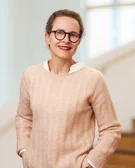
Kerstin Pospiech-Form , M. A.
Secretariat
Faculty of Health (School of Medicine) | Chair of Sociology
Alfred-Herrhausen-Straße 44
58455 WittenRoom number: FEZ-D.246
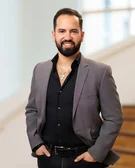
Georgios Alexiou , M. A.
Researcher
Faculty of Health (School of Medicine) | Chair of Sociology
Stockumer Straße 12
58453 WittenRoom number: 2.328

Hannah Cramer , M. A.
Researcher
Faculty of Health (School of Medicine) | Chair of Sociology
Alfred-Herrhausen-Straße 50
58448 WittenRoom number: C-2.328

Patrick Hampe , M.A.
Researcher
Faculty of Health (School of Medicine) | Chair of Sociology
Alfred-Herrhausen-Straße 50
58455 WittenRoom number: 2.328

Dr.
Jonathan Harth
Researcher
Faculty of Health (School of Medicine) | Chair of Sociology
Alfred-Herrhausen-Straße 50
58448 WittenRoom number: 2.328
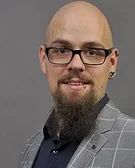
Jacob Loeckle , M. Sc.
Researcher
Faculty of Health (School of Medicine) | Chair of Sociology
Alfred-Herrhausen-Straße 50
58455 WittenRoom number: 2.328