School of Medicine
Chair of Urology
Teaching and research into the treatment of urological conditions
The Chair of Urology at Witten/Herdecke University is based at the Helios University Hospital Wuppertal, within the Department of Urology and Paediatric Urology. The field of urology covers a broad and comprehensive range of specialisms.
The Department of Urology and Paediatric Urology focuses on urology, uro-oncology, stone management, paediatric urology and urogynaecology. The range of treatments extends from surgical urology to conservative oncological therapy. The Department offers all surgical procedures to the highest standard. This includes minimally invasive endoscopic procedures, the full range of robotic urology, right through to complex open tumour surgery and reconstructive surgery.
Through our practice of training students at our Chair, we aim to convey the diversity of the urological discipline and spark interest in the field. The focus is on learning about and recognising important and common urological conditions and their relevance to everyday life, for example in tumour screening, stone disorders or incontinence. Other key topics for us include maintaining quality of life, complications and the interfaces with other disciplines.
The Chair of Urology’s objectives are patient-centred and care-oriented teaching and research.
What questions does the Chair focus on?
The Department of Urology and Paediatric Urology at Wuppertal University Hospital is one of the largest urology departments in Germany, treating more than 3,500 in-patient cases each year. Based in the city of Wuppertal, it serves large parts of the Bergisches Land region as well as the city of Remscheid. It is a national and international centre of excellence for complex urological conditions.
The department boasts state-of-the-art facilities. In addition to four operating theatres for endoscopic surgery, it has a latest-generation robotic surgical system, state-of-the-art MRI fusion biopsy equipment and a latest-generation unit for the fragmentation of kidney and ureteral stones (ESWL).
Furthermore, our clinic has its own radiology department as well as operating theatres for open surgery. In these, we perform robotic, laparoscopic and open surgery for kidney and adrenal tumours, as well as the removal of the prostate in cases of prostate cancer and the removal of the tumour-affected bladder with the creation of a colostomy bladder.
Other key areas of specialisation include complex paediatric urological surgery and all forms of incontinence surgery for women.
The clinic also offers a comprehensive range of reconstructive procedures in collaboration with the plastic surgery department.
Chair holder and Director of the Department of Urology and Paediatric Urology:
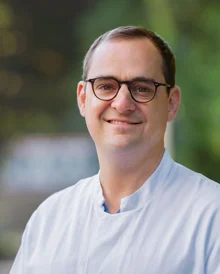
Prof. Dr. med.
Friedrich-Carl Von Rundstedt
Chair Holder
Faculty of Health (School of Medicine) | Chair of Urology
Heusnerstraße 40
42283 Wuppertal
Room number: 43.132
Research
The focus of clinical research is primarily on urological oncological conditions. Areas of research include outcome analyses following urological surgery, retroperitoneal fibrosis, modern pathological processing methods for macroscopic surgical specimens, innovative urological radiological examination methods, the evaluation of training models in minimally invasive surgery, and digital tools for mobilisation following urological procedures.
Research conducted within the Chair of Urology falls under the categories of clinical research and health care research.

Publications
All publications by the Chair of Urology at UW/H are listed in the university bibliography.
Teaching
Teaching in the subject of urology is structured throughout the entire curriculum of the model degree programme in Medicine in the form of a ‘learning spiral’. In this way, we revisit topics such as urological cancers time and again, each time at a higher level.
As part of ‘problem-based learning’ (PBL) in the first two years of study, anatomy and physiology are formulated as learning objectives using case studies of patients with, amongst other conditions, urological disorders, and are supplemented by clinically and urologically oriented ‘consultation sessions’.
This is followed by a two-week clinical training period in the hospital, conducted in small groups of four to six students. The objectives here are to acquire practical skills, such as inserting a transurethral bladder catheter or performing a digital rectal examination, and to learn about urological clinical pictures and their progression. The practical training is supported by daily seminars.
In the fifth year, we revisit the various clinical presentations as part of ‘differential diagnosis weeks’. The focus then shifts to treatment strategies.
The Chair, senior consultants and experienced junior doctors deliver teaching in seminars, as part of patient-centred training at the bedside and in the operating theatre.
The team at the Chair of Urology
Kerstin Krause
Faculty of Health (School of Medicine)
Chair of Urology
Chief Physician’s Office
Telephone: +49 202 896-3407
Fax: +49 202 896-3408
Email: kerstin.krause@helios-gesundheit.de

Dr. med.
Stephan Degener
Teaching and Practical Year Coordinator
Faculty of Health (School of Medicine) | Chair of Urology
Alfred-Herrhausen-Straße 50
58455 Witten
External lecturers
Priv. Doz. Dr. med.
David Lazica
Senior Consultant
Faculty of Health (School of Medicine) | Chair of Urology
St.-Jürgen-Str. 1
28205 BremenPriv. Doz. Dr. med.
Michael Mathers
Specialist
Faculty of Health (School of Medicine) | Chair of Urology
Alleestr. 105-107
42853 RemscheidProf. Dr. med.
Burkhard Ubrig
Chief Physician
Faculty of Health (School of Medicine) | Chair of Urology
Bergstraße 26
44791 BochumPriv. Doz. Dr. med.
Michael Waldner
Chief Physician
Faculty of Health (School of Medicine) | Chair of Urology
Werthmannstr. 1
50935 Köln