A World of Predators. How Can Europe Become Sovereign and Sustainable?
On 26 May 2026, Klaus Welle and Prof. Dr. Joscha Wullweber spoke at the Holzgebäude about the future of European security.
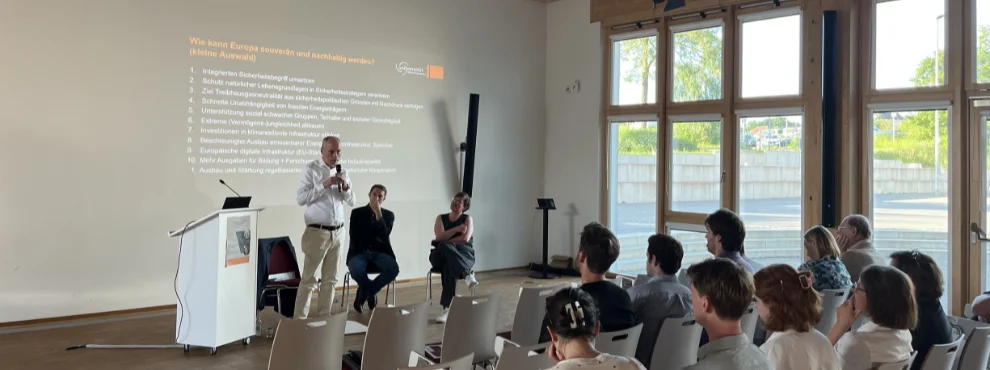
On 26 May 2026, the research center [tra:ce] hosted an event in the event hall of the Holzgebäude. Klaus Welle, Visiting Professor at the London School of Economics and an alumnus of UW/H, and Joscha Wullweber explored the question of how Europe can become sovereign and sustainable in a world of disintegrating orders.
Klaus Welle placed security at the center of his remarks and emphasized the importance of a shared European identity as a foundation for solidarity and cohesion. He also pointed to growing social tensions, which were tied in part to the consequences of climate policy and needed to be addressed politically. Klaus Welle reported on his recent visit to Ukraine and recalled the latest large-scale attack on Kyiv. At the same time, he voiced hope for a future ceasefire. Defense, he concluded, cannot be thought of in isolation.
Joscha Wullweber expanded the concept of security beyond its purely military dimension. In doing so, he referred to the discussions of the German Advisory Council on Global Change (WBGU), of which Wullweber is a member. The WBGU has been addressing issues of security for some time. Climate protection, the distribution of technology and raw materials, and social cohesion were, in his view, just as significant as military defense. Turning to the National Security Council established in 2025, he noted that while it speaks of "integrated security," it places its emphasis on internal and digital security and on the economy, while cooperative and civilian instruments of conflict resolution, along with climate and social questions, receive less weight. He considered greater independence from the United States sensible, but argued not for a "Europe first" approach but rather for a broader diversification of partner countries. He also warned of the ecological and social outlook: the world is moving toward warming of around 2.8 degrees, and social inequality continues to grow.
Following the talks, attendees brought their questions and perspectives into a shared discussion.