People at UW/H – Jan Postberg: Research Starts with a Good Question
In an interview, Prof. Dr. Jan Postberg discusses genetic research, the importance of good teaching, and the unique culture of collaboration at the university.
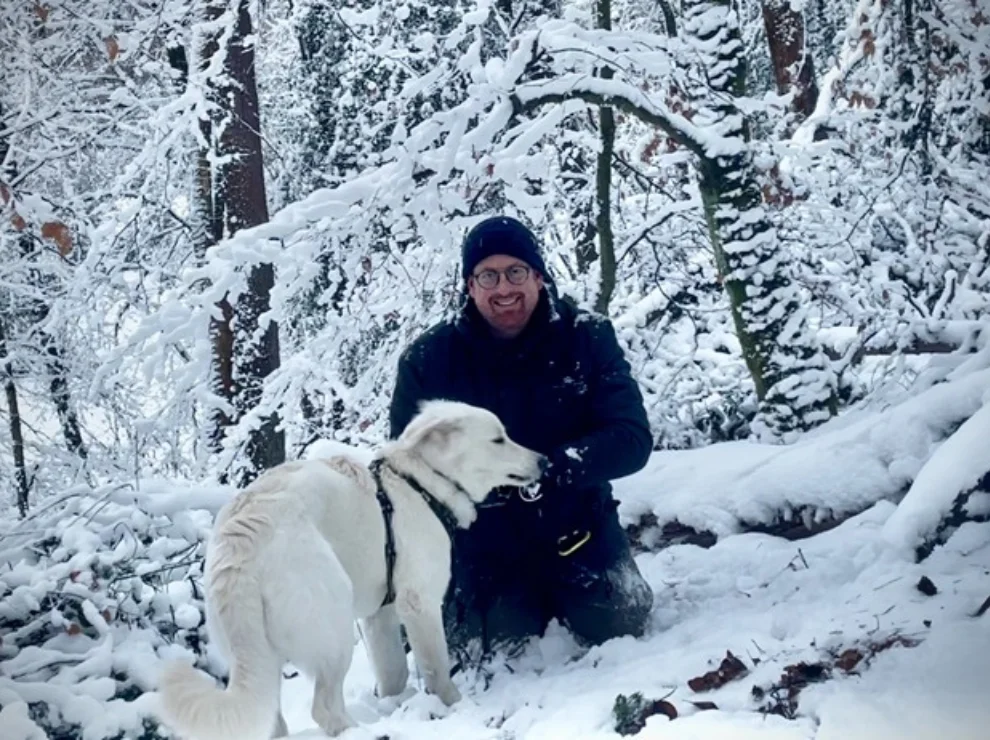
We’re top of the league when it comes to training young researchers because we have so many excellent university lecturers for whom teaching is not just a chore.
Prof. Dr Jan PostbergProfessorship of Clinical Molecular Genetics and Epigenetics
Who are you and what do you do at UW/H?
I have been Professor of Clinical Molecular Genetics and Epigenetics at Witten/Herdecke University since 2018 and head a research laboratory at Helios University Hospital Wuppertal. However, I’ve been at UW/H for much longer: after training as a laboratory assistant near Dresden and completing my undergraduate biology degree at Ruhr University Bochum, I studied biochemistry at UW/H from 1997 onwards. Today, few people are aware that this degree programme once existed at UW/H – though to some extent it lives on in the PhD programme in Biomedicine. For me, there were also some brief but important stops along the way in Santiago de Compostela, at LMU Munich and at the University of Cambridge’s Addenbrooke’s Hospital.
My work focuses on basic biomedical research, covering topics in genetics and epigenetics. As well as research, I really enjoy teaching: I teach human genetics to medical students and try to help them understand just how much modern medicine is now shaped by molecular concepts. Personalised medicine is, after all, about the best possible molecular diagnostics and the most precise therapeutic approaches. Genetics has undergone a revolutionary development over the last two decades. I always try to integrate the latest key findings directly into my teaching.
Within our academic self-administration, I currently chair the Habilitation Committee of the Faculty of Health. This, along with my involvement in doctoral committees and the faculty council, are great ways to keep my finger on the pulse of the UW/H and to network. What I also appreciate about this is that our work on the committees is so effective because our activities have such a direct impact on the academic quality of our candidates in research and teaching.
What do you particularly enjoy about your work, and what projects or topics are you currently working on?
For me, the greatest joy comes when initially abstract ideas suddenly give rise to a clear biological connection – that moment when an experiment truly explains something. I’m particularly interested in how genetic and epigenetic mechanisms – that is, not just the DNA itself, but also its regulation by so-called microRNAs, as well as variants and modifications of histone proteins – influence health and disease. Histone proteins are ancient proteins that organise our DNA.
At the moment, our work focuses, amongst other things, on histone variants – proteins that package DNA and, in doing so, actively regulate which genes are expressed. A particularly fascinating question here is how such variants evolve and take on new functions. One of these variants occurs only in the male germline and, in this form, probably only in humans. This is incredibly fascinating because there is hardly any other process like spermatogenesis in which control over the remodelling of the genome and epigenome is so crucial – except, of course, in oogenesis, but the regulation works differently there.
At the same time, we are working on projects investigating the role of RNA molecules in gene regulation, with a particular focus on the so-called microRNAs found in breast milk. We are currently interested in how these small regulatory RNAs enter the cells in which they exert their effects. If we can work out how they find their targets, this will help us to better understand biological networks.
What are your hopes for the future at the UW/H, and is there anything you would like to change?
I hope that we will build on the UW/H’s particular strength – the close link between research, teaching and clinical practice – even more consistently. And I hope that we can preserve what I knew so well at UW/H even as a student: the professors’ doors were always open, meaning they were approachable to us. At UW/H, we have flat hierarchies. I think that’s extremely important for academic exchange.
In the life sciences in particular, there is great potential in interdisciplinary work – that is, bringing molecular biology, medicine and data science closer together. This requires reliable structures and the freedom to conduct research. We may not always be able to keep up with the excellent large-scale equipment-based research carried out at other universities or major research institutions. But as is so often the case at the UW/H, the same applies here: when it comes to training young researchers, we’re top of the class because we have so many excellent university lecturers for whom teaching isn’t just a chore.
What do you get up to when you’re not working at UW/H?
I spend a lot of time cycling – both on the road and off-road. For me, it’s the perfect way to balance out lab and desk work. And, of course, spending time with my family plays a central role. Our new family member, Fiete – a ten-month-old White Swiss Shepherd mix – keeps us all on our toes and ensures we spend plenty of time out and about in the woods and meadows around Herdecke and in the Ruhr Valley.
Finally, I’ve also been an active diving instructor for over 25 years and, in recent years, have been particularly involved in children’s diving.
What is the most unusual or remarkable thing you have ever experienced at UW/H?
What impressed me most was the tremendous solidarity within the UW/H community at a time when the university was under massive financial pressure and, at times, even faced the threat of insolvency. Back then, we sat for a long time at the kitchen table in the Institute of Cell Biology, the mood very sombre, and nobody knew whether things would carry on – it wasn’t even clear whether salaries could still be paid.
It was remarkable to see how students, graduates, staff, benefactors and friends of the university then mobilised enormous energy and funds within a very short space of time to support the UW/H. That feeling – that many people do not simply view the university as an institution, but as something for which they take personal responsibility – has really stayed with me. Ultimately, the UW/H was stabilised at that time by a combination of commitment, a willingness to donate and the determination to carry it forward together.
Of course, special visits also remain etched in my memory. The fact that figures such as Mikhail Gorbachev or German Federal Presidents were guests at a comparatively small university and engaged in discussions with students says something about the special spirit of this university. Gorbachev’s visit has stayed with me in particular because, on that occasion, world politics suddenly felt very immediate and personal.