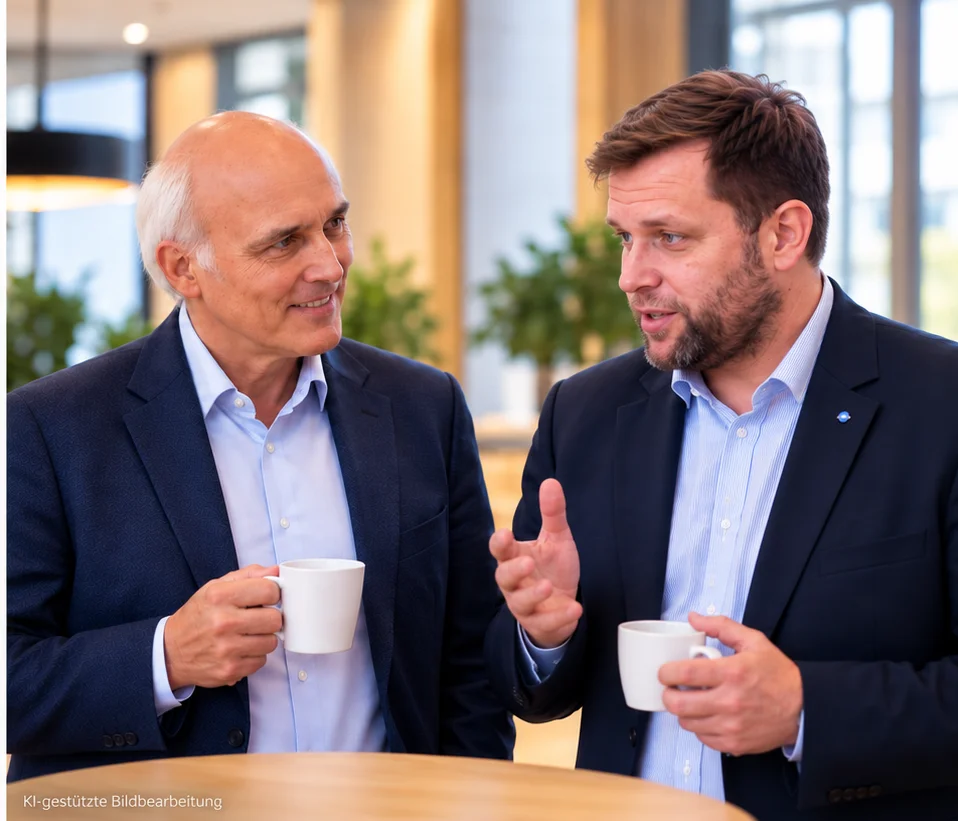
(Q) Let’s get started: What’s on your mind at the moment?
Sebastian Benkhofer: I’ve just come back from a two-day conference on the Future Workplace with representatives from German-speaking SMEs and larger companies. One of the topics discussed there was AI. If, in future, almost all organisations are able to access similar AI capabilities and knowledge resources, the question arises: how will companies still differentiate themselves? And where do people make the difference? This question also applies to universities and educational institutions.
The aim is to strengthen human capabilities and shape the interaction between people and AI across all staff categories in such a way that employees rethink their roles and see AI as an opportunity rather than a threat.
“How will companies still set themselves apart in future if everyone has access to the same AI tools? Where do humans make the difference?” – Sebastian Benkhofer
Rudi Ballreich: I can pick up on that straight away. I’m currently finalising the tender for a large municipal department. The central theme there is: cultural change and leadership. And the key question is: what exactly is the role of leadership within the organisation, and particularly in the organisation’s transformation?
My deepest conviction – and this is also a core element of our joint course – is that leadership shapes the organisation, and leadership also has the task of transforming the organisation in a forward-looking way. In practice, however, we often find that managers do not think in this way. Many say: ‘My job is whatever’s currently on my desk, to keep the processes running. I have neither the time nor the energy for organisational development!’
Of course, day-to-day operations are part of the job. But it is equally part of a leader’s role to think strategically ahead: Where will the organisation be in two or five years’ time? How do we implement digitalisation and AI? How do we develop the organisation further and how do we get staff on board? When it comes to fundamental change initiatives, however, it always starts with the manager initiating the change process within themselves – with their own thinking, feelings and behaviour.
And it’s about leaders taking full responsibility for operational success and for the necessary changes. In short: bringing leadership into leadership. – Rudi Ballreich
(Q) What is special about the part-time course ‘Transformation Management and Systemic Organisational Development’?
Rudi Ballreich: We have already run the programme very successfully as a pilot. In the second run, we want to stimulate the participants’ personal development process even more rigorously, as their own presence, clarity and flexibility in their roles have a strong impact on the shaping of transformation processes. The combination of personal development with systemic counselling is certainly something special.
Sebastian Benkhofer: The systemic approach is a key distinguishing feature. The University of Witten/Herdecke, shaped by figures such as Rudi Wimmer and Fritz B. Simon, has long been closely associated with systemic theory and practice.
For today’s change processes, this means recognising interconnections and remaining capable of acting where different logics converge. That is why it was important to us to clearly emphasise the systemic aspect in the title. It is precisely this perspective that participants learn and come to value.
(Q) Systemic perspectives alone are not sufficient in day-to-day leadership. Let us now turn our attention to leadership in times of multiple crises and constant uncertainty: what leadership approach is taught on the course? In the past, at any rate, the topic ofmindful leadershipplayed a major role in your joint projects.
Rudi Ballreich: That’s an exciting development. From 2015 to 2024, we worked very intensively on this topic through the Mindful Leadership conferences and the ‘Train the Trainer for Mindful Leadership’ course. Our focus was never solely on the Buddhist approach to mindfulness, but always included Western philosophies as well – for example, those of Julian Nida-Rümelin – concerning presence, awareness and clarity of thought.
Over time, however, it became clear to me that companies are not looking for ‘mindfulness’ as an end in itself. They are looking for leaders who excel at their jobs. Based on this, we at Concadora have developed the Excellent Leadership approach. Ambidexterity is a prerequisite, as Excellent Leadership rests on two pillars:performance orientation and development orientation.
Leadership must ensure that the primary performance processes function optimally. Whether it’s a university, a hospital or a car manufacturer: all units must serve the core value-creation process. At the same time, it is essential today to constantly scrutinise processes, think ahead and actively shape change.
Sebastian Benkhofer: As a participant in the pilot course, I can add: regardless of the leadership style under consideration – be it servant leadership, agile leadership or participatory and fluid approaches – everything stands or falls on self-leadership.
Change rarely succeeds amidst the constant stress of day-to-day operations, but rather in moments of pause. This means that a leader must create the space to pause and reflect (‘Where am I? Where is my team? Where is the organisation?’). Otherwise, you remain trapped on the hamster wheel. It is in this space (between stimulus and reaction) that our freedom and the quality of our decisions lie. And this is something that can be practised.
One challenge here is this: in times of constant change, I am transforming the organisation whilst operations continue at full speed – it’s like changing the oil whilst travelling at 180 km/h on the motorway. In this context, leadership must achieve the following:
Rudi Ballreich: When we empower leaders to shape change, we work systematically on five levels: self-leadership; facilitating dialogue and communication; team leadership and team development; and the organisation as a whole.
- Self-leadership involves dealing with pressure, chaos and one’s own fears, but also personal development, one’s own values and one’s own vision.
- Conversation management is essential, as 80 per cent of leadership takes place through communication. The Achilles’ heel of any transformation is the culture of communication. As long as the ‘hot potatoes’ are only discussed in the staff kitchen and not in official meetings, change will fail due to structures of fear and power.
- Team and meeting culture: Organisations are held together by hundreds of meetings. It is about thinking clearly, incisively and even controversially as a group. We need a culture of debate in which people can argue constructively about the issues at hand in order to move forward together.
- Leadership & Taking Responsibility: How do I take responsibility for the outcomes I have committed to? How do I delegate responsibility and create space for empowerment and personal accountability? I am at my most effective as a leader when I empower others.
- The organisation as a whole & its interfaces: What happens at the interfaces between departments? We often witness absurd ‘organisational madness’: units clash for years but never sit down together to resolve the underlying problem. Can we succeed in addressing tensions directly and structuring clarification processes in such a way that rigid interfaces become unifying points of connection?
Ultimately, everything is shaped and driven by organisational culture. When deep-seated patterns such as ‘We all love one another and don’t address problems’ dictate behaviour, everyone remains trapped. This course equips participants to bring these cultural patterns to the surface and change them in a targeted manner.– Rudi Ballreich
(Q) How do these approaches translate into tangible benefits in day-to-day working life? Who is the course aimed at, and how do participants apply their insights to real-world change initiatives?
Sebastian Benkhofer: The course is aimed at people who bear responsibility for change, whether as project managers, in-house organisational developers or managers.
We are expressly not looking for people who are merely seeking a quick ‘toolkit’ to apply a ready-made template to every issue. What is crucial for us is the combination of academically sound concepts, participants’ own professional practice and intensive reflection. Participants are expected to contribute; but they also bring real-life cases from their own organisations. Between modules, they return to their organisations, observe communication and cultural patterns with a keener eye, try out new approaches and reflect on the results in learning pairs. They then return to the next module armed with these practical experiences and new questions.
Rudi Ballreich: The ideal participant is someone who comes to us with a genuine organisational transformation in mind. Our course is therefore also a strategic offering to companies: send us your change agents!
We do not work on abstract theoretical constructs, but consistently on concrete organisational cases. That is, if you like, the USP of this course.
(Q)Let’s take AI as a current example of profound change: how do trust, communication and independent thinking help to shape change effectively within organisations?
Sebastian Benkhofer: AI can trigger uncertainty about one’s own role: ‘Am I still needed? Can I still play a part in shaping the future?’ Leadership must address these questions in team discussions and facilitate open-ended processes, even without ready-made answers. This requires psychological safety and trust:
“If basic trust is lacking, transaction costs rise enormously due to micromanagement, office gossip and political manoeuvring. Organisations with a strong culture of trust adapt to new conditions many times faster.” – Sebastian Benkhofer
Lexware provides an example: in the wake of the AI revolution, the CEO promised that nobody would lose their job, but that roles would change. Leadership should encourage employees to actively shape their own professional development.
Rudi Ballreich: The topic of AI leads us to a radical question about the future of human thought. Together with Sebastian and Yi-Cong Lu, I teach a module called ‘Awaken the Socrates within you: Problem-solving and decision-making with AI’ as part of the Studium fundamentale programme at the University of Witten/Herdecke. Socrates’ active questioning and thinking serve as an important model for dealing with AI, because the great danger with AI is that we allow ourselves to be tempted to conveniently delegate thinking to the machine. If managers do that, they lose their capacity for judgement and accountability.
Socrates taught us that a decision is only sound if I can justify it with my own insight. Furthermore, in the spirit of metacognition, we must be able to scrutinise the quality of our own thought processes. If the love of wisdom and independent thought (philosophia) is lacking within a company, human creative power is lost. The Socratic motto for our times could be: Use AI to sharpen your thinking, not to replace it.
Sebastian Benkhofer: To preserve independent thinking, we create analogue spaces in teaching and consultancy: first, tasks are thought through using pen and paper and reflected upon as a team; only then are they cross-checked against AI.
Anyone who cannot critically check AI results for errors and plausibility relinquishes professional autonomy. The responsibility remains with people. Behind this lies a difference in attitude: those who merely work through tasks ask, ‘What should I do?’ Those who take responsibility, on the other hand, ask, ‘What should be achieved through my actions?’
This fosters an awareness of one’s own effectiveness: it is not just an abstract corporate purpose that counts, but the experience of being capable of taking action oneself and helping to shape the organisation’s future.
Rudi Ballreich: This aligns perfectly with Deci and Ryan’s well-established self-determination theory. People derive motivation and satisfaction above all from experiencing themselves as self-effective: I shape something, take responsibility and see a result that makes sense and that I have personally created.
Unfortunately, in many organisations the opposite happens: driven by a fear of making mistakes or by bureaucratic constraints, people learn to hold back. A core task of modern leadership is therefore to create spaces in which employees are willing to take on responsibility of their own accord. If this is achieved across all levels, a learning organisation emerges – a system in which a vibrant spirit thrives, disagreements are openly resolved and continuous development takes place.
(Q) We have discussed leadership responsibility, systemic thinking, specific change initiatives and personal effectiveness. To conclude our conversation – what, for you personally, lies at the heart of shaping the future, and what insights have you gained regarding the capacity for transformation?
Rudi Ballreich: The core of transformational capacity begins with the recognition of a discrepancy. When I sense that something is amiss – in my team, in my organisation – I have two options: I can retreat into defence and protection mechanisms, or I can take responsibility and say: ‘Something isn’t right here, and it concerns me!’
“Transformational competence is the willingness to confront the pain and the discord – and to draw from this the impetus to take active steps to intervene and bring about change.” – Rudi Ballreich
Shaping the future requires three things:
- Clear thinking
- The ability to perceive the discord through one’s feelings – and the courage to face inner tension and whatever causes pain.
- The drive to tackle things in a practical way and not to stop at mere realisation.
This applies just as much to people within organisations as it does to people in society. When it comes to topics such as AI or planetary boundaries, for example, we must not become paralysed. When disturbing things happen, the question for each individual is: How do I deal with what causes me inner pain? What do I do? How can I make an effective contribution using my own abilities?
Sebastian Benkhofer: In the context of an organisation, I would summarise shaping the future in three key points:
- Visualising a desirable future: Leadership must work with teams to develop a vision of what a desirable future might look like – and demonstrate that each individual’s concrete contribution makes a real difference.
- Maintaining the ability to judge and act in the face of complexity: We cannot fully control either the development of AI or the complexity of the world. But we must cultivate the human capacity to remain capable of judgement and action despite uncertainty and open-ended outcomes.
- Embedding the ability to adapt as a principle: We cannot predict the future with precision, but we can create organisations that continuously experiment, reflect on decisions, open up spaces for learning and evolve flexibly.
Ultimately, transformational competence means precisely this: not passively awaiting the future, but developing one’s own abilities to help shape it collectively, courageously and with full responsibility.
(Q)Thank you very much for the inspiring conversation and the practical insights into leadership and transformational competence!
The interview was conducted by Nina Maas (Concadora) and Aude Bertrand-Höttcke (UW/H).
The university course ‘Transformation Management and Systemic Organisational Development’ begins on 22 November 2027. The course is a collaboration between the Professional Campus at the University of Witten/Herdecke and the management consultancy Concadora GmbH.