Exkursion nach Wuppertal: Transformative Forschung vor Ort
Am 18. November 2026 fand eine Exkursion nach Wuppertal im Anschluss an das [tra:ce] Wuppertal Research Seminar statt.
The seminar, which was awarded the Teaching Prize for Sustainable Development Education, provided students with insights into the practice of transformative research at the Wuppertal Institute for Climate, Environment and Energy (WI) and took place as part of the partnership between UW/H and the WI.
Transformative research is characterised by the fact that research always aims to have an impact on the ‘real world’. The aim was to explore this impact. Dr Matthias Wanner led the group of students and Dr Sonja Knobbe to projects in Wuppertal’s Nordstadt district, where research, civil society and the city work together.
The first stop was the Ölberg Hub on Sattlerstraße. Since 2023, the former shop has served as a meeting place for the neighbourhood and local initiatives in the Ölberg area. Gaby Schulten from the ‘AG Wärmewende’ and the ‘Unternehmer/innen für die Nordstadt e. V.’ association presented the Hub and its services, including an advice kiosk, co-working spaces and a repair workshop. She emphasised how important grassroots engagement is for the neighbourhood, as is an active civil society.
Following a general introduction to transformative research, Paula Quentin from the City of Wuppertal then presented the SInBa project (Social Innovations in Construction, Housing and Urban Development). Funded by the BMFTR, the project is being carried out in cooperation with the Wuppertal Institute and the agency inter3 in the cities of Wuppertal and Mannheim. Its aim is to test social innovations in the fields of construction and housing in real-world laboratories in both cities. The aim is to develop methods that other local authorities can also utilise. Wuppertal is working on the climate-friendly refurbishment and heating supply of existing buildings, as well as on revitalising and repurposing vacant properties. For the Ölberg district, the local heating plan envisages a pilot project for local district heating, in which climate-friendly heating solutions are to be identified in collaboration with property owners.


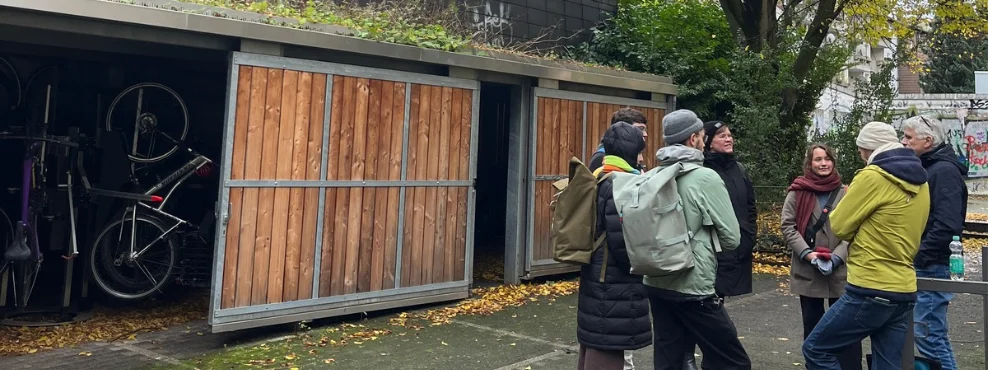
After the lunch break, the second stop on the tour was the bike-sharing stations in the Mirke neighbourhood. Thomas Weyland from ‘Unternehmer/innen für die Nordstadt’ explained how the association aims to offer alternatives to car use in the neighbourhood through decentralised stations. In 2019, the association built Wuppertal’s first mobility station at Schusterplatz. Today, it manages bicycle garages at four locations. The stations combine car-sharing, cycling and bus services and are large enough to accommodate cargo bikes. As part of the ‘Mobilstationen im Quartier’ (MiQ) project, the WI, the University of Wuppertal, Neue Effizienz and the association used EU funding to investigate how such stations could be rolled out to other neighbourhoods. Weyland emphasised that the initiative for the stations so far has come from local civil society. However, to roll them out across the whole city, a higher authority would be needed to coordinate and implement the scheme.
To round off the visit, the group visited Utopiastadt at the historic Mirke railway station on the Nordbahntrasse. Beate Blaschczok and Christian Hampe founded Utopiastadt in 2011 as a network for creative people, with studios and co-working spaces in the disused station building. Today, the site is home to, amongst other things, an open workshop, repair cafés, a community garden and concerts. Most of these activities are run by volunteers. At the end of 2016, Stadtsparkasse sold the listed station building to Utopiastadt for a symbolic euro; in 2018, the non-profit organisation Utopiastadt GmbH purchased a further 11,000 square metres of land surrounding the station. Together with the city, the initiative is developing the Utopiastadt Campus there as an open space for pilot projects on sustainability. Matthias Wanner, who wrote his PhD thesis on real-world laboratories in the Mirke neighbourhood, presented his research on Utopiastadt as a real-world laboratory that, above all, offers space for experimentation. Drawing on Anthony Giddens’ theory of structuration, he described the role played by values and norms, as well as authoritative and allocative resources, in this context. Open channels of communication with the city also facilitate access to funding.
