How does hormonal birth control affect mental health?
A long-term study involving Witten/Herdecke University, based on data from more than 5,200 women, dispels concerns about psychological side effects
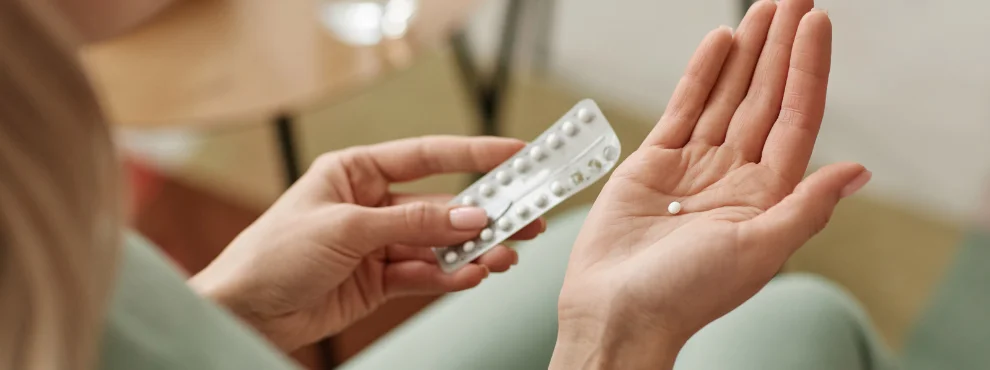
The contraceptive pill is the most widely used hormonal contraceptive worldwide. In Germany, around one in four women aged between 18 and 49 takes this type of contraceptive. At the same time, there has been a debate for years as to whether these contraceptives can affect mental health.
To find this out, researchers from the University of Witten/Herdecke (UW/H), Göttingen and Leipzig analysed data from the large-scale German longitudinal study pairfam. In this study, more than 5,200 women aged between 16 and 50 repeatedly reported on their contraception and well-being over a period of up to 14 years.
The result: on average, hormonal contraception had no measurable effect on depressive symptoms, life satisfaction or self-esteem. Furthermore, the psychological effects of contraception on individual women varied less than is often assumed.
Long-term data provide a more detailed insight
The advantage of the long-term study is that it goes beyond a single snapshot: the researchers were able to observe how the participants’ well-being changed – for example, when women started using hormonal contraception or stopped using it again. At the same time, the research team took into account numerous factors that could influence the results, including age, relationship status and life circumstances. This makes it easier to distinguish whether changes are actually linked to contraception or have other causes.
Why the side effects of the pill are difficult to assess
“It is difficult for any individual to work out how hormonal contraception affects them personally. Decisions about contraception are not made in a vacuum, but because relationship patterns and family planning are changing. It is also difficult for researchers to distinguish the effects of the hormones from these changing circumstances. Unlike previous longitudinal studies, we have paid particular attention to taking this into account,” says Prof. Dr Ruben Lennartz (née Arslan), Professor of Psychological Research Methods at the UW/H. “This dispels the differences that were otherwise discussed as psychological side-effects of the pill. In our data, we see no effect on well-being or depressive symptoms. Nor do we find any evidence of markedly different reactions among individual women.”
At the same time, the researchers warn against presenting potential risks in a one-sided manner. Exaggerated reports of alleged psychological side effects could unsettle girls and women. Previous waves of heightened scepticism towards the pill – so-called ‘pill scares’ – have shown that such debates can have real consequences, such as falling usage rates and more unwanted pregnancies. At the same time, the researchers emphasise that women should make individual decisions about their contraception and that there is a wide range of hormonal and non-hormonal options available.
Further information:
The analysis was published in the journal Personality Science: https://doi.org/10.1177/27000710261499575
Contact person

Svenja Malessa
Press Officer
Administration | Communication & Marketing
Alfred-Herrhausen-Straße 48
58455 Witten
Room number: 2.F05