People at UWH – Renate Buschmann: Thinking Interdisciplinarily, Questioning Artistically
Prof. Dr. Renate Buschmann discusses digital art, cultural education, and the power of a change in perspective.
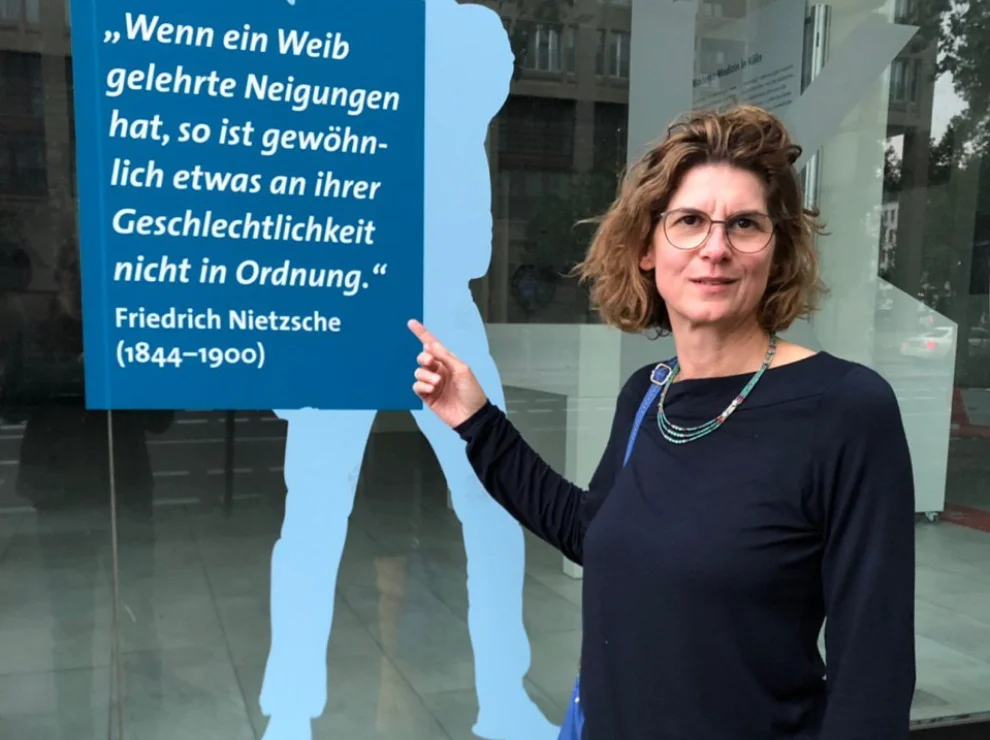
“So far, I’ve got the impression that there is a great deal of openness towards the arts and that a great deal is possible.”
Prof. Dr Renate BuschmannHolder of the Chair of Digital Arts and Cultural Communication
Who are you and what are your responsibilities at UW/H?
Since January 2020, I have been part of the Studium fundamentale centre with my Chair of Digital Arts and Cultural Communication. Prior to that, I spent eleven years as managing director and artistic director of the Düsseldorf Media Art Foundation (imai). Art that is expressed through technical media and explores the impact of technology has thus become my speciality. The research, preservation and dissemination of the video art collection held there were the main focus, but for me this also provided an opportunity to collaborate with universities and colleges and to make the collection accessible and usable for research and teaching. This led to several research projects, and seminars and workshops at various universities became an increasingly integral part of my work. The transition from applied research to academic work eventually seemed a natural step, and I was delighted to be appointed to the UW/H.
I studied general art history in Cologne and Florence. During my doctoral studies on the ‘between’ exhibition series (1969–1973), I turned my attention to a curatorial question – something that was still unusual in the 1990s – and in doing so recognised the ‘in-between’ as an important zone of open-ended engagement. In art in particular, significant impulses arise on the fringes of the mainstream, where the canon – what is recognised as art – can more easily lose its validity. Video art, media art, digital art – whatever we choose to call the products of contemporary artistic practice in dialogue with technology – is so interesting to me because art brings us closer to the complexity of digital living conditions and offers food for thought ranging from utopian to dystopian.
Through my seminars, I aim to raise awareness of the impact of contemporary art. The ‘Studium fundamentale’ is, in a sense, a space in between – inserted precisely between the established norms and requirements of the specialist degree programme – and is therefore ideally suited to prompting students to rethink their own attitudes through artistic perspectives. It is my task to give the arts greater prominence within the Studium fundamentale, to introduce students to contemporary art discourses with academic rigour, and, of course, to inspire enthusiasm for contemporary art. My research currently focuses on digital art education.
I am pleased that, as a member of the Board of Directors of the Studium fundamentale Centre, I can contribute to the strategic direction of the Stufu. At the moment, we are focusing on determining which content and teaching formats are appropriate for making interdisciplinary, self-directed learning outside specialist degree programmes attractive and rewarding for students. WittenLab Magazine, which will be published for the second time in July, reflects Studium fundamentale’s overarching ambition to explore topics from multiple perspectives. My colleague Larisa Perski and I are responsible for the art section of the magazine. For me, the Studium fundamentale acts as a bridge between the various degree programmes at the UW/H, but also between the university and the realities of life that exist outside it. It is precisely in this kind of productive and imaginative space in between that I feel most at home.
What do you particularly enjoy about your work, and which projects or topics are you currently working on?
I particularly enjoy being able to draw on my extensive network of artists and cultural practitioners to bring exciting discussion partners and project collaborators to the UW/H. During the last few semesters of online teaching, I haven’t been able to visit exhibitions with the students, but instead we’ve occasionally had artists as guests in our Zoom sessions. As soon as it’s possible again, I’ll be taking my seminar groups to visit museums and studios.
A series of talks with artists, open to all interested parties at UW/H, will be launching in June at very short notice. Our partner for this is Unikat, where the talks are then set to take place live and on-site on a regular basis from autumn onwards. We aim to provide an insight into artistic challenges and possible solutions. To kick things off in June, we will be talking to three artists about the importance of networks – which, incidentally, is the central theme of the second issue of WittenLab Magazine.
Together with the Executive Board of Studium fundamentale, I am working towards the goal of establishing an artist-in-residence programme, which we expect to launch from the winter semester onwards. Artists are to be present at UW/H, work on site and – ideally – initiate joint research projects with departments at UW/H. In future, I would like to curate exhibitions for UW/H, for example for the new building, in collaboration with students.
What are your hopes for the future at UW/H, and is there anything you’d like to change?
To be honest, I won’t be able to consider changes until I’ve got to know UW/H better. So far, I’ve gained the impression that there is a great deal of openness towards the arts and that a lot can be achieved.
In general, I’d like to see diversity put into practice. An important foundation for this has been laid with the appointment of the representative for Equality and Diversity and the vice president for Organisational Development. The Studium fundamentale Centre can play a pioneering role in fostering a culture of interdisciplinary research and teaching – this requires the willingness of all UW/H lecturers to cooperate.
What do you do when you’re not working at UW/H?
Visiting art exhibitions has always been part of my life. It’s my professional development – the sine qua non of my job. I need the time in the evenings, at weekends and during holidays for that. For me, art is both a source of tension and relaxation. Otherwise, I try to keep my mind and body agile! My job keeps my mind agile, whilst yoga, jogging and hiking are my little escapes for my body.
What’s the strangest or most remarkable thing you’ve ever experienced at the UW/H?
The strangest thing is probably that I’ve been at the UW/H for 17 months now and most people only know me as a Zoom tile. Hopefully that will change soon!