UW/H PhD student develops app to help manage chronic pain
A PhD student at Witten/Herdecke University has now been awarded the Pain Research Prize for her work on developing an app-based follow-up treatment programme for chronic pain in children and young people.
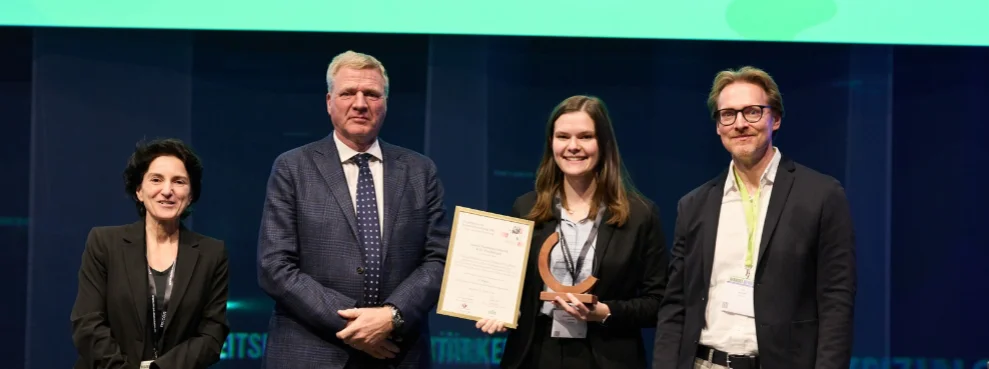
Amelie Schmidt, a doctoral student at the University of Witten/Herdecke (UW/H), has been awarded the German Pain Society’s Prize for Pain Research. She received the first prize, worth 7,000 euros, in the ‘Clinical Research’ category for her scientific publication on app-based follow-up care for children and adolescents with severe chronic pain. The award ceremony took place on 22 October at the German Pain Congress in Mannheim. Schmidt is pursuing her PhD in the research group led by PD Dr Julia Wager at theChair of Children's Pain Therapy and Paediatric Palliative Care, headed by Prof. Dr Boris Zernikow.
App supports children and young people in returning to everyday life
More than 500,000 children and young people in Germany suffer from chronic pain. Those affected are significantly restricted in their daily lives. Many are only able to attend school irregularly, withdraw from their social circles or suffer from sleep disorders. At the German Paediatric Pain Centre at the Vestische Kinder- und Jugendklinik in Datteln, more than 300 young patients with severe chronic pain disorders are treated as inpatients each year. Following the three-week course of treatment, those affected face the challenge of applying what they have learnt in everyday life. This is where the ‘Feed-bApp’ research project comes in: Schmidt investigated how an app can support children and their parents in managing pain after their hospital stay.
Personalised support improves treatment outcomes
As part of the project, which received over two million euros in funding from the Innovation Fund, participants used the ‘MyBrainCity’ app over a period of six months. They received varying levels of support – ranging from simple feedback and tips to active guidance from a pain psychotherapist. The results show that children and adolescents who were supported via the app by a pain psychotherapist demonstrated greater improvements in their everyday functioning than those who received only automated messages.
Even within the group of those supported by a pain psychotherapist, Amelie Schmidt identified differences: “Only children who were contacted regularly and proactively by the therapist, rather than the therapist waiting for the children to get in touch, also showed improvements in the areas of depression and anxiety,” said Schmidt. “Proactively reaching out to the children is crucial when developing a pain app.”
App could complement pain therapy
These findings can help to develop digital aftercare services for young pain patients in a more targeted manner. “Digital applications can usefully complement care. However, this is conditional on their effectiveness being scientifically proven,” emphasises Prof. Dr Boris Zernikow, head of the research project.
The project, led by PedScience Vestische Forschungs-gGmbH, involved the University of Witten/Herdecke and the German Paediatric Pain Centre, as well as the health insurance providers BARMER and Techniker Krankenkasse, and clinical partners in Garmisch-Partenkirchen, Stuttgart and Augsburg.
Further information: PedScience Vestische Forschungs-gGmbH was founded in 2018 as a subsidiary of the Vestische Kinder- und Jugendklinik Datteln. This non-university research institution focuses in particular on clinical research, healthcare and prevention research in the field of paediatrics and adolescent medicine. One area of focus is paediatric pain and palliative care research.
Photos to download

contact

Lennard Halfmann
Communications Officer
Administration | Communication & Marketing
Alfred-Herrhausen-Straße 48
58455 Witten
Room number: 2.F05