Ia Estella Pedroli: between conviction and new perspectives
Between art and academia, personal convictions and new perspectives: PPE student Ia Estella Pedroli shares what brought her to UW/H and how she hopes to help shape its community.
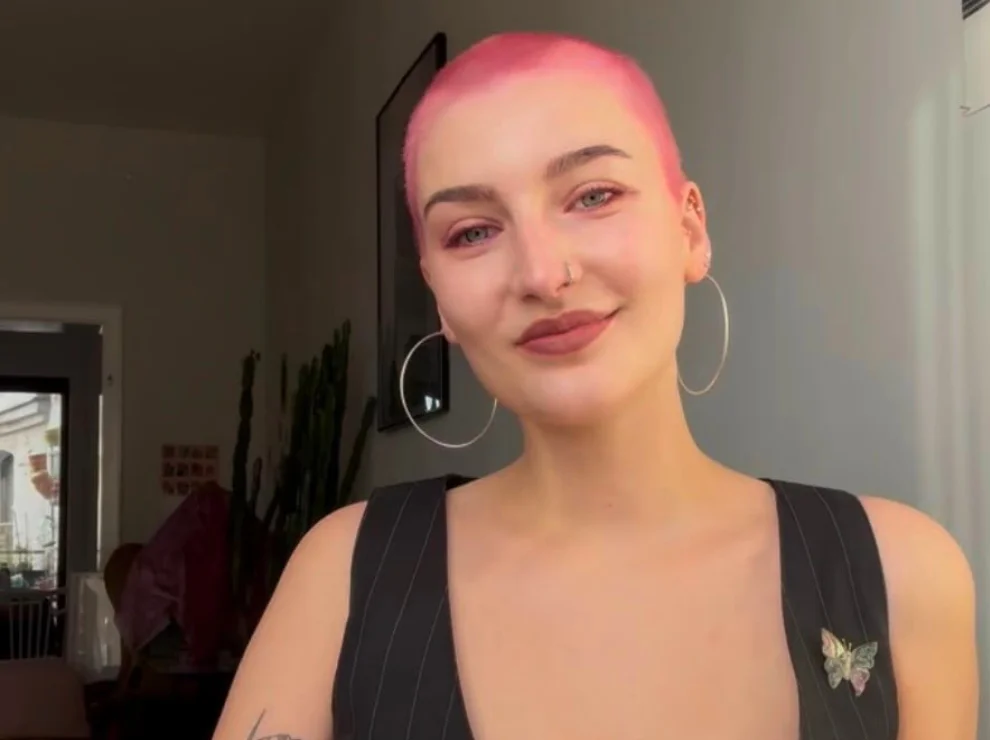
Ia Estella Pedroli has a strong sense of justice – and a desire to constantly question her own convictions. That is precisely why she is studying PPÖ – Philosophy, Politics and Economics – at Witten/Herdecke University, where she is about to start her second semester. In this interview, she explains what drives her and what she herself hopes to achieve at university.
You previously studied social sciences at another university and are now exploring social issues from philosophical, political and economic perspectives as part of your PPÖ degree programme. Why did you choose this degree programme and decide to transfer to UW/H?
I’d been involved in activism from an early age and wanted to underpin my commitment with academic research during my studies. Social sciences seemed the obvious choice because the subject covers many different social issues and allows you to continually re-evaluate your own position. Academic research claims to be neutral. However, I wouldn’t agree with that unreservedly. I feel that academia without values simply doesn’t work.
My previous university also felt very large and impersonal. I realised that I wanted a more personal atmosphere with smaller groups. So I looked for a degree programme that would allow me to build on my previous experiences in the subject.
I’m already familiar with PPÖ from the time I lived in Amsterdam. Some of my friends studied it there and I found the combination really exciting. I think it gives you a more comprehensive view of the world, because the degree programme doesn’t just focus on philosophy, but also on economics and politics, enabling you to understand interdisciplinary connections.
During your time in Amsterdam, art played a particularly important role, and it continues to be a part of your everyday life today. What exactly does art mean to you?
I could never really make up my mind between art and science. In Amsterdam, I studied art for a year at the Gerrit Rietveld Academie and worked at a photography museum that often explores political themes. I really enjoyed using photography to help school classes understand concepts such as queerness or decolonial perspectives.
I hope to find a job in the future where I can also give free rein to my creative side. For example, I’m very interested in the work of community centres and the implementation of social and democratic ideas at local level. Art can play an important role in this and bring people together. I’m convinced that art – or rather, the act of creating art – is always political.

In my private life, art is, above all, an important way for me to find balance. As I have ADHD, painting and making music help me to wind down and regulate my emotions.
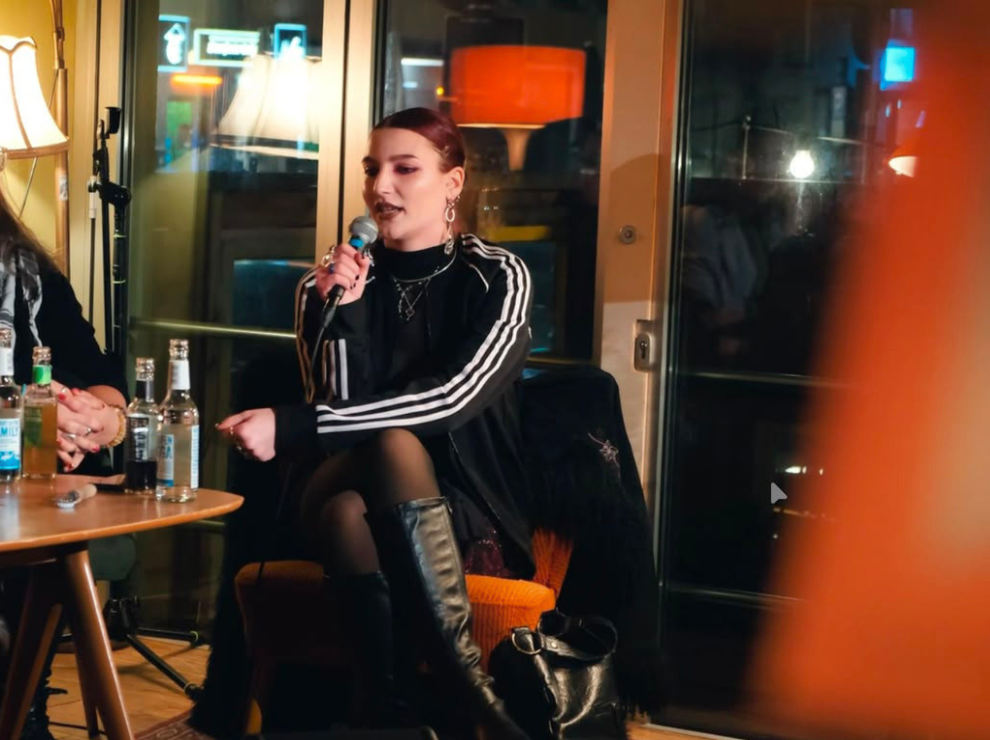
You’ve been committed to social issues ever since you were a teenager. Where does this drive come from?
My friends were all interested in politics and took me along to readings critiquing society when I was just 14. Although I didn’t fully understand everything at the time, a sense of justice began to take root within me.
I still remember the years 2014 to 2016 very well, when many refugees came to Germany. At my school, there was an opportunity to volunteer to help with integration – in other words, to give German tuition. Through this, I got to know a few girls who confided in me about their experiences, some of which were deeply traumatic. These were formative encounters that you never forget.
Ever since then, my solidarity with refugees and those affected by racism has been very strong. I always try to consider how I, as a white person who isn’t personally affected by this, can still help. As a queer woman, I can to some extent understand what it’s like to be excluded and systematically overlooked.
A few years ago in Cologne, I founded an intersectional collective for FLINTA people – that is, for women, but also, for example, for non-binary or trans people. I wanted to provide them with as safe a space as possible in which to exhibit their art, make music together and dance without experiencing harassment.
Accessible and low-threshold political education is very important to me. I believe that small-scale neighbourhood projects are just as important as, for example, a strong online presence – it’s the commitment that counts.
You have strong views on many issues. How do you find it when different perspectives clash during your studies?
In discussions, patterns of thought that one has picked up from one’s family or social background always seem to come to the fore. This brings different perspectives and life experiences into contact with one another, but I think that’s a good thing. University is a place for exchange and learning. You have to be able to tolerate a diversity of opinions, at least in a formal setting such as a seminar, and be open to engaging in discussions.
At the same time, I think it’s important that we can agree on certain basic rules of discourse and a shared set of facts. Otherwise, we won’t get anywhere. That’s why it’s so important to me to underpin my stance and opinions with academic evidence, so that I can argue my case soundly and counter opposing views in discussions. That’s exactly what we can practise at university.
It’s different for me outside the seminar. Over a coffee, for example, I don’t want to discuss whether people actually experience discrimination on the basis of their background or sexual orientation, or whether their experiences should be taken seriously.
For me, therefore, the question is less whether one can be tolerant of intolerance, and more about how to deal with intolerant views in a humane way, without downplaying discriminatory statements or trivialising the experiences of those affected.
When we talk about diversity, however, it’s not just about different perspectives and ways of life. You have ADHD yourself. How do you experience that in your everyday student life?
For me, the diagnosis four years ago answered many unanswered questions and dispelled my doubts. Today I know that my ADHD was the main reason for my problems at school and why I repeatedly reached my limits there. I hope that now, as a student, I’ll be able to spot early on when a situation is becoming critical, so I can seek help in good time or take preventative action. Sometimes certain lectures last four hours – that’s definitely too long for me. After three hours, I can no longer concentrate and need a break. Even though I’ve learnt to cope with this, I love it when teaching is interactive. Presentations, for example, are right up my street – both preparing them visually and delivering them, whilst engaging the audience in the lecture. Personally, this interaction really helps me to stay on track and follow the content more easily.

You’ve only recently arrived at UW/H and in Witten. What would you like to achieve in your new place of study and residence?
I’d like to get involved in the area of equality and diversity. I’d also like to find out more specifically about the places and services available to neurodivergent people to make their everyday university life easier.
Here on campus, there is, on the one hand, the ‘Room of Silence’, where yoga classes are also held, and a relaxation room. This is specifically designed to help you wind down and recover from the many stimuli. I’m also planning to set up a small studio for students, where they can retreat and be creative together. The first steps have already been taken: I’ve launched an initiative, developed a concept and hope to be able to bring the space to life on campus very soon.
I also think it’s important to talk to neurotypical students at UW/H about what it means to be neurodivergent – for example, to be autistic or to have ADHD. This is absolutely vital for fostering genuine solidarity and inclusion.
To meet new and like-minded people away from campus as well, I set up the group Ruhrpott Rendezvous. This brings together people from Witten and the surrounding towns. We meet every two weeks in my courtyard and organise creative sessions such as poetry or film evenings. I enjoy being the social butterfly and taking others under my wing to foster a sense of community. I focus on low-key events that are inclusive and encourage genuine interaction.