“If it says Harvard on the outside, it’s Harvard on the inside.” Two UW/H students on their research placement at the elite university
Determination and initiative led Adrian Illmann and Lotta Keller to spend three months at one of the world’s most renowned immunology laboratories.
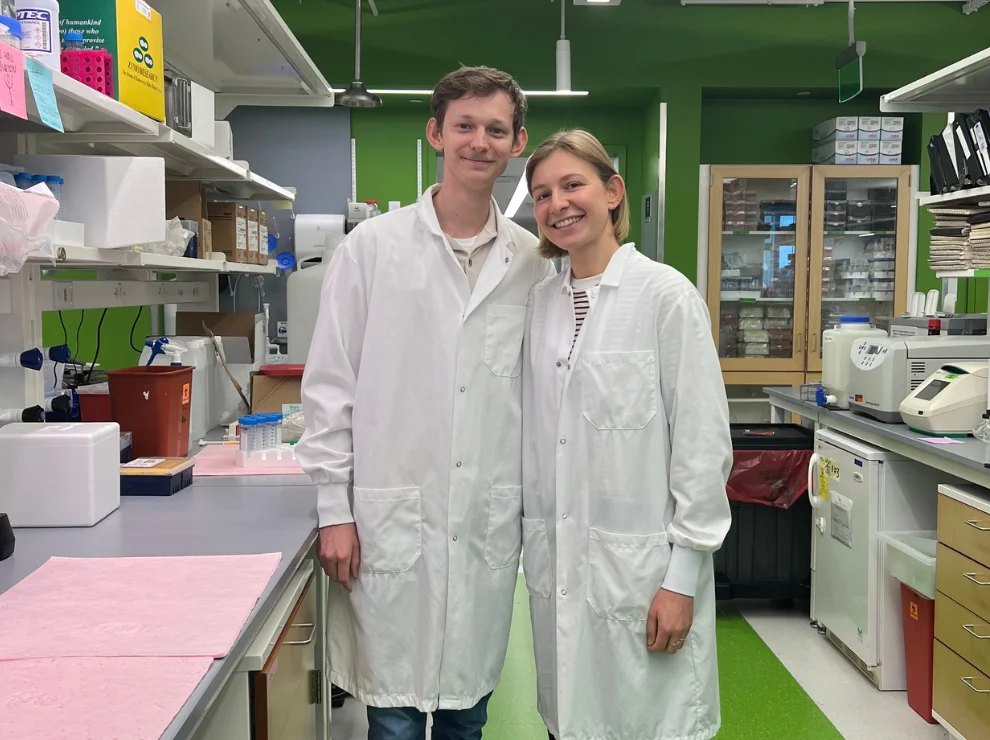
Every morning, the Red Line took Adrian Illmann and Lotta Keller from their accommodation in Dorchester to Cambridge, Massachusetts (USA). A few minutes later, they put on their lab coats and set to work. For three months, this journey was part of their daily routine at the Ragon Institute of Mass General Brigham, MIT, and Harvard.
The fact that the two medical students from Witten/Herdecke University were able to conduct research at one of the leading immunology laboratories is down to their own commitment and determination: Whilst looking for insights into immunology that went beyond the content of his own lectures, Adrian came across an online course offered by Harvard Medical School – he was particularly drawn to the idea of being able to learn from the very best in the field. After completing the course, he and Lotta wrote to the course leader to ask if they could undertake a research placement with him. For Lotta and Adrian, who are both in their ninth semester, this was the ideal opportunity to combine international experience with their final dissertation in the ‘Scientific Work (WIA)’ module.
A research semester as part of the UW/H medical degree paves the way into academia
WIA is an integral part of the medical degree programme at UW/H and prepares students for a potential career in research. As early as the second semester, students learn the theoretical foundations of laboratory work at the molecular level in the so-called ‘MediLab’. As the course progresses, supplementary lectures on statistics and clinical research follow, until students finally write their own “WIA research paper” in the ninth semester. This enables them to apply the theoretical foundations they have previously learnt in a practical context.
As part of the team led by the renowned scientist Prof. Shiv Pillai, Adrian and Lotta contributed to a research project on the rare autoimmune condition IgG4-related disease. “IgG4-RD can affect almost any organ. Characteristic features include, amongst other things, swelling, the progressive replacement of healthy, functional tissue with hardened connective tissue – a process known as fibrosis – and elevated levels of the IgG4 antibody in the blood,” explains Adrian. “Our task was to produce and purify a protein so that it would be available for further investigations.”


Between the microscope and the Petri dish: this is what everyday life in the laboratory was like
Her daily routine in the laboratory was tightly scheduled: experiments had to be planned, carried out and analysed. Not every experiment worked straight away, but patience is part of the job. Despite her initial experience, much of it was new to her, Lotta explains: “I learnt how to culture cells, prepare genetic material and apply a wide range of molecular biology techniques in the lab. Naturally, the learning curve was correspondingly steep.”
As well as their practical work in the laboratory, the two took part in seminars at which renowned US scientists presented their latest research in the field of immunology. During the weekly boot camp, they discussed molecular biology concepts with Prof. Shiv Pillai in order to get a sense of the ‘big picture’, as Adrian put it. Towards the end of their stay, they finally presented their own project to the whole team. As well as gaining deep insights into science, both were particularly struck by the warmth and openness of the people they met. “We realised just how much time and enthusiasm Prof. Shiv Pillai devotes not only to his research, but also to training young people.”
Immunology also fascinates the two medical students: The immune system must recognise and fend off pathogens, identify and eliminate abnormal cells to prevent the development of tumours, and at the same time build up a memory that provides immediate protection upon renewed contact with a pathogen – and all this without attacking the body’s own tissue. “To truly understand these processes, you need in-depth knowledge from a wide range of disciplines – biochemistry, molecular biology, microbiology, physiology – and it is precisely this interdisciplinary nature that makes immunology so appealing to me,” explains Adrian. Lotta is particularly struck by the complexity of the field and by the fact that “much of what happens at the molecular level is still not fully understood by science today.”
What Adrian and Lotta took away from their time at Harvard
Her three months in Boston have changed the way she sees her own future. Whilst she was previously unsure whether an experimental PhD was the right path for her, Lotta can now well imagine working in a laboratory again in the future. That’s why she can wholeheartedly recommend a research project at a US university: “You learn not only in your field, but also lessons for life. But the expectations are very high too! If it says ‘Harvard’ on the outside, it’s Harvard through and through.”


Their time at Harvard and the affiliated research institute had a lasting impact on the two students. Lotta said: “The venerable, magnificent buildings on campus and the centuries-old traditions create an atmosphere you won’t forget in a hurry.” At the same time, they also noticed parallels with UW/H. “What impressed me most was the way of thinking,” says Adrian. “At Harvard, performance is assessed less on whether you have the right answer at the ready, and more on how you deal with open-ended questions and dissent.”
Next term, Adrian and Lotta will continue their medical studies in Witten. Adrian is certain that he would like to continue working in research in the future. “I can well imagine taking part in a PhD programme alongside my specialist training to continue my research in immunology.” He emphasises that cutting-edge research is not the preserve of elite universities, nor is it tied to specific titles or awards. “Good science is about asking the right questions, carefully analysing data and drawing the right conclusions from it.”
Another lesson the pair have learnt from their experience is that courage pays off – and sometimes a simple email can open up a huge opportunity.