Macht verstehen – und für Gutes nutzen
RMI Distinguished Lecture mit Prof. Tiziana Casciaro von der Rotman School of Management
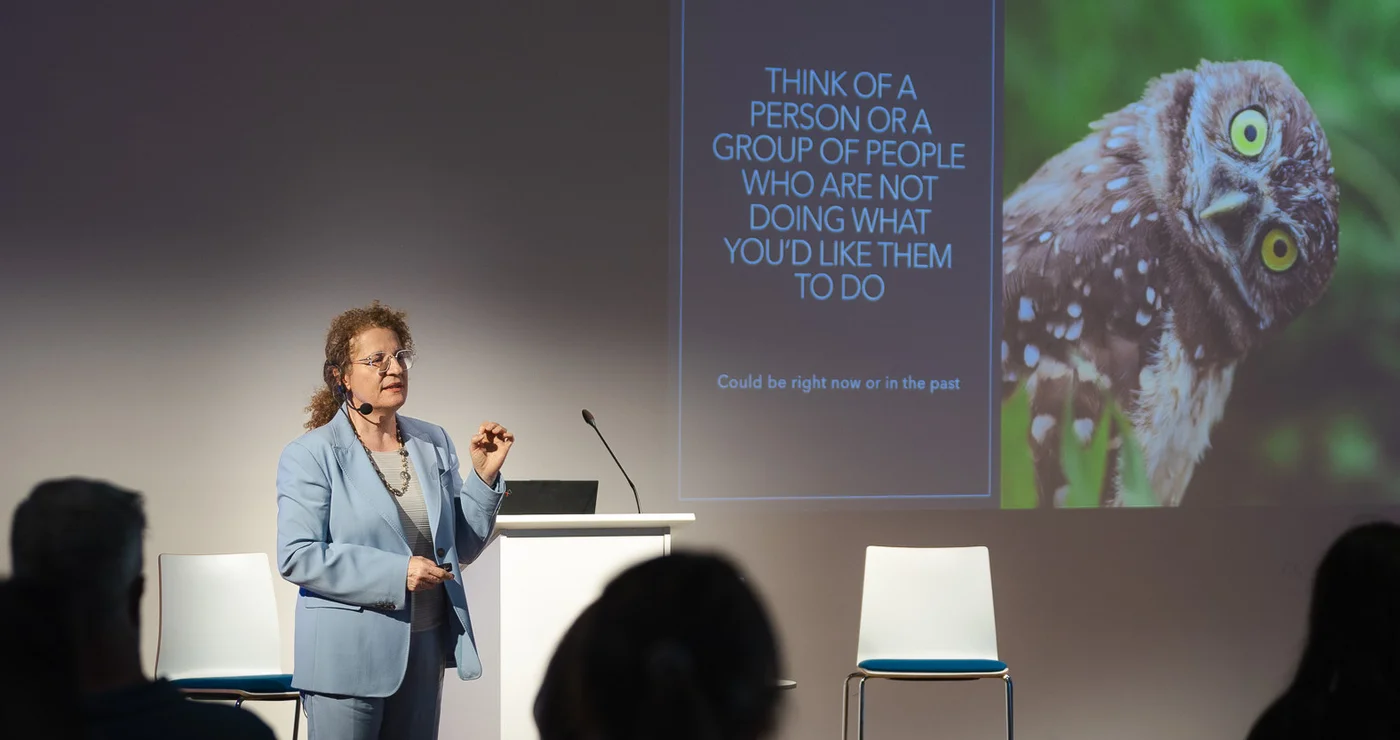
On 24 June 2026, Prof. Tiziana Casciaro, Professor of Organisational Behaviour and Marcel Desautels Chair in Integrative Thinking at the Rotman School of Management, University of Toronto, was honoured by the Reinhard Mohn Institute with an RMI Distinguished Lecture.
Following a welcome address by the Dean, Prof. Dirk Sauerland, Prof. Hendrik Wilhelm opened the evening with a laudatory speech. In it, he paid tribute to Tiziana Casciaro as an internationally renowned scholar whose research has been published in leading academic journals and has received numerous awards. Her work has also resonated far beyond the academic world: it has been featured in publications including *The Economist*, the *Financial Times*, *The New York Times* and *TIME*. Tiziana Casciaro has a special connection to the work of the RMI: through her excellent research on cooperation, her effective transfer of knowledge into practice, and her ability to bring people together and thus facilitate collaboration.
In her RMI Distinguished Lecture, which was as interactive as it was entertaining, Tiziana Casciaro delivered a talk entitled ‘Power for All: How to Influence People by Understanding What They Want – What They Really, Really Want – and How to Use Your Power for Good’. In it, Tiziana Casciaro demonstrated that power should be understood not so much as a fixed characteristic of individuals, but rather as a relational dynamic that arises within social relationships. The focus was on how people can better recognise the motives that drive themselves and others, and how this understanding can form the practical basis for influence and power. Tiziana Casciaro thus built on her book of the same name, co-authored with Julie Battilana, which was honoured with, amongst other awards, the George R. Terry Book Award from the Academy of Management.
Despite the high temperatures, more than 80 participants followed the lecture with great interest. During the subsequent Q&A session, a lively discussion ensued on how power can be used not for control, but responsibly ‘for good’ – for example, by better understanding and taking into account the needs, goals and motivations of others. The positive atmosphere continued afterwards over drinks: many guests took the opportunity to engage in personal conversations, to explore the ideas from the lecture in greater depth and to enjoy a lively exchange of views.
(Photos: Laurenz Kienitz)