People at UW/H – Rene Geißen: From Molecules to the Research Landscape
Dr. Rene Geißen talks about the challenges and opportunities of clinical research, his passion for cycling, and the unique “Witten spirit.”
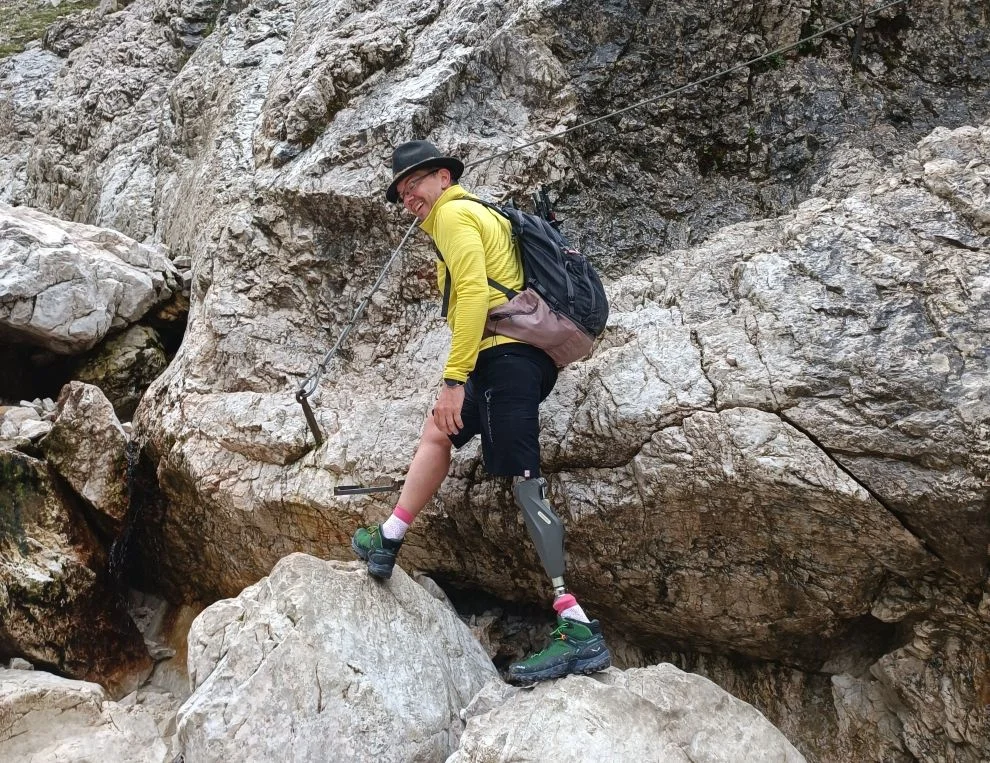
What I find remarkable about UW/H is that, despite having comparatively limited resources compared to state universities, we are absolutely competitive and, in some cases, even significantly more innovative.
Dr. rer. nat. Rene Geißen Managing Director of the Centre for Clinical Studies at Witten/Herdecke University (ZKS)
Who are you and what do you do at UW/H?
I trained as a molecular biologist and completed my PhD in the field of transcriptional regulation in prokaryotes. In my research, I investigated how bacteria control which of their genes are expressed and which are not – in other words, which genes are active and which remain ‘switched off’. My ‘pet organism’ for this research was the relatively easy-to-cultivate bacterium E. coli. During my postdoc, I then spent several years working with Candida albicans, a yeast that occurs naturally in the human body but can also become pathogenic under certain conditions.
I have been working at the Centre for Clinical Studies (ZKS) at the Witten/Herdecke University (UW/H) since 2015. I have been managing the ZKS as its Director since 2020, and since 2021 I have been sharing the leadership role with the Scientific Director in a co-leadership arrangement.
Although I used to love working in the laboratory and never really wanted to become a ‘desk-bound’ professional, I now have a very interesting job that I thoroughly enjoy.
To describe my work, I must first say a little about the ZKS and its responsibilities. Clinical trials are subject to varying degrees of regulatory requirements, depending on the specific trial design.
The ‘premier category’ consists of so-called clinical examinations involving medicinal products and/or medical devices, as well as in vitro diagnostic medical devices. In vitro diagnostic devices are medical tests in which samples such as blood, urine or saliva are examined outside the body to detect, for example, diseases or specific health characteristics. They are governed by increasingly complex regulatory requirements at national and international level. In the case of self-initiated trials, the trial team must, in addition to providing adequate care for patients, take on a wide range of additional tasks, including those relating to quality assurance in the conduct of the trial.
In many cases, however, these additional tasks have little to do with day-to-day clinical practice. They therefore require additional expertise and a considerable investment of time to ensure compliance with all national and international laws, regulations and guidelines. In the normal course of daily work, this additional workload is almost impossible to manage – particularly for researchers in clinical departments who, ‘on the side’, are also caring for patients.
To remove as many of these barriers to clinical research at the UW/H as possible, the ZKS, as a central support unit, therefore assists all researchers in the Faculty of Health with the planning and implementation of clinical research projects. Our approach is: ‘From idea to project’. You are therefore welcome to come to us with project ideas at any stage.
To avoid this becoming too much of an advert, I would like to refer you directly to our website for further details about our services: Centre for Clinical Studies – Witten/Herdecke University
As Managing Director of the ZKS, I also have the privilege of representing UW/H within the KKS network, the national association of university coordination centres for clinical trials. This also allows me to participate in exciting working groups that bring together various stakeholders in clinical research – such as authorities, ethics committees and industry.
Furthermore, I have the great pleasure of being a member of the Research Committee of the Faculty of Health and, in this capacity, of being able to contribute to the research landscape at UW/H.
What do you particularly enjoy about your work, and which projects or topics are you currently working on?
The most interesting and, at the same time, most rewarding aspect of my work is that it gives me an insight into almost the entire spectrum of research activities at the Faculty. At the same time, I automatically get to know a large number of researchers at UW/H, the affiliated hospitals and also other central infrastructure units at the university.
Naturally, this makes it exciting – and sometimes challenging – to adapt to very different personalities, working styles and approaches. But for me, that is precisely where part of the appeal lies. Every project brings its own unique potential pitfalls. Thanks to our experience, most of these are easily recognisable – though sometimes challenges arise that nobody could have anticipated.
When we then manage to successfully carry out a demanding project – from the initial idea through to implementation, evaluation and publication – or even secure a successful external funding application as a result, I am naturally particularly pleased.
Of course, for a wide variety of reasons, this doesn’t always work out. But as a molecular biologist who once had to manage largely without the practical test and laboratory kits from various manufacturers, such as QIAGEN, you develop a fair bit of frustration tolerance over time.
The project I currently find most interesting – after all, there has to be one that’s the most exciting – is the BMFTR-funded ViBa-IMS project. This is a consortium project involving several universities and small and medium-sized enterprises (SMEs). On the part of the UW/H, the Chair of Microbiology and Laboratory Medicine is leading the project, with the Centre for Clinical Systems Research (ZKS) also involved as a partner.
The aim of the project is the rapid and non-invasive detection of infections directly on site by analysing exhaled breath.
What are your hopes for the future at the UW/H, and is there anything you’d like to change?
First and foremost, my hope for the future of the UW/H is that we can continue the steady growth we have experienced in recent years. This should also enable research and teaching to continue to develop and expand in close tandem.
In my view, it would also be desirable for the field of digitalisation to take a significant leap forward – particularly in the area of data and document management.
Furthermore, the structuring of processes – or at least the transparency regarding how certain processes work – does not always strike me as entirely self-explanatory, even though I have been here for quite some time now. Flat hierarchies, such as we often have at UW/H, are generally very welcome because they break down barriers and facilitate direct communication. However, if this means it is unclear who to approach with a specific issue, or – in the worst case – you end up going round in circles because the key contact person is not apparent, things become difficult.
I am, of course, aware that both points are easier said than done. But one can always hope.
Personally, my main hope is that I’ll continue to be able to work just as smoothly and trustingly with my team and the many contact persons I deal with as part of my job.
What do you get up to when you’re not working at the UW/H?
Anyone who knows me can probably tell you a thing or two about how I start raving as soon as you make the mistake of bringing up this topic.
My great passion for over ten years has been serious cycling. I mainly ride a mountain bike. As a resident of Wuppertal, I have the perfect terrain right on my doorstep: the Bergisches Land and the Ruhr region. Nevertheless, the call of distant horizons is, of course, always there. So crossing the Alps is a regular feature of my trips. As well as the great lakes of the Alps, I’ve even made it as far as the Adriatic Sea.
A few years ago, I succumbed to the marketing hype and got hooked on a gravel bike. It’s remarkably capable off-road, whilst also allowing me to include longer stretches of tarmac in my rides.
When I’m cycling, especially on longer day trips, I find it incredibly easy to clear my head. With the physical exertion being quite demanding, at some point there’s simply no mental capacity left to think about anything else. Most of the time, I’m also out and about in a larger group, which is a wonderful way to take my mind off work. As an added bonus, you get to see so much of our beautiful countryside. It was only through cycling that I really learnt to appreciate what a lovely region I actually live in.
It was through cycling that I also discovered alpine hiking for myself. That’s another activity where I can switch off really well and recharge mentally.
Apart from sport, I also try my hand at gardening as a hobby. Although I only have a balcony to work with, it’s regularly overrun with all sorts of edible and/or insect-friendly plants. It’s amazing what other exciting things – and in some cases even very tasty ones – grow alongside the plants I’ve sown when you’re too lazy to weed.
What is the most curious or remarkable thing you’ve ever experienced at the UW/H?
What I find remarkable about the UW/H is that, despite having comparatively limited resources compared to state universities, we are absolutely competitive and, in some cases, even significantly more innovative. Perhaps it is precisely the need to sometimes achieve our goals using unconventional and not necessarily ‘highly sophisticated’ methods that fosters this innovative spirit.
The somewhat elusive ‘Witten spirit’ is also something I haven’t experienced in this form at any other institution. Of course, we also have our share of stress, differing views and occasional disagreements in our day-to-day work. Nevertheless, I still find that, on the whole, the way we interact with one another is much more like a close-knit family than one would expect at an institution of this size. Joint events such as the Christmas party or the summer party certainly contribute to this.
I very much hope that we can maintain this sense of community even as we continue to grow.
On a personal note, I had a lovely experience not too long ago that, for me, perfectly embodies this ‘Witten spirit’. For many years, the ZKS office was still housed in an old clinic building belonging to the HELIOS Medical Centre Wuppertal in Elberfeld. In September 2025, we were finally able to move to Witten. Although not directly on the campus, Stockumer Straße is also a lovely location.
The Chair of Biochemistry and Molecular Medicine is housed one floor below us. When I see the laboratories there, I sometimes feel a bit wistful and find myself wanting to get back to the bench myself.
One day, my office door opened and I looked into a face that seemed somehow familiar. Standing in front of me was a former student of mine – probably even the last Bachelor’s student I’d supervised closely myself during my postdoc. She now works at the aforementioned department and had seen my name in some sort of group email. So she just wanted to pop by and say hello.
It’s at moments like these that you realise: the world really is a small place.