People at UW/H – Judith Schmitz: Internationalization Thrives on Encounters
In this interview, Judith Schmitz discusses international mobility, new exchange programs, and why internationalization is a responsibility for the entire university.
Ultimately, however, it is the people who make the most of these opportunities and shape them with their own ideas who breathe life into internationalisation.
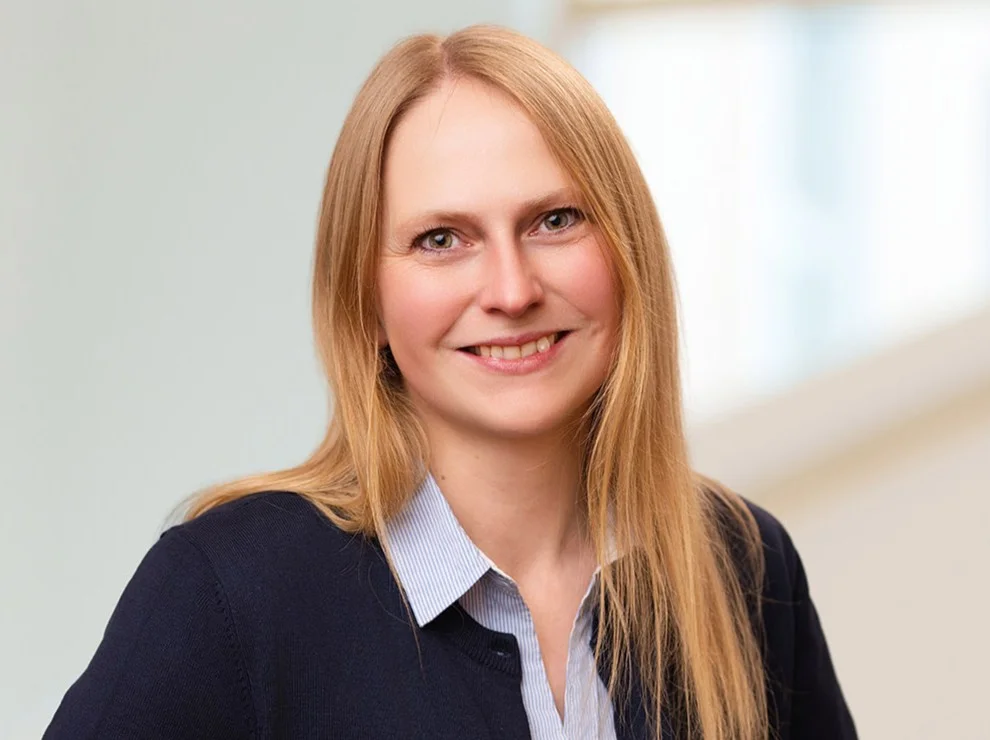
Judith Schmitz, Head of the International Office
Who are you and what do you do at UW/H?
People, encounters, international mobility – that’s what my day-to-day work is all about. I’m Judith Schmitz and I head up the International Office. My work brings me into contact every day with a wide variety of people and their stories: with students who are thinking about studying abroad for the first time, with international visiting students who come to our university, and with colleagues who develop international projects.
Our tasks are as varied as the people we meet in the International Office. Of course, as a team, we also have our day-to-day business to attend to: we process applications, keep track of deadlines, manage several funding programmes and maintain our network of partner institutions. At the same time, we ensure that international students settle in well at our university and quickly feel at home – for example, through the buddy programme, German as a Foreign Language courses and other support services to help them get started with their studies. But it is precisely in the space between these tasks that new ideas and exciting projects keep emerging, whether in the form of very personal plans or visions aimed at institutional development.
What do you particularly enjoy about your work, and which projects or topics are you currently working on?
For example, when I’m able to make a semester abroad possible through a scholarship, for me it’s more than just approving a grant. For many students, a stay abroad is a great wish, sometimes even a long-cherished dream. Being able to play a small part in making that dream a reality has always been, and continues to be, something very special to me.
We have recently reviewed our advisory and events programme. In future, we want to structure our information sessions around specific topics and target groups, thereby inspiring even more students, PhD candidates, lecturers and staff to take part in mobility abroad. We are also considering where there is potential for expansion within our current funding programmes. Short-term mobility placements under the Erasmus+ programme, delivered in a blended format, could, for example, be an alternative to the traditional semester abroad. For students of medical subjects in particular, this could present an opportunity to complete the practical components required by their study and examination regulations whilst abroad.
What are your hopes for the future at UW/H, and is there anything you would like to change?
I would like to establish further exchange formats and focus our work even more strongly on different target groups within the university. After all, international experience is no longer just a matter of the traditional semester abroad.
A good example is the Erasmus+ programme, which is also one of the most important programmes at our university for funded mobility abroad. Erasmus+ is not aimed exclusively at students. Lecturers can receive funding to travel to our partner universities for teaching purposes, whilst staff can take part in further education and training activities abroad. At the same time, teaching staff from our partner institutions can also be involved in teaching at our university. We would like to raise the profile of these opportunities even further in future and generate enthusiasm for them.
In doing so, I am also aiming for the broadest possible understanding of internationalisation. For me, internationalisation is a cross-cutting task that affects the entire university. It can take many different forms and arises wherever people with different experiences, perspectives and cultural backgrounds come together – in teaching, in research, in student life and in everyday interactions on campus. The International Office can provide impetus, open doors and offer support. Ultimately, however, internationalisation is brought to life by the people who make use of these opportunities and shape them with their own ideas.
What do you get up to when you’re not working at UW/H?
I’m drawn to the outdoors. I enjoy going for walks with my family and our dog. I spend a lot of time in our garden, which is close to nature – whilst there’s always something to do there, it’s also a place where you can simply let your mind wander.
I also enjoy being creative and drawing. When time allows, I like to try out something new. As a mum of two, everyday life is rarely boring and can’t always be planned. That’s precisely why I cherish those little moments when I find time for creative pursuits.
What is the strangest or most remarkable thing you’ve ever experienced at UW/H?
What I particularly appreciate about our university is its personal atmosphere. Communication lines are short, and interaction amongst colleagues is straightforward. You don’t get lost in the crowd here – and that applies to students and staff alike.
One of the first exchange students I looked after at our university put it very aptly at the time. She said she’d initially had reservations about studying at a smaller institution. In the end, however, she was delighted by how close the contact was with the other exchange students and the Erasmus Student Network. After her semester abroad, she said to me: “I’ve made real friends here.” At a very large university, she said, that would probably be much more difficult, because there you meet so many people every day – and they’re always different ones.
That sentence has stayed with me. International experiences aren’t just the result of large-scale programmes and official partnerships. Ultimately, it’s the encounters that matter – and strangers become friends.