Rafael Dietzel: From PPÖ student to global networker
UW/H graduate Rafael Dietzel talks to us about his studies, formative experiences and connections – and why you shouldn’t plan your career on the drawing board.
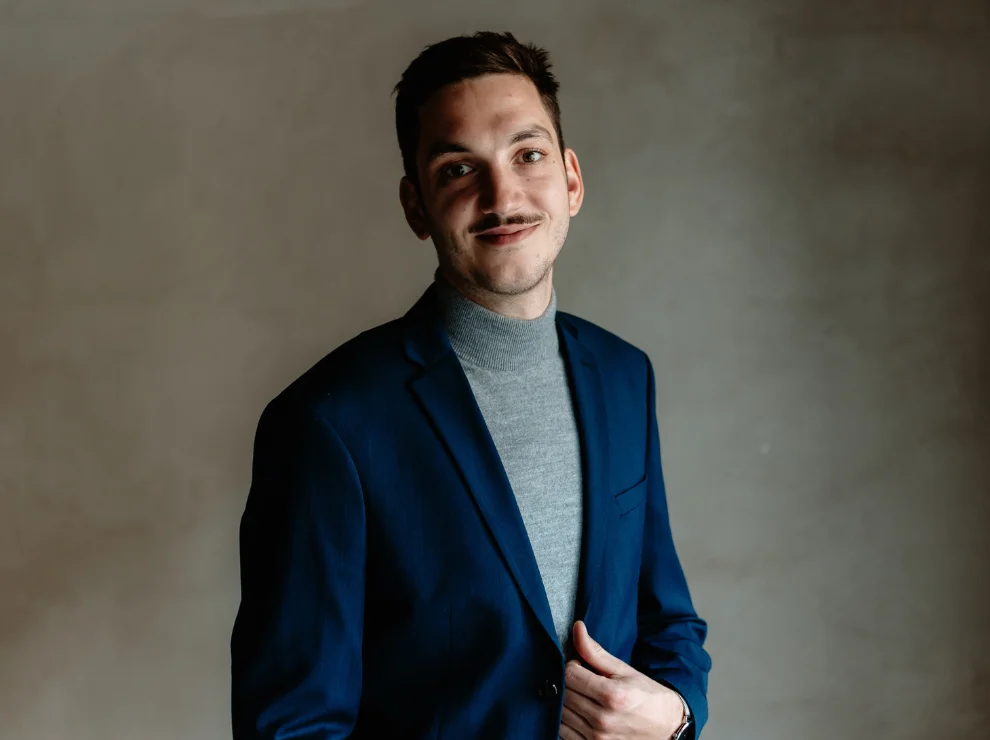
From Witten to the world: anyone who meets Rafael Dietzel today will find someone who is completely at home in international settings. Over the past two years, the graduate of Witten/Herdecke University has, as co-founder and managing director of Super Climate, built up a global network of investors in the climate tech sector – with the aim of channelling capital into sustainable technologies.
“With Super Climate, we’ve created spaces where the right people meet at the right moment,” says Rafael, describing his work. The key, he explains, has been to create an environment where genuine conversations can take place. To this end, the events have been deliberately and carefully curated so that participants have points of contact and synergies can emerge. “We’ve turned down the volume – figuratively speaking. When someone turns round, the next person they speak to should be relevant. That has always been my benchmark for a successful event.”
The UW/H as a space for thought and possibility
Rafael developed an interest in corporate structures and decision-making processes whilst still at school. After obtaining his higher education entrance qualification, he wanted to explore this further by studying management. Before that, however, he embarked on a year-and-a-half-long journey through New Zealand and Asia. During this time, he gained experiences that changed his perspective. During this time, he developed a desire not merely to focus his studies on figures, but to explore and gain a comprehensive understanding of the interconnections between business, politics and society. It was precisely this connection that he ultimately found in the PPÖ degree programme – Philosophy, Politics and Economics – at UW/H.
Choosing Witten was also a choice in favour of a particular way of learning and thinking. Seminars in which different disciplines were deliberately interwoven had a particularly formative influence on him. To this day, he regards this as one of the most important foundations of his work: the ability to view complex topics from different perspectives simultaneously and to tolerate ambivalence rather than rushing to resolve it.
Alongside the intellectual stimulation, it was above all the freedom that made his time at university in Witten so special for him. Many students are actively involved in initiatives alongside their studies or are pursuing their own projects. Rafael himself was involved in the Unikat cultural association, later taking on responsibility as part of the extended executive committee whilst gaining experience in organising a wide variety of events. “For a long time, I didn’t even question this high level of activity. It was only when talking to friends from other universities that I realised just how special this culture of experimentation and active participation is in Witten.”
The Congress for Family Businesses as a formative experience
A key part of his time at university is closely linked to the Congress for Family Businesses (FUK), one of the largest student-organised business events in Europe. The event enjoys a particularly strong reputation amongst students, especially those on business-related degree programmes.

Rafael’s first involvement with the congress came right in his first semester, when he helped out at the event as a shuttle driver. “During the journey, I had the opportunity to chat with participating entrepreneurs. That was absolutely fascinating and had a lasting impact on my view of entrepreneurship.” Over the years, he took on more and more responsibility, worked in various departments of the congress and eventually became part of the organising team himself. “The Congress for Family Businesses is essentially a guided start-up for a limited period,” explains Rafael. Students set up their own company for the organisation, negotiate with service providers, secure sponsors, take on HR responsibilities and operate in a professional environment alongside well-known companies. For Rafael, this experience was formative: “I’ve always wanted to start my own business, so it was exciting to get a taste of what that’s like.”
His in-depth involvement with the FUK also formed the basis of his bachelor’s thesis. In it, he explored the question of whether organising the Congress for Family Businesses serves as a kind of formative experience for future entrepreneurial activity. In conversations with graduates, a recurring pattern emerged: many former organisers of the congress went on to successfully set up their own businesses or take on senior roles in companies.

On valuable networks and the courage to seize opportunities
Whilst working on his final-year project, Rafael began looking for a job. Initially, he focused on roles in the consultancy sector. The fact that he ultimately started his career at Super Climate – and thus in a completely different sector – is down to his knack for spotting valuable opportunities, his self-confidence and the connections he made in Witten.
Although others often describe him as a good networker, he himself struggles with that label. “I never think in transactional terms when interacting with people. Instead, I find it much more important to approach everyone with an open mind, without expecting anything in return or any immediate benefit from that interaction. Synergies often arise naturally from good relationships.”
One evening, in the WhatsApp group ‘Wittener Start-up Connection’, he came across a request: ‘They were looking for someone keen to set up a start-up and, as managing director, capable of organising high-profile, international events for a company, as well as dealing with high-net-worth individuals (wealthy investors) and capital. So I expressed my interest. The fact that I’d already organised the FUK at UW/H served as a good calling card. That’s how I made contact with my future co-founders in Berlin.” Shortly afterwards, the opportunity arose to attend an initial event to familiarise myself with the concept. The trip took him to Dubai. “It was surreal! On the flight there, I was still putting the finishing touches to the final version of my bachelor’s thesis. Once there, I suddenly found myself at the UN Climate Change Conference (COP) and in five-star hotels, and got a taste of my future working environment.” By the time he was on the return flight, Rafael had already made up his mind: he would embark on this new adventure.
The Development of Super Climate: Between Responsibility and Self-Conception
When he moved to Berlin in January 2024, Rafael embarked on the intensive start-up phase of his new company. Together with partners from the venture capital sector, he founded Super Climate and led the company both operationally and strategically, working closely with his co-founders.

In terms of subject matter, the former PPÖ student was venturing into a field that was new to him. “I first had to familiarise myself with topics such as venture capital and learn to understand certain interdependencies that exist between the various players. The same goes for the role that Super Climate ultimately plays within this ecosystem. That was certainly a challenge.”
As successful as the development of Super Climate was, it was equally demanding on a personal level. For a long time, Rafael made many decisions on his own and bore the responsibility for the organisation’s development largely by himself. This experience showed him once again just how valuable collaboration and dialogue are. “During this time, I learnt: I’m a better team player than I’d previously thought,” says the graduate of himself. “I’ve come to really appreciate how good it is to have people around you with whom you can make decisions and develop ideas together. Trust and honest mutual feedback are incredibly valuable.”
Lasting connections to Witten and valuable lessons
In March 2026, Rafael returned to his alma mater and took part in the Congress for Family Businesses as a speaker. He describes experiencing the FUK this time from the perspective of a participant asa “full-circle moment”. Many encounters felt familiar, conversations built on past experiences, and a sense of continuity emerged. It was particularly remarkable for him to see “that many of the ideas I put forward back then have been passed on and adopted. At the same time, I feel a deep sense of gratitude towards the university and the congress – without both, I wouldn’t have got off to such a good start in my professional life.”
Rafael left Super Climate at the end of March 2026 and is looking forward to his next challenge. What remains are personal connections, a deep understanding of venture capital and the experience of having built an international community. The graduate describes himself as someone who doesn’t cling stubbornly to plans, but is open to opportunities and boldly seizes them – true to the motto “You have to be open to luck to get lucky”. This attitude has already opened many doors for him in his career so far. When it comes to his next step, Rafael remains true to himself: “I’m currently talking to various people, looking forward to new encounters and am keen to see what comes of them. My gut feeling has rarely let me down so far.” First, however, he will be taking parental leave before devoting himself to a new project.
One piece of advice he’d like to pass on to future generations of students, drawing on his own time at university: “Anyone just starting their studies shouldn’t plan their career on the drawing board or worry from the outset about what comes after graduation. Instead, you should focus on the things that bring you joy, so that you can improve at them. At the same time, you should ask yourself whether you actually enjoy doing the things you’re good at.”