UW/H graduate Oliver Skopec: “You can’t step out of your comfort zone often enough.”
From start-up founder to member of the state parliament: Oliver Skopec on entrepreneurial thinking, politics and the power of networks.
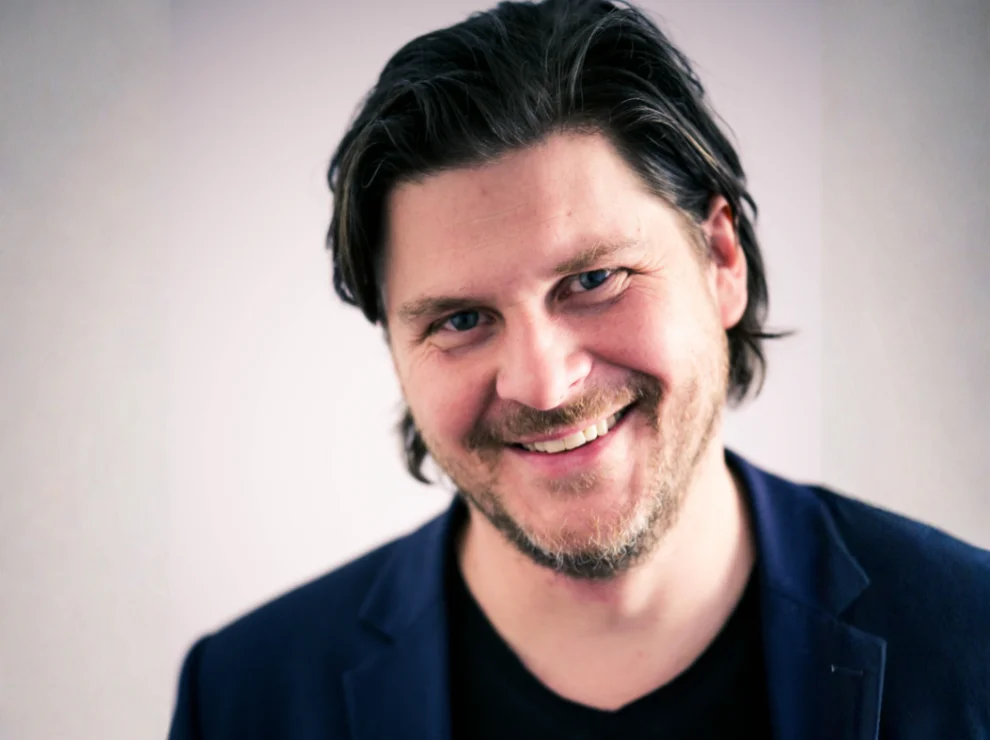
Oliver Skopec studied economics at Witten/Herdecke University. As a co-founder of the social network schülerVZ, he gained early experience in the start-up world. Following further start-ups, roles in international companies and projects in the field of innovation, he entered politics in 2024 with the then newly founded Sahra Wagenknecht Alliance (BSW). Today, he is a member of the Brandenburg State Parliament. In this interview, the graduate talks about entrepreneurship, changing perspectives and why graduates and alumni are important bridge-builders for future generations.
You studied economics at the UW/H. What was your experience of your time in Witten like?
I look back on my time at university as a fantastic experience in two respects. Firstly, I had already had a few entrepreneurial ventures under my belt before I started my degree and was able to explore these further academically at UW/H.

On the other hand, there was something about my time at UW/H that I really appreciated: I never felt I had to explain myself to anyone. As fellow students, we knew that we could all approach one another with the same openness. That made this period of my life incredibly warm and wonderful.
As we speak, the opening event of this year’s alumni reunion is taking place. What does it mean to you to return to your alma mater, and what role does the UW/H still play in your life today?
For me, the alumni reunion is like a family gathering. It’s lovely to see that the culture I experienced as a student is continuing across generations.
During my studies, I myself benefited greatly from graduates who returned to give talks on professional experience, offered work placements or presented themselves as potential employers at the job fair. It was through graduates that I first became aware of UW/H in the first place. That’s why I now see it as my responsibility to give something back.
Which people have particularly influenced your decision?
One of my first mentors at school was UW/H graduate Prof. Dr Stefan Jung. Later, whilst studying for my first degree at the Berlin University of the Arts, I met Prof. Dr Franz Liebl, who had previously taught at UW/H and inspired me greatly. I associated both of them with Witten and thought to myself that the university must be a very special place if it brings people like them together.
The deciding factor was then a conversation with Manuel Dolderer, a student at the time, during an open day in Witten. He really ‘grilled’ me during our chat and asked what I actually expected from a degree course. After that, I knew pretty much for certain that I wanted to go to Witten and began my studies in 2009. This experience also showed me the role graduates can play in building bridges for prospective students.
You gained your first experience of starting a business even before you began your degree, as a co-founder of schülerVZ. How did that come about, and how did that experience shape you?
Whilst at school, I was the regional student representative for Baden-Württemberg, which meant I was very much in touch with the issues facing school pupils. At the time, the founders of studiVZ were looking for people from precisely this target group to build a network for younger users.
That’s how I ended up at schülerVZ, which was effectively a sub-brand of studiVZ. So, in a sense, I was running a start-up within a start-up and had an incredible amount of freedom. Those were two very intense years, during which the company became increasingly professional. At some point, I realised I was no longer needed there.
After that, I worked on a few more projects together with one of the founders of studiVZ. From then on, there have been recurring chapters in my life centred on start-ups, business launches and innovation – either with me in the role of founder, as an investor, or at the interface between innovation research and practice. This also included my time at the Berlin Institute for Innovation, which I helped to build up over ten years and during which I supported numerous projects from the initial idea right through to market launch. At the end of the day, it was always about successfully establishing something new. And I remained true to this credo right up until I moved into politics – although in my current role as a member of the state parliament, I am still involved with start-ups, just from a different perspective.

Was there a particular stage that had a big impact on you?
One experience that had a profound impact on me was a chapter I wrote whilst in East Africa between 2014 and 2018. In Dar es Salaam, Tanzania, we set up Tupomoja, an e-commerce and logistics start-up that harnessed the potential of the internet and mobile communications.
What particularly impressed me about the local economy was the phenomenon known as ‘leapfrogging’ – in other words, skipping stages of development. Until about 20 years ago, a very high proportion of people in many countries of the Global South had no access to bank accounts. Whilst the banking system as we know it in Europe has developed over centuries, mobile phone operators in Tanzania have, without any detours, introduced a banking system in the simplest sense, whereby customers can use the credit on their own SIM card not only for making calls but also for transferring money to other devices.
We have also witnessed this form of ‘leapfrogging’ in our own business environment: rather than first building up a traditional infrastructure, digital solutions emerged directly on the basis of the already widespread mobile phone technology.
For me, the most important lesson from this period was that we in Europe have an incredible amount to learn from markets in the Global South, which are developing with scarcer resources and often under immense social, climatic or political pressure. We need to be more humble and recognise that the flow of knowledge goes both ways.
What advice would you give to people who want to start a business? And what mistakes would you warn them against?
As a founder, you shouldn’t try to guard against mistakes at all. You should make them. The only mistake would be to worry too much about avoiding them.
The important thing is to get started, not to be put off by the first setback, and to keep getting back on your feet. A good safety net is also invaluable – socially, emotionally, financially and professionally. It’s good to have people by your side – be they mentors, parents or friends – who are fully committed to the venture alongside you and who will help you get back on your feet when you’re feeling down. For some, the start-up phase brings existential worries; for others, emotional self-doubt. But even these can be opportunities for personal growth.
You’ve worked in start-ups and large corporations, and are now in politics. What aspect of your approach to work always remains the same?
Despite the different contexts, the following approach has proved its worth for me: analysing problems, boldly assessing risks and seeking concrete solutions.
It’s crucial to take an unconventional approach and draw on resources with untapped potential – be it technologies, management styles or working methods.
I also try to think in terms of ‘quick wins’ and ‘low-hanging fruit’. In other words, rather than striving for the perfect solution and possibly getting lost in complex strategies, I focus on finding the next sensible step that actually improves the situation.
Were there any specific experiences that prompted you to go into politics?
My entry into politics was motivated by both personal and economic factors.
On the one hand, my personal experiences have given me a new perspective on many issues relating to family law, education, transport and public services.