What do people with dementia and their families need?
A research partnership at Witten/Herdecke University has identified ten key questions for gender-sensitive care for people with dementia.
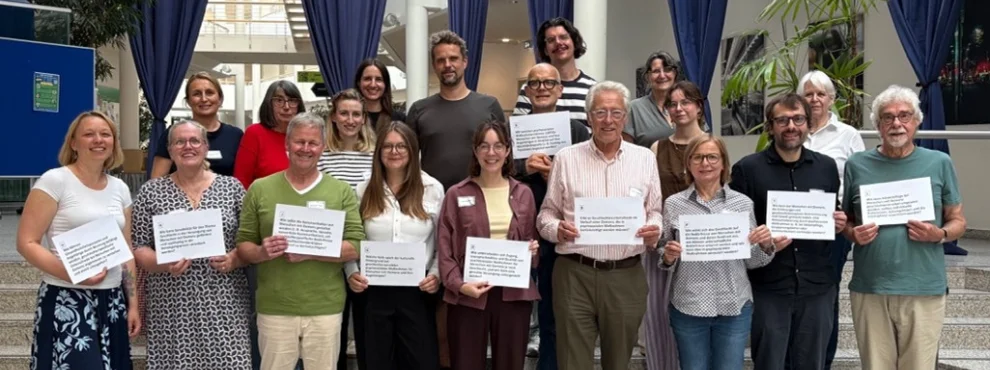
Dementia changes everyday life, both for people with dementia themselves and for those who support and care for them. However, their needs are not the same for everyone. Gender can also influence how dementia is experienced, what kind of support is helpful, and how relatives feel about providing care. So far, this has not been given sufficient consideration in care provision.
The ParGenDA research partnership, run by theChair of Nursing Science at Witten/Herdecke University (UW/H), has therefore worked with people with dementia, family carers and healthcare professionals to identify the questions that research urgently needs to address. Together, they have formulated and prioritised ten key research questions. These are intended to highlight gaps in knowledge and provide impetus for future research and care.
What remains unclear in care
The ten research questions delve into the everyday lives of people with dementia: they concern, for example, personal hygiene and how this can be managed without infringing on boundaries of modesty or privacy. Dealing with experiences of violence and discrimination, in order to avoid re-traumatisation, is another key issue. Furthermore, access to psychosocial support services—whether or not it is gender-dependent—as well as support for LGBTIQ+ people with dementia and their carers are further unexplored aspects. The full list of the ten research questions can be viewed at: https://pargenda.de/
“Research into psychosocial dementia care becomes more relevant when it addresses the areas where people with dementia and their carers see the greatest need for clarification,” says Prof. Dr Margareta Halek, project leader and holder of the Chair of Nursing Science at the UW/H. “With ParGenDA, we have highlighted where knowledge is still lacking on the issue of gender sensitivity in psychosocial dementia care, yet where those affected expect answers. For us, the ten research questions represent a contribution to research that is developed not just about, but with, people with dementia and their carers.”
To ensure this could succeed, the project team adapted the James Lind Alliance approach so that people with dementia could actively shape the research process. In the long term, the research findings are intended to help tailor care for people with dementia more closely to their diverse needs.
Further information: ParGenDA stands for ‘Priority Setting Partnership on gender-sensitive psychosocial interventions for people with dementia and their family carers’. The project was carried out by the Chair of Nursing Science at the University of Münster (UW/H) in collaboration with the German Alzheimer’s Association (Deutsche Alzheimer Gesellschaft e. V.) – Dementia Self-Help Group, and was funded by the Federal Ministry of Research, Technology and Space.
Contact person

Svenja Malessa
Press Officer
Administration | Communication & Marketing
Alfred-Herrhausen-Straße 48
58455 Witten
Room number: 2.F05