Witten/Herdecke University is researching new approaches to the development and potential treatment of cancer
Prof. Dr Thomas Dittmar is investigating how cell fusion influences the development and growth of cancer. A new specialist book summarises the current state of research.
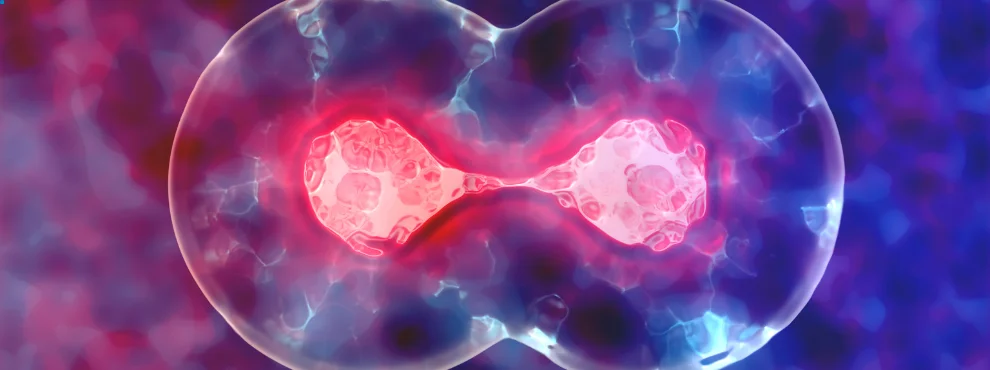
Cell fusion – the merging of two cells – is a natural process that occurs within the body. It takes place, for example, when an egg is fertilised by a sperm, or during the formation of skeletal muscle. However, cell fusion also takes place in a pathophysiological context, for example in connection with cancer. It is precisely this connection that Prof. Dr Thomas Dittmar, Professor of Immunology and Tumour Biology at Witten/Herdecke University (UW/H), is investigating with his research group. Their findings are now summarised in a new specialist textbook.
Understanding metastasis as the key
“It is important to understand: what happens inside the cell during cell fusion? How do the cells fuse together? What mechanisms are involved?” says Dittmar, describing the central questions of his research. This is because the process is not yet fully understood.
“We know that so-called tumour hybrids arise when cancer cells fuse with other cells. These often have more malignant properties than the original cancer cells: they are even more malignant and can metastasise more readily,” explains the UW/H professor. Furthermore, tumour hybrids are more resistant to drugs used, amongst other things, in chemotherapy to inhibit cell growth and division.
If we can gain a better understanding of the mechanisms of cell fusion, it might be possible to prevent the development of particularly aggressive tumour cells and thus also reduce the formation of metastases – one of the most common causes of death in cancer patients.
“The problem with cancer is usually not the primary tumour; that can be easily removed surgically. 90 to 95 per cent of all cancer-related deaths are ultimately attributable to the presence of metastases. If we can understand early on how these fusion processes work, we hope to be able to suppress them and thus stop or at least slow down metastasis,” says Dittmar.
The current state of research on cell fusion in a book
Together with Dr Julian Weiler and Dr Mareike Sieler, Prof. Dr Thomas Dittmar has published a book summarising the current state of research in this field. Internationally renowned scientists specialising in cell fusion have each contributed a chapter.
*Cell Fusion – New Insights into the Mechanism of Cell Fusion and Its Biological Consequences* has been published by Springer Nature and builds on earlier books by Dittmar and Zänker from 2009 and 2011.
“A lot has happened in the meantime. Many new findings have emerged, particularly regarding the process of cell fusion in tumour development. For example, new molecules involved in this process have been identified,” explains Dittmar.
Photos to download

contact

Lennard Halfmann
Communications Officer
Administration | Communication & Marketing
Alfred-Herrhausen-Straße 48
58455 Witten
Room number: 2.F05